


The South Portland Police Department is requesting funds in next year’s budget for another Flock Safety camera, or stationary automatic license plate reading device.
The city already has seven of these cameras, which use artificial intelligence and machine learning to scan and log information from every vehicle passing by its field of view, with a contract extending through February 2027.
The department wants $4,000 for another camera. The police department will present information about the technology, and the council will decide at a budget workshop Tuesday whether to approve the expenditure.
Some South Portland residents are concerned about how the data is being collected and who has access to it, and have called on the council to reject the request. Some are urging the city to end its contract with Flock altogether.
“I don’t want to live in a surveillance state,” said Shelby Leighton, a South Portland resident and attorney. She’s joined forces with other concerned residents to form No Flock for South Portland, a group organizing around the issue.
“It’s a corporation that I don’t necessarily trust with my information,” she said.
Flock Safety, an Atlanta-based company that contracts with more than 5,000 law enforcement agencies across the country, has come under fire for who has access to the data it collects. A report found that the company shared data with federal immigration and border authorities.
“The same issues do not exist in South Portland,” said Shara Dee, the city’s spokesperson. She said there have been no reported instances of misuse of the technology in the city.
Alicia Rea, a policy fellow with the American Civil Liberties Union of Maine, said that AI cameras are a new frontier, and she anticipates future litigation.
“This is location tracking,” she said. “And it is a violation of the Fourth Amendment.”
The cameras are in use in Lewiston, Auburn, Falmouth and York, as well as South Portland, according to the ACLU of Maine. The organization has been conducting a concerted public records request campaign to figure out which — and how — Maine communities are engaging with this company.
The ACLU determined Flock cameras are not being used in Portland, Saco, Ogunquit, Kittery, Brunswick or Sanford.
Some towns, like Falmouth, did a “clean job,” according to Rea, putting the purchase in the municipal budget and making plans to train officers. Other municipalities, like Lewiston, acquired their cameras through grant funding, so it did not have to go before the council or give the public an opportunity for input.
The ACLU of Maine received documents from the city of South Portland on Thursday afternoon, six months after Rea submitted her first request for information and about a month after the ACLU sent South Portland a check to cover the staff’s work to compile the documents. The city initially said it would have the documents — including the contract, expenses and communications about the cameras — two weeks after it acknowledged receipt of the ACLU’s request with no anticipated costs.
HOW THE CAMERAS WORK
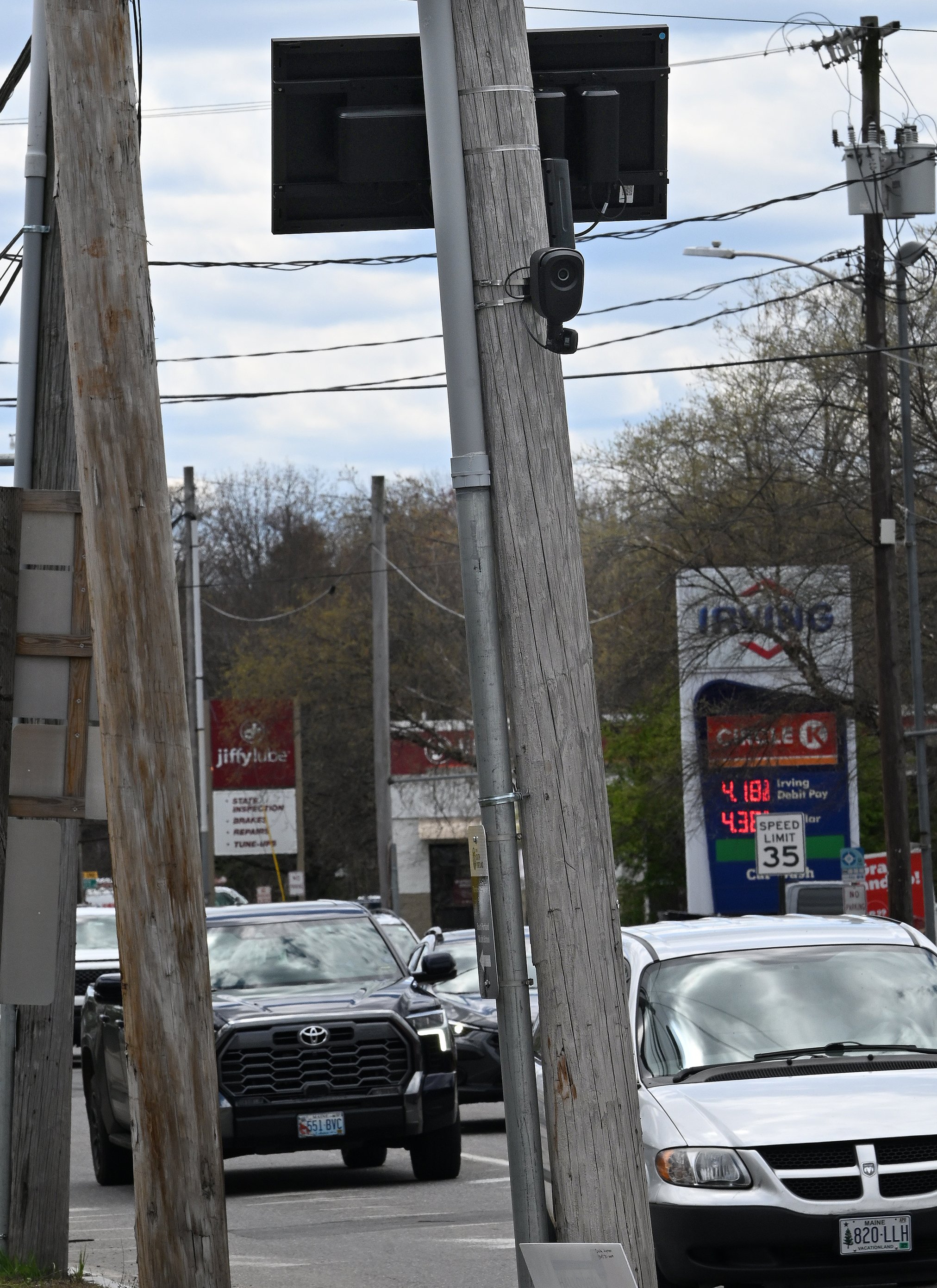
South Portland police Chief Daniel Ahern said these cameras have been useful tools for his force. The department averages three searches per day and 90 per month, said Dee, the city spokesperson.
“These cameras are like a force multiplier,” Ahern said at a council meeting last month. “I wish I had 10 more cameras.”
The department uses the technology to locate stolen vehicles, wanted and missing persons, and to help out with investigations, Ahern said. The technology was instrumental in helping the force identify an online child predator and locate suspects in a bank robbery and a shooting, Dee said.
No Flock for South Portland, in a news release late Friday evening, said the police department had conducted more searches than it has said, based on the city’s responses to the group’s public records request for search audit records.
Eleven months of search audit data from June 2025 through April 2026 show the monthly average was actually 183 searches per month. There were more than 200 searches in nearly half of those months, and in August of last year, officers searched the database 539 times, according to the records released by No Flock for South Portland.
In response to questions about that data, Dee said officers sometimes conduct follow-up searches related to the same incident.
Flock representatives advised the city on the placement of the cameras in high-traffic areas — two near 1-295 by Pape Chevrolet, two on Western Avenue by Maine Mall Road, two at Cash Corner and one on Maine Mall Road, Dee said. The city did not provide more specific details about the cameras’ locations.
“You want to have these things at gateways,” Ahern said. “Who’s coming in and out of our community? Where are they coming in and out of the community?”
The cameras take images of license plates and vehicles, collecting information such as make, model, color and other identifiers like bumper stickers, according to Flock’s website.
Maine law prohibits police from using traffic cameras to enforce the law or employ facial recognition technology in any capacity. The cameras do not collect information about vehicle operators, according to Flock’s website.
The systems also cannot be used for general surveillance of protected First Amendment activities, such as protest. Ahern said he has not heard any complaints about the South Portland police monitoring activities at rallies.
“These license plate readers read license plates,” Ahern said. “That’s the technology.”
The cameras compare the collected images of license plates to a list of plates of interest listed in databases spanning local, state and national geographies. Departments can create a “hot list” of vehicles for notification if they cross the path of one of these cameras.
An alert from a Flock camera is not enough to justify pulling over a vehicle, according to the city’s standard operating procedure. Officers first have to search or contact the source database to get more information. And only those trained in the technology can use it, according to Ahern.
The city’s contract says the data is stored for 30 days, and the city’s standard operating procedure says the files aren’t retained for more than 21 days, in compliance with state law. City officials did not respond to questions for clarification on how long the data is actually stored.
All uses of the technology must be documented, all searches are audited, and the user has to select an offense type before they initiate a search.
WHO HAS ACCESS
The city’s contract says that Flock does not own or sell customer data, and it is up to the customer to decide if it wants to share its data with other parties.
Ahern said the South Portland police’s data is only discoverable for sharing within a 50-mile radius.
According to the search audit records released by No Flock for South Portland, South Portland police officers searched the database 138 times in January, assisting investigations in 11 other municipalities, including Portland, Westbrook, Lewiston and Bangor.
Dee said the city’s police department regularly helps other towns: Other police agencies send “be on the lookout” notices and plate numbers, and South Portland helps to recover stolen vehicles and missing persons.
No outside agency is permitted to access the city’s images for activities related to immigration enforcement, reproductive rights or protests, Dee said. And she said individual officers do not have the option to search the database without valid reason, or on behalf of other agencies.
No Flock for South Portland said in its release that records indicate that 600 agencies have been granted access to data from South Portland’s Flock cameras, including 70 law enforcement agencies that collaborate with federal immigration enforcement. The group alleges that South Portland has shared Flock network access with groups in 44 states, and that more than a hundred of the 2,000-plus searches since April 2025 were on behalf of other agencies, many of them unnamed, according to No Flock for South Portland.
City officials did not provide information about which departments and organizations have access to South Portland data, nor what measures the city takes when approving these partners.
And some clauses in the city’s contract with Flock give residents and councilors pause about the department’s certainty regarding data security.
One section of the contract stipulates that Flock may access, use, preserve or disclose footage to other departments “if legally required to do so or if Flock has a good faith belief that such use, preservation or disclosure is reasonably necessary” to comply with processes or prevent an emergency situation. City officials did not respond to questions about that clause.
“That’s a humongous loophole,” Leighton said. “I don’t see a way that the South Portland police department can meaningfully limit who’s seeing this data, even if they’re trying to.”
Santa Cruz, California, for example, was one of many cities in that state that learned that data collected from its Flock cameras had been shared with national networks without city officials’ knowledge, violating a state law that prohibited sharing license plate data with federal agencies or aiding federal immigration efforts. That city voted to end its Flock contract in January, less than two years after it began and after mounting public concern.
Another section in the contract gives Flock a “limited, non-exclusive, royalty-free, irrevocable, worldwide license to use the customer data and perform all acts as may be necessary for Flock to provide the Flock services to the customer.”
“If they can do whatever they want with the data, it doesn’t really matter who owns it,” Leighton said.
And at the end of the contract, a line says that “these terms and conditions are subject to change.”
“The idea that a city would agree to a contract where the other party can change the terms any time they want and have those terms go into effect is a total abdication of the city’s responsibility,” Leighton said.
City officials did not respond to questions about that clause, nor did they acknowledge whether the terms and conditions of the contract have changed.
When Leighton sees language like that in consumer contracts, she tells her clients not to sign: The contract isn’t enforceable at that point, she says.
“It may seem like police departments are in control, but really, they’re not,” she said.
Editor’s note: This story was updated on May 11 to say the ACLU of Maine received a response to its FOAA request on May 7, after a reporter spoke with the organization.

We invite you to add your comments. We encourage a thoughtful exchange of ideas and information on this website. By joining the conversation, you are agreeing to our commenting policy and terms of use. More information is found on our FAQs. You can update your screen name on the member's center.
Comments are managed by our staff during regular business hours Monday through Friday as well as limited hours on Saturday and Sunday. Comments held for moderation outside of those hours may take longer to approve.
Join the Conversation
Please sign into your Press Herald account to participate in conversations below. If you do not have an account, you can subscribe here. Questions? Please see our FAQs.