

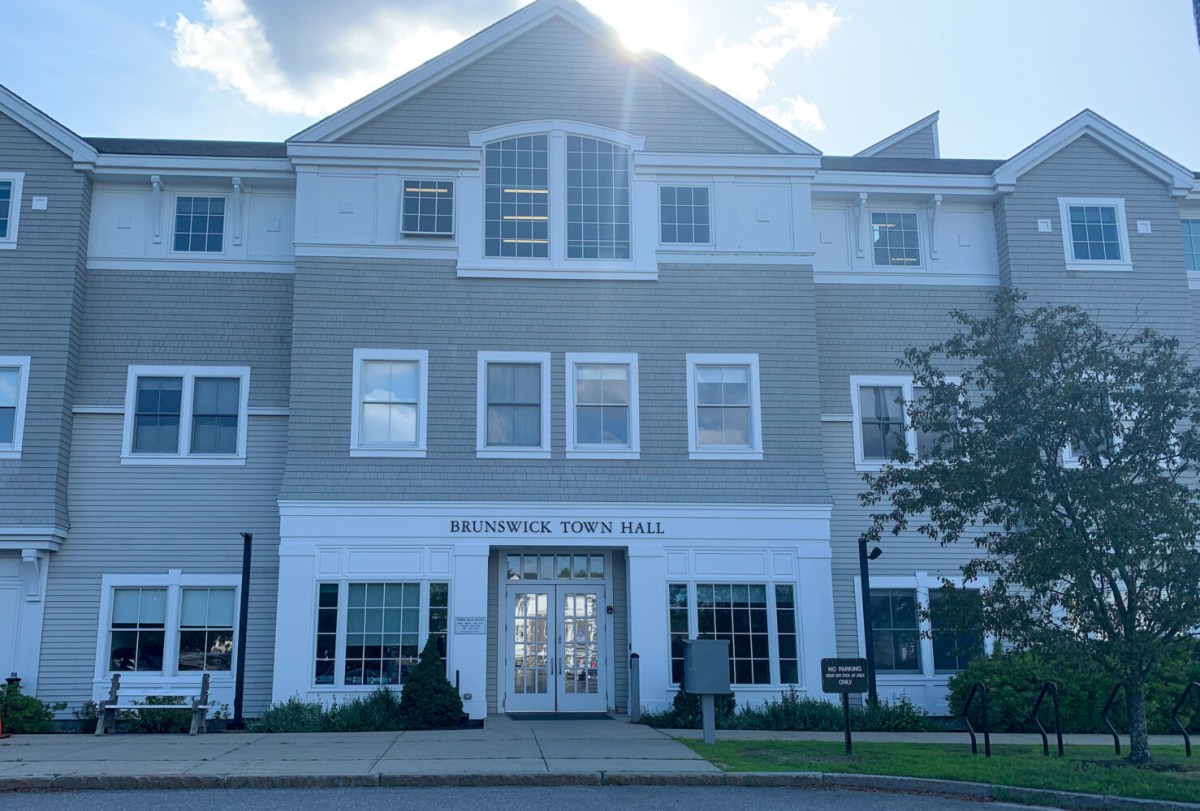
Brunswick’s town councilors Monday night passed a budget for the upcoming fiscal year that’s expected to raise the property tax rate by 5.18%.
The $103 million adopted budget combines expenditures for the town, school district and the county tax assessment. The school spending plan won’t be officially adopted until voters weigh in at the polls on June 9.
Municipal expenses account for a roughly 1.9% increase in the tax rate. The school budget reflects a 2.7% tax increase.
As in previous years, education expenses are the largest contributor to the budget, at more than $61 million total.
Councilors landed on the roughly 5.2% tax hike after lengthy deliberations last week. Four of the nine councilors voted against recommending that increase, arguing that residents’ taxes are already too high.
Monday night, Councilors Richard Ellis, Jamie Ecker, Steve Weems and Kathy Wilson voted in opposition of the municipal budget and several aspects of the school budget, including total spending.
Weems, the District 7 councilor, said that it would have been feasible to fund town services while keeping the tax increase around 4.5%.
“I am dismayed at both the process that brought us to this and the product itself,” he said Monday.
Councilor Jennifer Hicks, of District 5, spoke in support of the budget and the town services it funds.
“There are many of us who felt like this budget was necessary, that the increase was important for our town to continue providing the services, staying the course, being the last resort in a country where we’re not sure what kind of support we are expecting from our government,” Hicks said. “Town government, local government, is the last line of defense, in a way.”
Initial town and school budget drafts presented by Town Manager Julia Henze and Superintendent Phil Potenziano would have resulted in a tax hike of roughly 9%, taken together.
In both cases, employee wages and benefits were some of the most significant cost drivers. High special education costs, which the school district is legally required to fund, also shaped the school side of the budget.
Throughout the past few months, the council and school board have worked to bring the budget down.
The council voted to cut about $100,000 from its side of the budget last week by eliminating a plan to hire two new firefighters.
The school board adopted its portion of the budget in April after making $2 million in cuts. The reductions came in the form of delayed projects, cuts to supplies funds and lower-than-expected insurance premiums.
The school budget also eliminates eight positions, which includes two administrative assistants, one custodian, three positions in ESOL (English for speakers of other languages), one high school teacher and one technology support role.
The school board members amended their budget last week and voted to use $123,000 in one-time state assistance to further reduce the school’s share of the tax burden.
Several teachers and school employees expressed their support of the budget to town councilors in this year’s budget workshops and asked the body to avoid further cuts.
The council Monday also approved a capital improvement program that outlines planned town projects for the next five years. The CIP does not appropriate funding in itself. The projects planned for the upcoming fiscal year and funded through the budget include replacing the windows at Brunswick High School and replacing the culvert on Richards Drive.

The Times Record Sustaining Sponsor
We believe a community must be informed to thrive. bowdoin.edu

Comments are not available on this story. Read more about why we allow commenting on some stories and not on others.
We believe it's important to offer commenting on certain stories as a benefit to our readers. At its best, our comments sections can be a productive platform for readers to engage with our journalism, offer thoughts on coverage and issues, and drive conversation in a respectful, solutions-based way. It's a form of open discourse that can be useful to our community, public officials, journalists and others.
We do not enable comments on everything — exceptions include most crime stories, and coverage involving personal tragedy or sensitive issues that invite personal attacks instead of thoughtful discussion.
You can read more here about our commenting policy and terms of use. More information is also found on our FAQs.
Show less