

In her third book, “Baby in a Box,” Sarah Braunstein explores boxes both real and metaphorical. Across the collection’s 11 stories, characters fall into and resist the societal expectations of caretaking, family, class and love.
A diner patron tells a waitress the story of a baby in a box. A boy enters a raffle for a lifetime supply of aluminum foil for his family. A woman fakes a pregnancy to attend prenatal yoga. Through winding and witty storytelling, Braunstein weaves narratives that are both mundane and epic, bringing the everyday world into the eerie, magical and extraordinary.
Braunstein is an associate professor of English at Colby College and lives in Portland. She spoke with the Portland Press Herald about her latest interests in fiction and how they shaped this collection.
This collection offers a rich perspective in reimagining the roles of motherhood, family and autonomy. In the title story, we meet a waitress hesitant to commit to her younger lover, a cook who still lives with his mother and an older regular who tries playing matchmaker. How does this story kick off the collection for you?
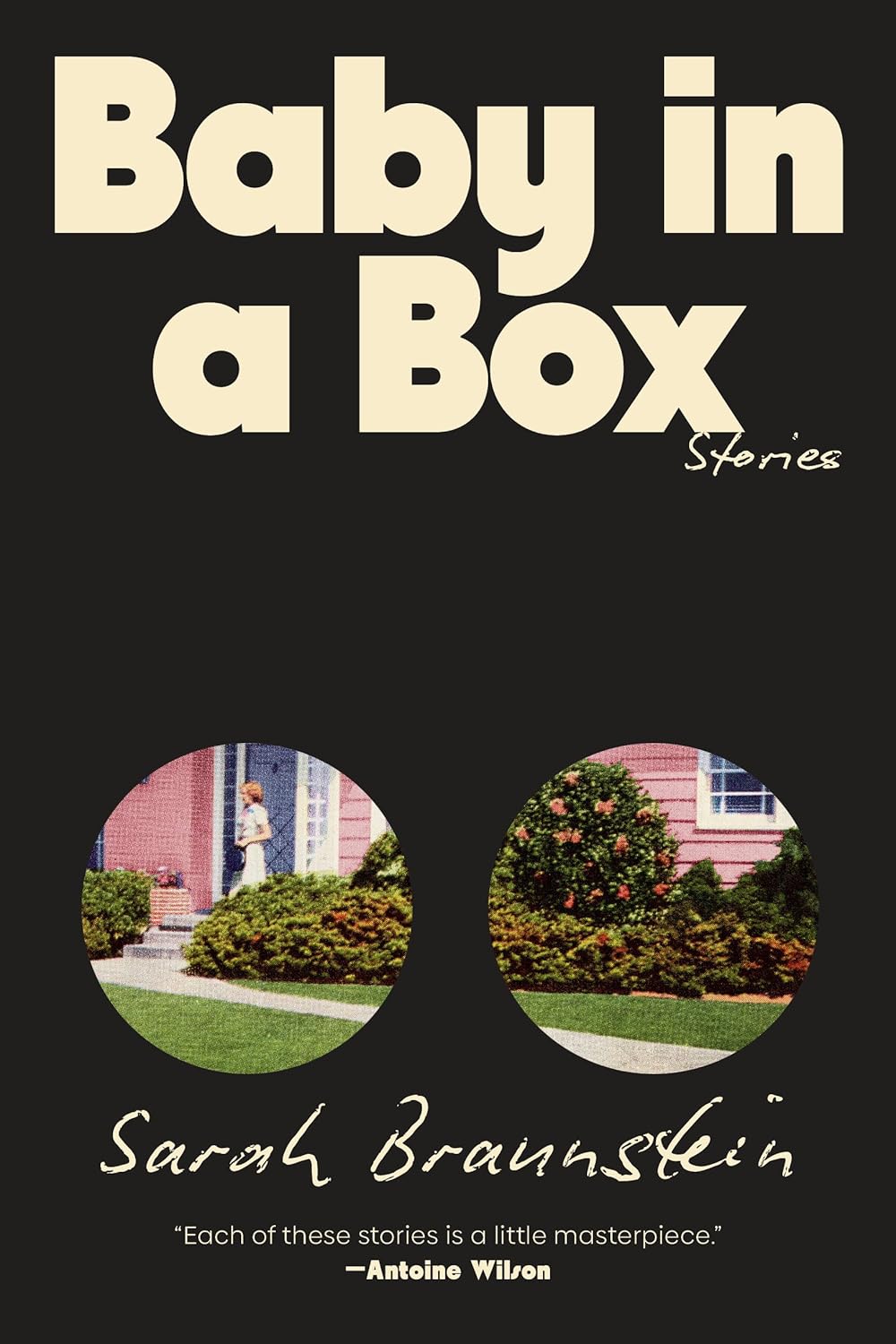
That story began with a line that no longer appears in it: “There once was a woman who’d given away a baby.” I started building around this idea of who is making this confession and why, to whom and under what circumstance. I discovered it to be a story about social engineering and loneliness but also about wanting different kinds of lives that aren’t recognizable narratives. I called it “Baby in a Box” and began to think about the whole collection in terms of boxing and people feeling constrained. I suddenly began to see some of the broader questions of the book more clearly. It became my working title and then the book, to my delight, emerged with it as its guiding star.
I was particularly interested in how you crafted characters whose maternal nature transcends traditional blood relations. How do you examine motherhood in your work?
One of the words that came up when I was initially trying to describe the book was caretaking. I wrote this book over many years while I was raising a son, so writing these stories was a new way to explore the nuances of caretaking, especially earnest but potentially misguided caretaking. Throughout the collection, there are all sorts of questions about maternal impulses and what happens in the absence of maternal care.
I was also thinking about caretaking through the book’s epigraph, which is a quote by psychologist James Hillman about what the caregiver should do. It’s not saying, “Feed and clothe and be kind.” It’s saying, “Have a fantasy, put odd fellows and peculiar ladies within the child’s perimeter and let the child be obsessed about things.” I feel like all the stories are speaking to the odd fellows, peculiar ladies and child’s obsessions.
This collection travels all over, landing in Maine, New York, Los Angeles, Arizona and Nebraska, to name a few. How does place shape your work?
My last novel, “Bad Animals,” was very much a Maine novel, but this isn’t what I wanted to do with the story collection. I came to Maine almost 20 years ago, so Maine has been my longest home. But in that decade and a half after college, I lived in the Midwest, the Pacific Northwest, in New York City, in Western Mass and on Cape Cod. This is a very “America” book, geographically at least. It reflects a period of my life and an interest in geographical expansiveness.
I was taken with the house on the island in Maine described in your story, ‘Porcupine.’ Was that inspired by somewhere in particular?
I had the great fortune of briefly being a coastal studies scholar at Bowdoin College where I had access to this island near Orr’s Island where there was a farmhouse. I wrote this story imagining that house was in a private family, and I made my narrator a struggling writer in Maine trying to write a novel, but I made her an economically imperiled office assistant who has a lot of anger she takes out on her family.
This collection has some deeply satirical moments, too. How does humor play a role in your writing?
I’m interested in writing uncomfortable stuff, and a lot of the characters I’m inventing are following paths that are inherently uncomfortable. People are funny, and I enjoy finding humor in scenarios that are highly consequential. The parts in my life that have been most punctured by grief or loss have also been the times I’ve laughed as hard as I’ve ever laughed. The comfort and laughter I have found in grief speak to the need to be funny in hard times.
I loved the quiet sagas within your stories, the way you played with time to stretch and narrow across a character’s life. How do you determine a story’s pace and movement?
I think that if I could write simpler stories I might. In grad school, I was always struggling with how long a story should take. And then, I just decided to let myself play with bigger leaps in time, particularly in time that’s narrated. In the story, “Abject Naturalism,” we jump a decade in a paragraph. I didn’t know I could do that. I think that captures the experience of life, of being a parent. That decade feels as big as the white space between paragraphs.
I was excited to see the way you broke out of a simple story structure, too. It feels like a narrative mirror to the conceit of breaking out of boxes.
Thank you for saying that. It is such a gift now to be able to take a step back and look at these stories as a formal experiment I was undertaking and am continuing to undertake on the new stories I am working on. I want to see what else I can do with the story form. These stories are based in psychological realism, and yet there are ways that things can get very unreal, and that time can stretch and warp so that they sometimes start to feel speculative. It captures something of what it feels like to be alive right now.
Emily Lowe is a writer living between Brooklyn and Connecticut. Her work has appeared in The Chicago Review, Off Assignment, River Teeth and elsewhere.
We invite you to add your comments. We encourage a thoughtful exchange of ideas and information on this website. By joining the conversation, you are agreeing to our commenting policy and terms of use. More information is found on our FAQs. You can update your screen name on the member's center.
Comments are managed by our staff during regular business hours Monday through Friday as well as limited hours on Saturday and Sunday. Comments held for moderation outside of those hours may take longer to approve.
Join the Conversation
Please sign into your Press Herald account to participate in conversations below. If you do not have an account, you can subscribe here. Questions? Please see our FAQs.