

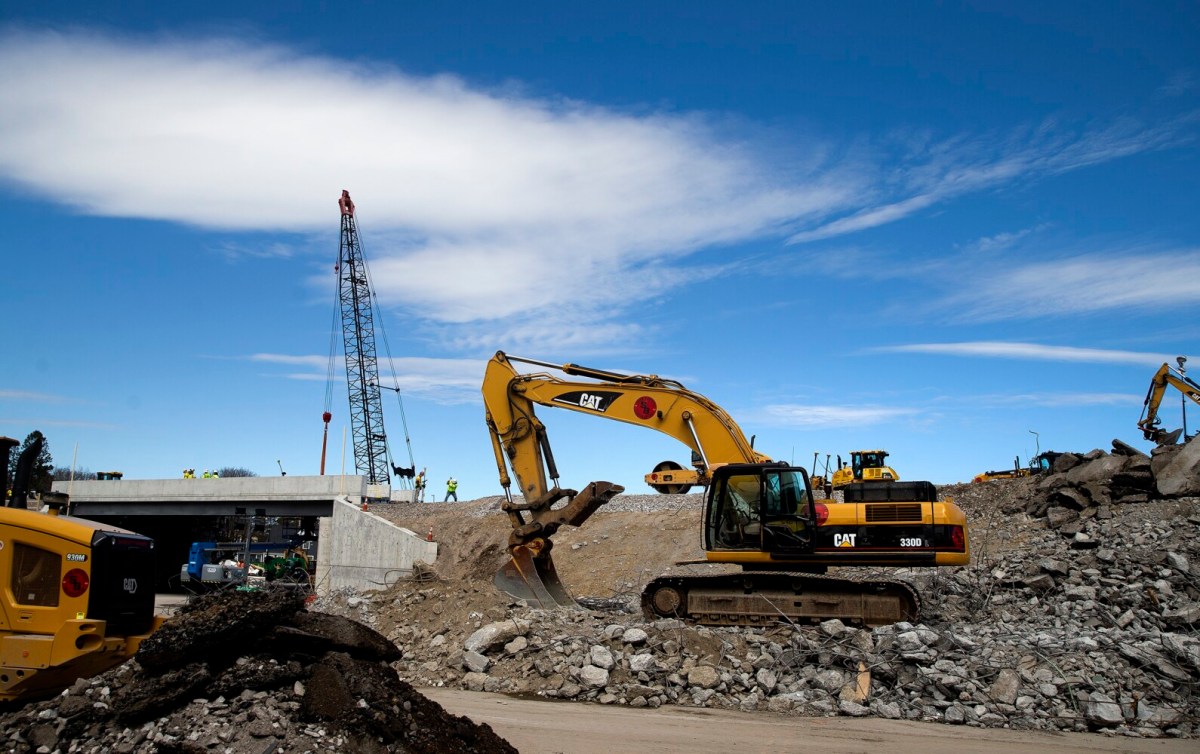
Maine transportation officials are planning to delay hundreds of millions of dollars in road and bridge repairs because of a budget crisis that is threatening the safety and reliability of its aging infrastructure system.
Paving crews are parking their trucks and engineers are wiping projects off the calendar as the Maine Department of Transportation grapples with an $84 million a year shortfall caused by a combination of a failed bond bill, federal volatility and rising material costs.
This week, when explaining the shortfall to lawmakers, contractors and the media, Maine DOT Commissioner Dale Doughty compared the state transportation network to a basement furnace. Easily forgotten until there’s something wrong with it.
“There’s nothing more needed in January than the furnace,” Doughty said.
According to a May 18 memo that Doughty wrote to Gov. Janet Mills — first reported by the Bangor Daily News — that furnace is about to run out of fuel. If policymakers can’t come up with a fix, some Mainers who rely on the 8,800 miles of state-managed roads will be left out in the cold.
On Friday, DOT confirmed six paving projects valued at $50 million in Brunswick, Fort Kent, Holden-Dedham, Newport-Dexter, Rockland and Saco have been put on hold. The agency will identify another $150 million in bridge, highway and intersection project delays by mid-June.
Because the state has a three-year road plan, and because federal authorities reimburse the state for about 80% of state road projects, Maine faces a structural budget gap that will force the DOT to delay up to $400 million in total work, Doughty said.
According to Doughty’s memo, Maine needs $240 million in capital funding every year just to keep the current system in good shape. If that funding dips down below $200 million, Maine’s transportation network will “erode over time.”
However, Maine only set aside $156 million in state capital funds for DOT’s 2028 budget year.
The math behind this shortfall is a mix of bad luck and political gridlock. Doughty expected to close his budget gap with $130 million in state bonds, but two bills that would have done so did not win approval in the last legislative session.
Meanwhile, the price of doing business, and building roads, is skyrocketing. Global conflicts, including a war with Iran, have sent the costs of fuel, asphalt, concrete and steel soaring. The state doesn’t yet know the full impact, but Doughty knows it won’t be good.
Maine has a small population of 1.4 million people that support the sprawling system of roads and bridges. Every year, Doughty said he must take a “leap of faith” that the governor and state lawmakers would find the money to fill the gaps in its three-year work plan.
“It’s always been a good leap of faith,” Doughty said. “This time, that didn’t happen.”
Doughty argues that the state cannot keep “chasing our tail year after year.” He is pushing for a two-stage fix: a bond to cover the immediate two-year budget gap and a long-term permanent, reliable funding source developed by state lawmakers to prevent future crises.
The timing of the shortfall is particularly painful for the local economy.
Kelly Flagg, the executive director of the Associated General Contractors of Maine, said learning of the shortfall at the start of Maine’s construction season is “deeply troubling.” Contractors have already hired workers, bought equipment, and invested in materials based on advertised projects.
“At this stage, those investments and the livelihoods tied to them are put at risk,” Flagg warned.
The federal government, which usually pays for 80% of major road projects, is facing its own drama. The current law that authorizes federal transportation spending expires this fall, and Maine officials worry about a potential federal shutdown.
Independent gubernatorial candidate Rick Bennett has called for public hearings, arguing that Doughty and the Mills administration kept the shortfall quiet for months while thousands of jobs hung in the balance.
“Mainers can handle tough news,” Bennett said. “What we won’t accept is being kept in the dark.”
For the workers on the ground, the lack of a long-term plan is a recurring nightmare, said Flagg. The state’s funding system is unsustainable and has relied on temporary fixes for too long. She called on elected leaders to find a way to protect the infrastructure that businesses need to thrive.
As the department prepares to release a detailed list of delayed projects next week, Doughty is focused on convincing policymakers that roads aren’t just asphalt and dirt, but the backbone of the economy.
“We’ll paint a picture of why they’re so important, then let the priorities fall where they may,” Doughty said.

We invite you to add your comments. We encourage a thoughtful exchange of ideas and information on this website. By joining the conversation, you are agreeing to our commenting policy and terms of use. More information is found on our FAQs. You can update your screen name on the member's center.
Comments are managed by our staff during regular business hours Monday through Friday as well as limited hours on Saturday and Sunday. Comments held for moderation outside of those hours may take longer to approve.
Join the Conversation
Please sign into your Press Herald account to participate in conversations below. If you do not have an account, you can subscribe here. Questions? Please see our FAQs.