

The exhibition “To Monhegan, With Love: The Susan Bateson and Stephen S. Fuller Collection,” opens July 1 at the Monhegan Museum of Art & History (through Sept. 30). As the title suggests, it represents the culmination of a great romance. It involves the actual human relationship between two people, of course. But, more significantly, it is an affair of the heart between these collectors and a place that has thoroughly enchanted them.
The show consists of over 90 artworks and a sculpture by Monhegan Island artists that spans the years 1890 to 2000, all of them collected by Susan Bateson, a former human resources executive in the banking and biotechnology industries, and her husband Stephen (“Steve”) Fuller, an economist who was a professor of public policy and economic development for most of his life.
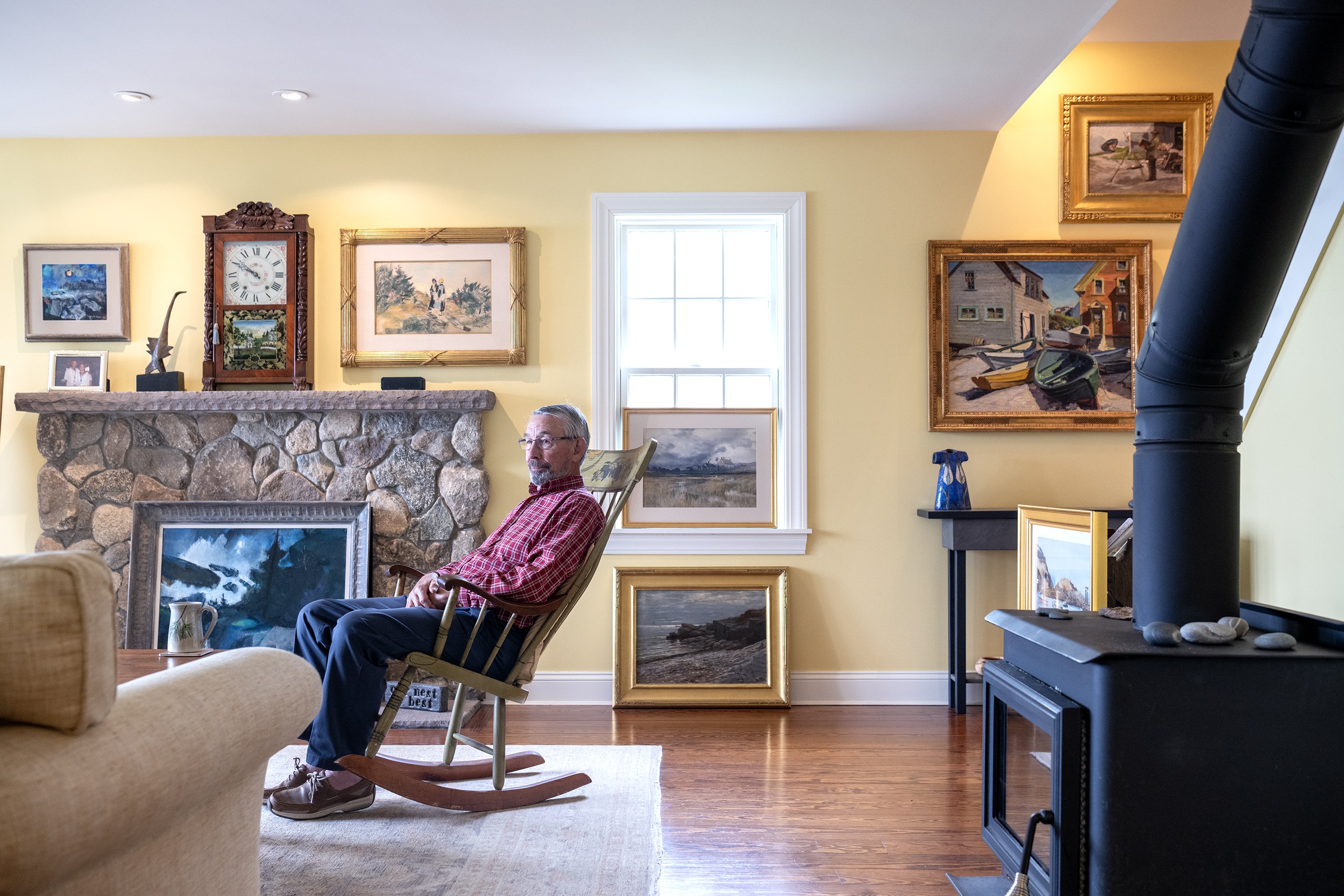
The significance of the couple’s bequest, the largest in the museum’s history, cannot be underestimated. The institution’s president, Adam Blumenthal, observes: “Susan and Stephen’s remarkable gift to the museum reflects their love for the island, its people and its history. The quality and breadth of this collection reflect their passion and commitment to our community and will create a permanent legacy for future generations.”
The human part of this romance began in 2008, when Bateson and Fuller met through mutual friends and immediately bonded over their enthusiasm for adventure travel, much of it involving sailing. Over the years, they have crisscrossed the globe, visiting far-flung destinations such as Antarctica, the Galapagos Islands, Iceland, Patagonia, New Zealand, Tasmania and, most recently, Portugal. They married in 2009 at Robinhood Marine Center in Georgetown (where they now live year-round amid their ever-growing collection). The marina’s accountant officiated. After the ceremony, they cast off on their Hinckley 43 “center-boarder” yacht, embarking on an island-hopping honeymoon. Their first stop was Monhegan Island.
Fuller was already familiar with the island. Since 1978, he had moored in its harbor many times, sleeping on the boat and rowing onto Fish Beach to buy provisions. Soon he discovered, he says, that “The more often you go there, the more layers you peel off. You begin to see beyond just what you need.” What he discovered was that “Monhegan is a wonderful place that is human-scaled. If you take time to understand it, you find everything you like to find in a society.”
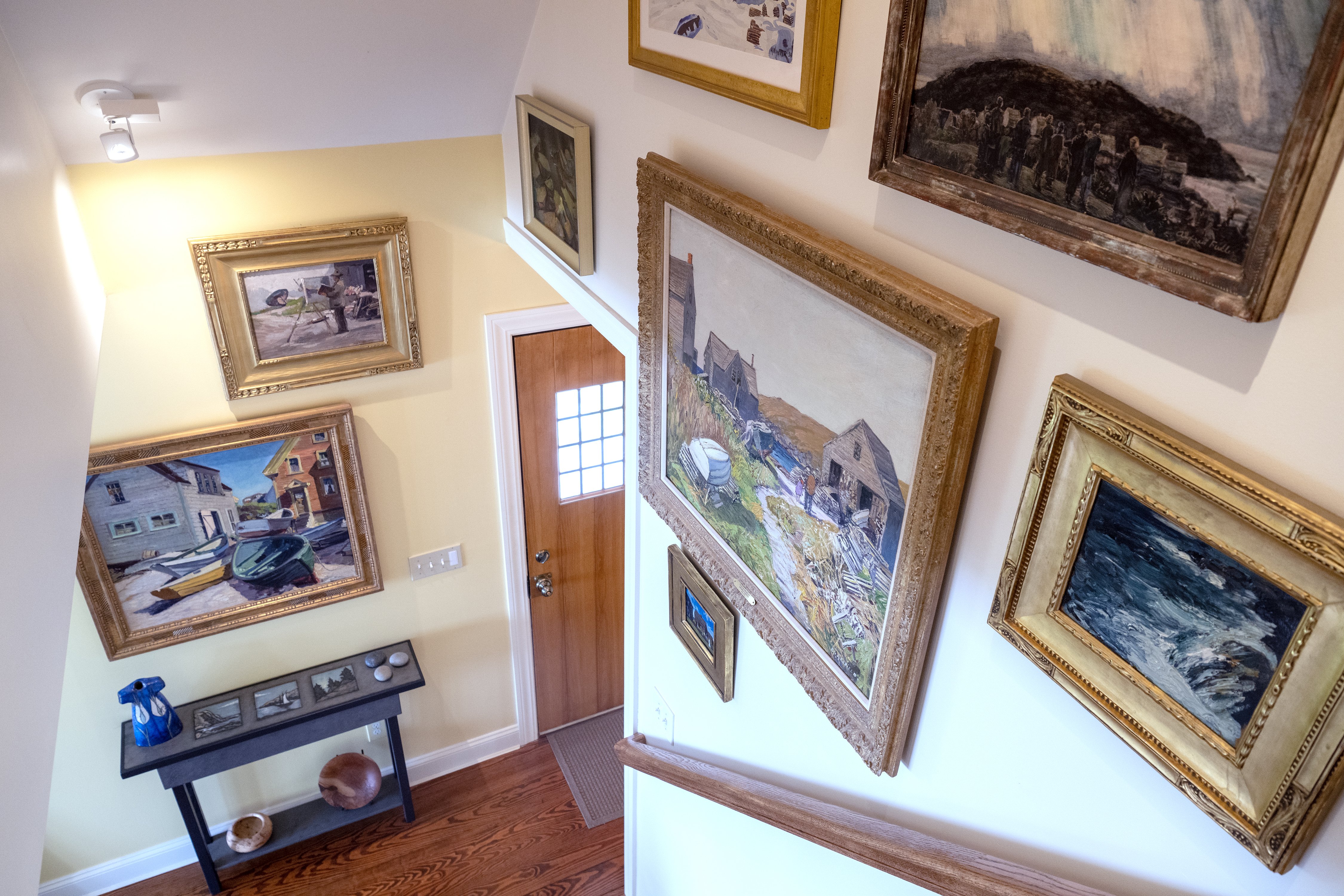
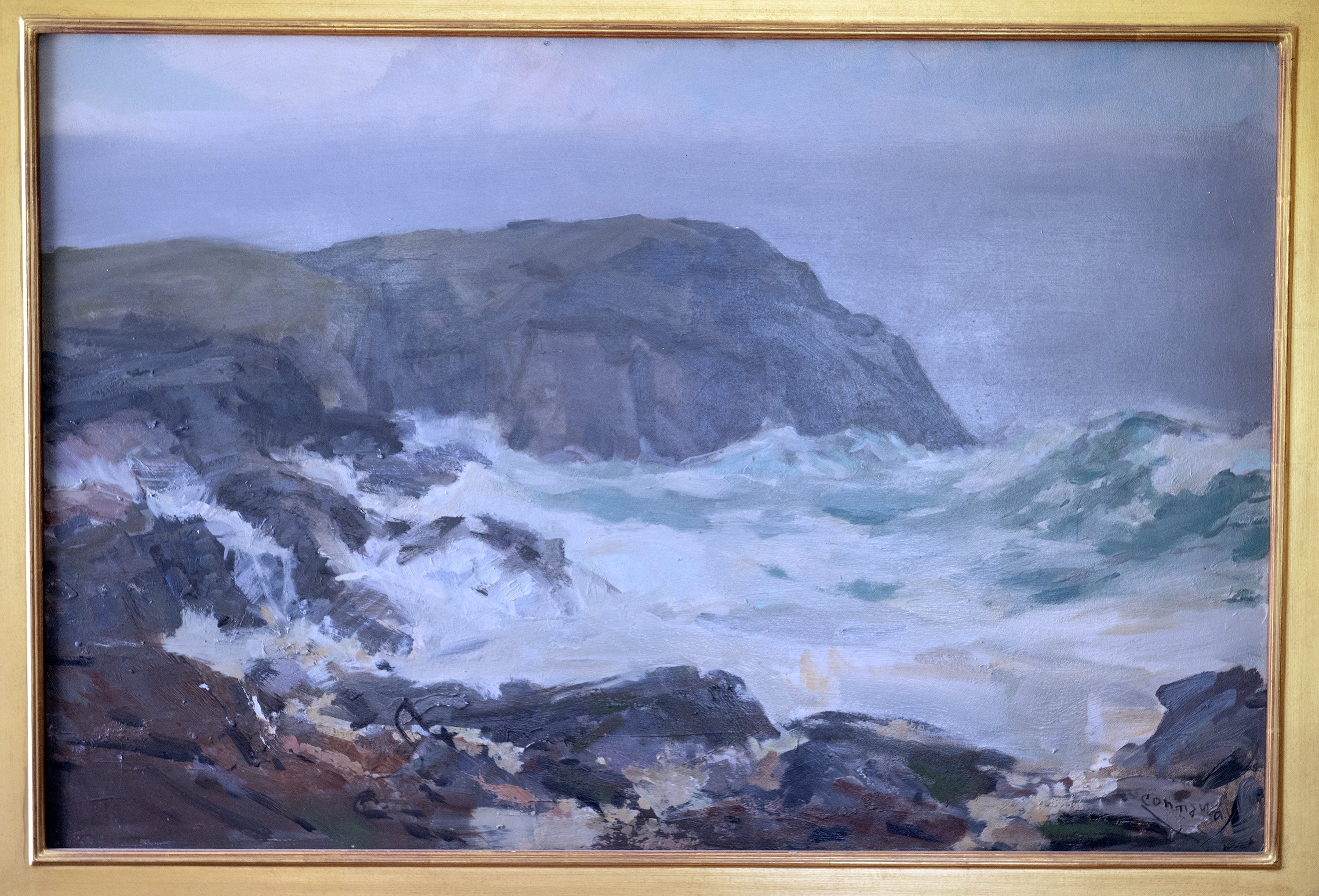
On one visit, he climbed the hill to the museum and was taken with “Marine,” an 1895 canvas by the turn-of-the-century artist Alfred Thompson Bircher. The work sparked Fuller’s desire to own a painting of the island that he could hang in his Alexandria, Virginia home. He did eventually purchase a Bircher of his own—“Whitehead” (also painted in 1895) which depicted the familiar promontory he had come to know from his vantage point on the water. But his very first acquisition in 2007 was Jay Connaway’s “Seas at White Head, Monhegan” (1940), a view of the stretch of the rocky Gull Cove between Burnt Head and White Head.
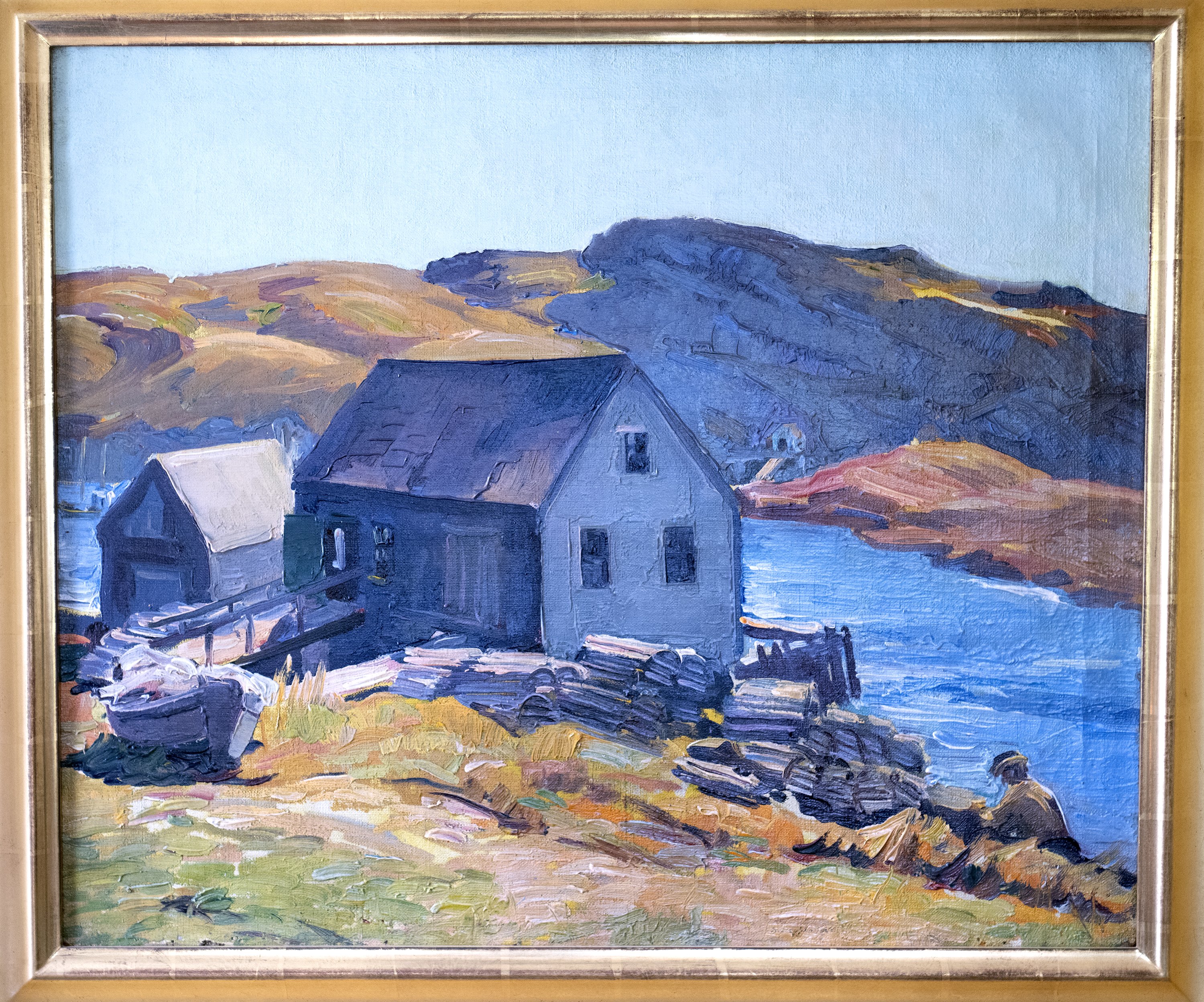
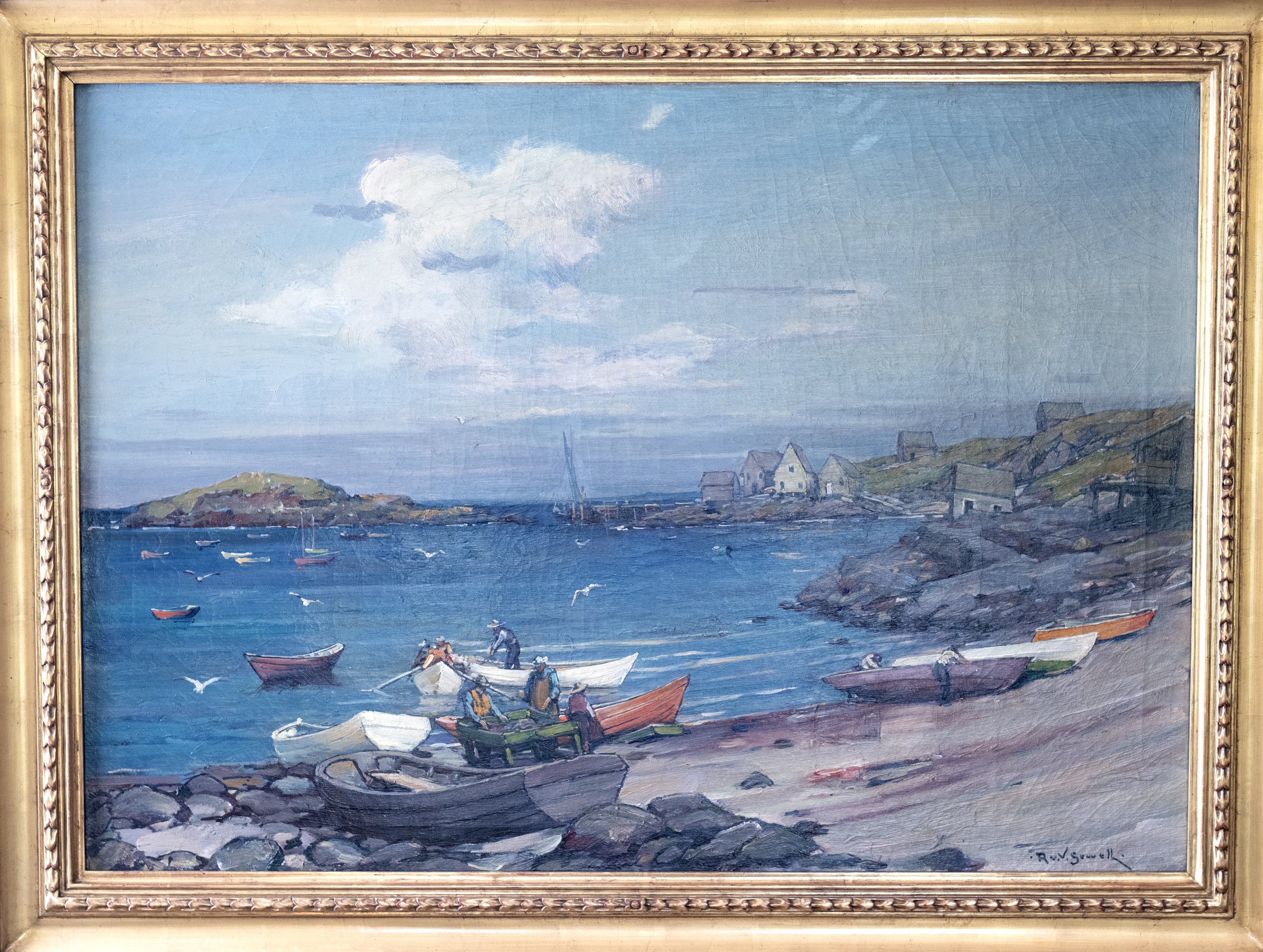
As Fuller returned again and again to the island, a desire grew to buy art that represented facets of the island beyond its geological and oceanic features. His next purchase, then, was Abraham J. Bogdanove’s “Mending Lobster Pots” (1925) which brought to life for him the livelihood of the island. It wasn’t long after they married that Bateson also “caught the bug” for collecting Monhegan art. Bateson purchased “Bringing in the Catch” (1920) by Sears Gallagher as their third piece, and collecting became a shared passion thereafter.
“What is so wonderful about Monhegan is its authenticity,” Bateson says. “It is a community of people who truly treasures the place they live. They take care of their historical and artistic artifacts. It’s an intersection of a landscape that is stunningly beautiful and a working village.”
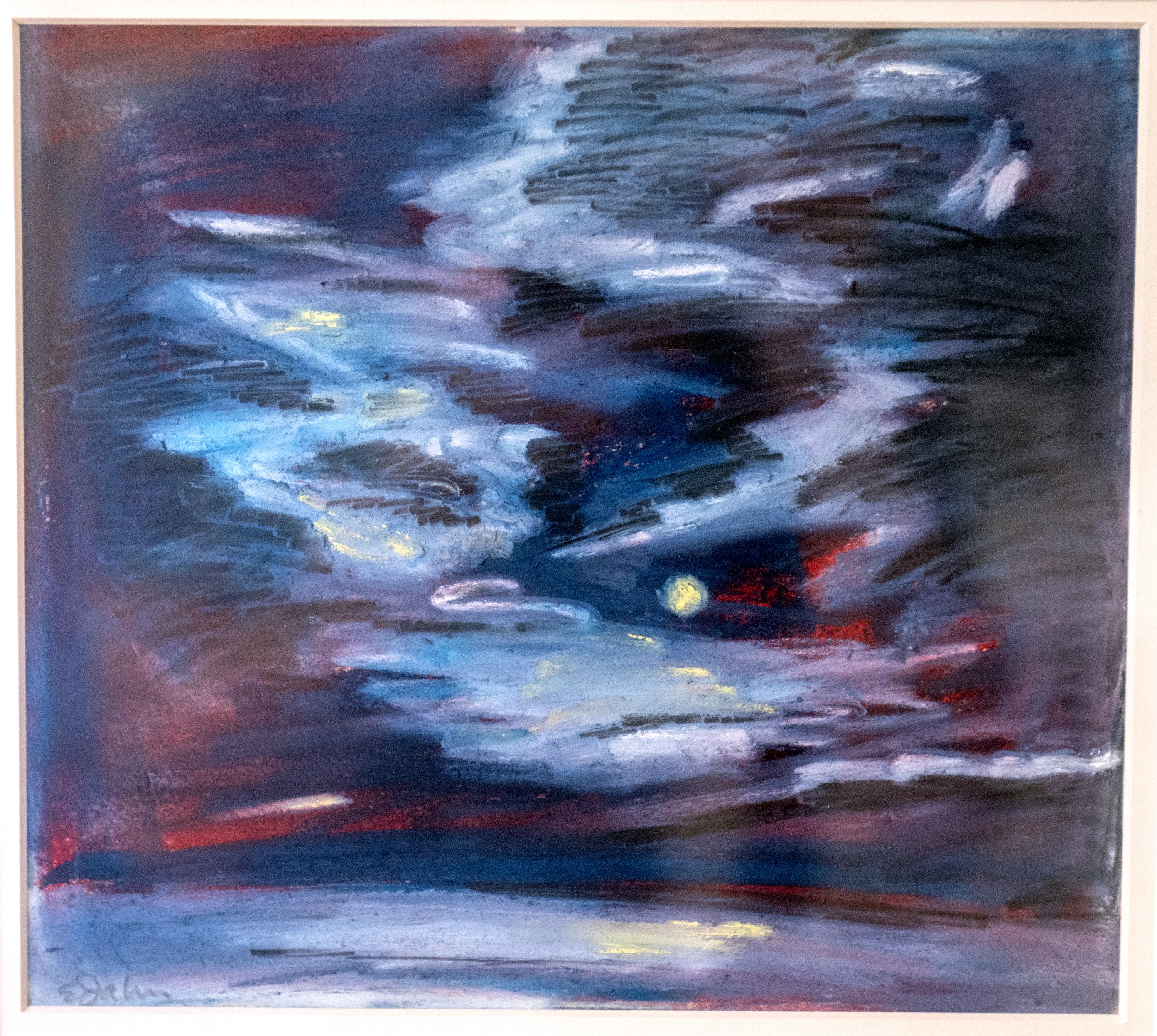
In the intervening years, Bateson and Fuller have amassed works by an impressive roster that includes Maud Briggs Knowlton, Joseph De Martini, James Fitzgerald, Robert Henri, Jacqueline Hudson (a founder of the museum), Elana Jahn, Rockwell Kent, Mary King Longfellow, Leon Kroll, Zero Mostel, Edward Potthast, Edward Redfield, Samuel Peter Rolt Triscott, William Trost Richards, Robert Sewell and Andrew Winter… among many others.
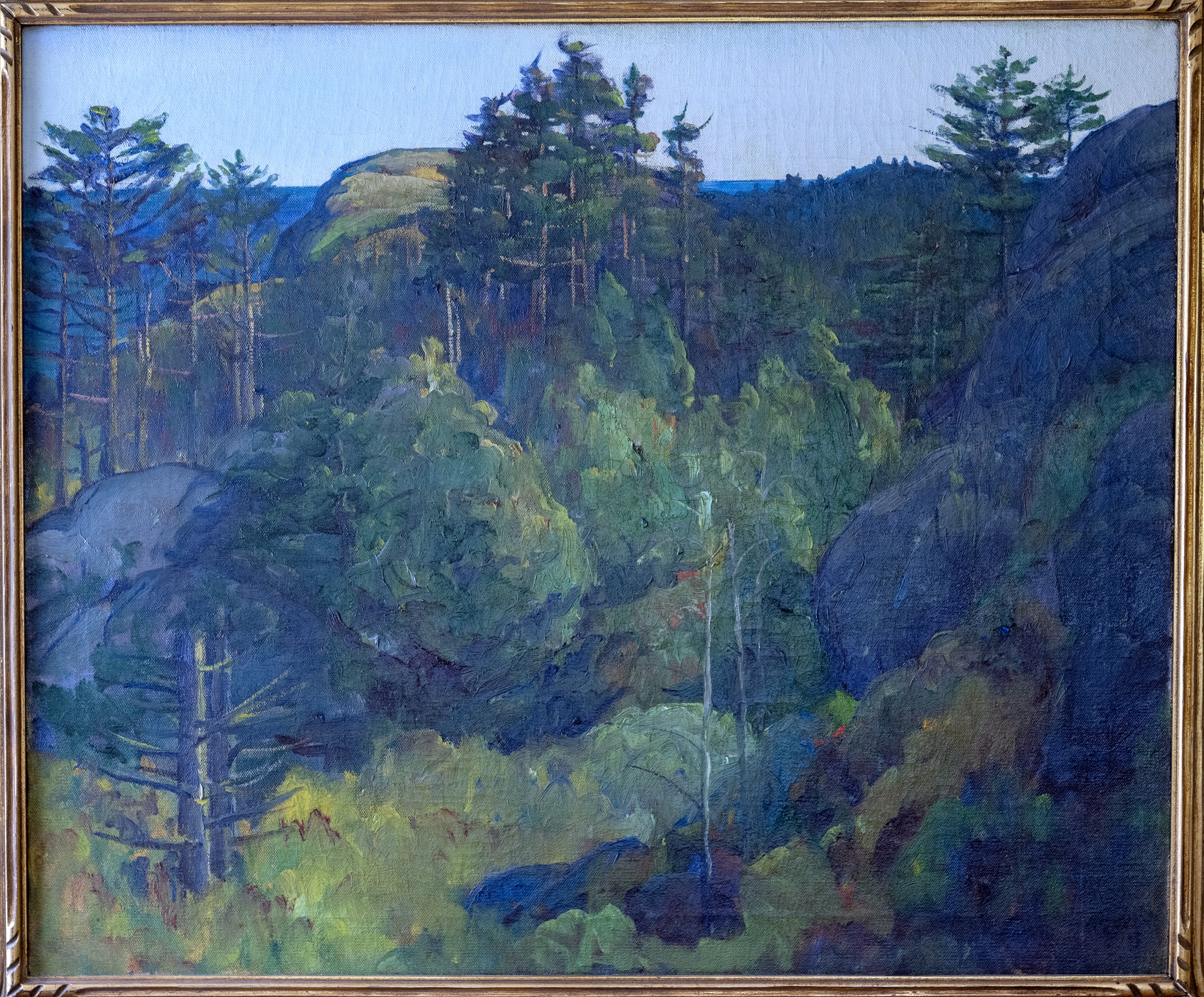
The boldface names are, of course, a hallmark of Bateson’s and Fuller’s connoisseurship. However, for Jennifer Pye, director and chief curator of the Monhegan Museum of Art & History, the real value of the collection supersedes artist recognition and the high price tags of several of the works. “What drove Susan and Stephen to collect were the stories behind the art,” Pye says. “The connection they demonstrated between the residents and the island visitors helps tell the story of the island more completely…Especially in the works that include figures, it’s helped us understand more about the people of Monhegan because they were able to learn things about a specific boat or a hat that appear in one painting or another.”
One example is Jay Connaway’s “Monhegan, 1937,” a wintry scene in which Connaway’s wife, Louise Boehle, is depicted with her back to the viewer as she approaches a house. “She was a trained nurse [also a classical pianist],” says Pye, “and she has her bag under her arm and her dog by her side. It led us to stories about the people she nursed. Steve and Susan have been as captivated by the stories as the artworks themselves.”
Bateson and Fuller’s sleuthing led them in 2013 to Edward L. Deci, the former board president and volunteer director of the museum who passed away earlier this year. They had just purchased Emil Holzhauer’s portrait titled “Monhegan Fisherman” (1931) and hoped Deci might be able to identify the subject. Bateson writes in her catalog essay for the exhibition: “Ed offered to ask some longtime Monhegan residents if they recognized this particular Monhegan fisherman. Within a few weeks, Ed wrote to us that the fisherman had been identified as Leslie Davis (1893-1974), son of Walter Davis (1865-1956), both descended from the families that began the permanent Anglo-European settlement of the island in the late 1700s. It is a wonderful work, and it is so much more meaningful to us now that we know the subject’s name and background.” She adds that living with this work for years has made them feel as if Leslie Davis was “a family member.”
The collection bridges traditional landscape painting, genre scenes and portraiture up to more modern works by artists like De Martini and Jahn that feel looser and/or more abstract. Bateson and Fuller have put no restrictions on how the works are exhibited or whether they are lent to other institutions.
Much of Deci’s own collection will also eventually come to the museum. As of now, the museum’s holdings number over 2,000 works and over 30,000 historical artifacts connected to the island. The board is currently engaged in a campaign to raise $5 million. It will pay to build additional climate-controlled storage (so there will be no need to rely on off-island storage), install robust new climate control systems for the museum, winterize year-round affordable housing for staff, and invest in technology (including digitizing the collection).
Meanwhile, Bateson and Fuller have sold their boat (“I swallowed the anchor when I turned 75,” jokes Fuller) and settled into retirement. There will likely be other gifts down the line. They are thrilled to leave this legacy to the Monhegan Museum of Art & History, says Susan, because “That’s the place that will prioritize the collection. Many museums have so much that they can’t show most of it.” Not so on Monhegan.
“It’s not just that it’s meaningful personally and artistically,” says Pye of the generous bequest. “It feels right. These paintings are returning to where they were made.”
Jorge S. Arango has written about art, design and architecture for over 35 years. He lives in Portland and can be reached at [email protected]. This column is free to access through support by The Dorothea and Leo Rabkin Foundation.
We invite you to add your comments. We encourage a thoughtful exchange of ideas and information on this website. By joining the conversation, you are agreeing to our commenting policy and terms of use. More information is found on our FAQs. You can update your screen name on the member's center.
Comments are managed by our staff during regular business hours Monday through Friday as well as limited hours on Saturday and Sunday. Comments held for moderation outside of those hours may take longer to approve.
Join the Conversation
Please sign into your Press Herald account to participate in conversations below. If you do not have an account, you can subscribe here. Questions? Please see our FAQs.