


A new report on Maine’s housing production shows that the state not only met but surpassed its housing goals last year, an important step in an aggressive attempt to build more than 80,000 new homes by 2030.
But a closer look at the data reveals that the most significant growth is not happening in the parts of the state where it’s most needed.
Maine issued 7,499 building permits and 518 demolition permits last year, according to the report released Friday, resulting in a net gain of 6,981 units. The goal was 6,900.
The state meeting its housing goals is welcome and perhaps even surprising news.
Still, Maine is a long way from solving the housing crisis, and the goalpost is only moving forward each year. By 2030, the state is expected to be producing roughly double the number of units it produced last year.
Nine Maine counties exceeded their goals while seven failed to meet them.
The report represents the first time Maine has had comprehensive data on its housing stock, following a bill passed last year (and then another one to amend it this session) requiring municipalities with more than 4,000 residents to report a host of information, including building permits, demolitions and certificates of occupancy, as well as the affordability of the units that are approved.
Officials received data from 79 of the 88 towns that were required to submit information, plus 103 that submitted voluntarily. Census and Land Use Planning Commission data helped fill in the gaps.
The information provides a baseline to measure against as officials work to chip away at the state’s ambitious building goals. But it’s going to take work.
The Greater Portland Council of Governments, a regional nonprofit planning and economic development agency, compiled the data for the state and wrote the report. Executive Director Kristina Egan said the results were encouraging.
“Maine now has information to tell us whether we are building enough housing for today’s Mainers and tomorrow’s workforce,” she said in a statement. “For us to meet the state’s 2030 goal of 84,000 new homes, progress needs to accelerate in the coming years. But, for now, the news is good.”
WHAT IS BEING BUILT
The vast majority of the permitted units (87%) were market-rate housing or nonsubsidized, according to the report. Only 12 municipalities reported permitting any affordable or income-restricted housing, and the bulk of those 722 units (73%) were concentrated in Portland and Lewiston.
Single-family homes captured the greatest share of the construction market, with 5,033 permits statewide. Larger multifamily developments were the second most popular, with 1,516 units permitted across buildings with at least five units. The majority were in Portland, Biddeford and Lewiston.
Accessory dwelling units made up a larger share of units than expected, representing about 7% of permits.
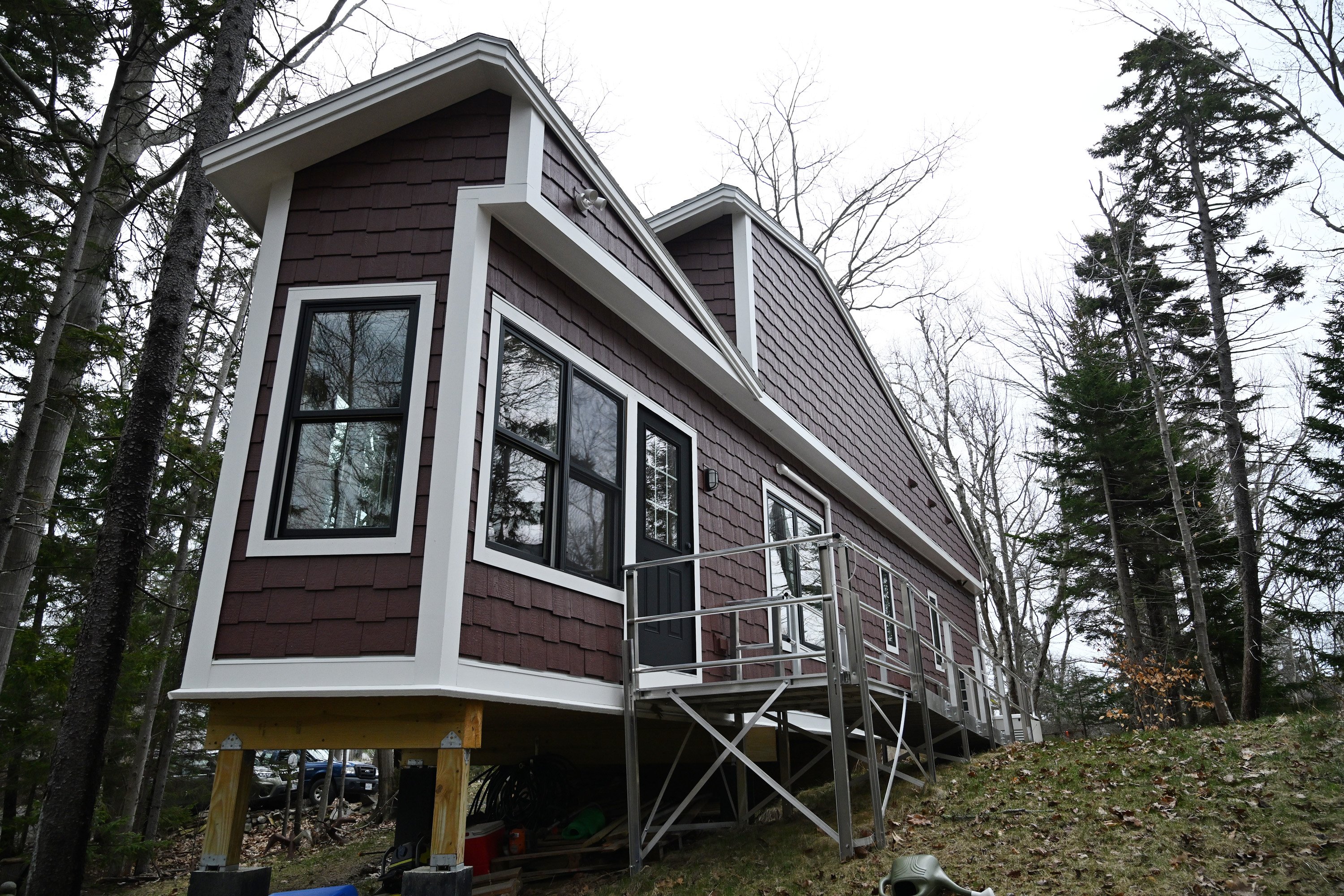
Overall, the data is positive: Maine municipalities rolled up their sleeves and successfully exceeded their production goals.
“Each new home helps reduce housing costs and puts housing in the reach of more Maine people, so families can put down roots, our employers and our economy can thrive, and our communities can grow and prosper,” Gov. Janet Mills said in a news release.
However, the data also raises important questions about affordability, housing diversity and whether growth is happening where it’s needed, according to HR&A Advisors, the firm that completed Maine’s 2023 housing needs study and subsequent 2025 “roadmap” of possible policy solutions.
RURAL, SEASONAL AREAS DRIVE GROWTH
While several busier southern Maine cities — Portland, Lewiston, Biddeford, Sanford — and surrounding suburbs permitted the greatest number of units last year, it wasn’t enough.
York and Cumberland counties fell short of their county-level production targets by 9% and 4%, respectively.
Meanwhile, some of the state’s more rural counties blew past their goals. Washington County beat its target by 118%. Piscataquis, the only county that doesn’t need to increase its production at all in the next four years, still surpassed its baseline by 69%. Franklin County added 36% more units than it was aiming for.
Maine’s coastal, mountainous and lakeside towns — or seasonal and recreation-driven areas — also saw an outsized increase in housing growth.
While these areas have their own challenges, the findings raise important questions about whether growth is happening at the necessary scale in Maine’s economic hubs, HR&A said.
The statewide average is about 5.5 permits per 1,000 residents, but Newry, home to Sunday River, approved nearly 54 permits per 1,000 residents. In Rangeley, it was 35. In Carrabassett Valley, home to Sugarloaf, it’s more than 46 per thousand, according to the HR&A analysis of the data.
Charlie Woodworth, executive director of Greater Franklin Economic and Community Development, wasn’t surprised to hear that Franklin County surpassed its housing goals, but he also wasn’t under any illusions about who was pulling the permits.
In Rangeley and Carrabassett Valley, the housing growth was driven largely by second-home owners, he said. That’s not the kind of housing Franklin County communities need.
“We are elated that we have these second homes being built in the area because it’s reflective of the growth and the success of the recreational economy,” Woodworth said, “but the success creates challenges for the year-round residents of the communities and the local businesses.”
Housing has become both scarce and cost-prohibitive for the workforce, he said.
“We need housing for people who want to work here and live here,” he said.
Two promising workforce housing projects on the horizon: an 18-unit development in Rangeley that recently started construction and more than 40-units still in the works in Carrabassett Valley.
MEASURING PROGRESS
In 2023, a state report found that Maine was short about 84,000 homes and would need to increase its housing stock by 11% to remedy historic underproduction and accommodate the new residents it needs to support a dwindling workforce.
In order to do that, according to a report published the following year, Maine needed to ramp up production by 92%, starting with 5% in 2025, an additional 10% in 2026 and then an additional 15% in each of the following four years until the state is pushing out about 13,300 building permits in 2030 to reach the targeted 84,300 units.
The report also outlined county-specific goals that ranged from no increase (Piscataquis) to a 1,283% increase (Washington County).
While the targets gave the counties a concrete number to work toward, the state had no way to track their progress. Historically, officials relied on data from the U.S. Census Bureau, which is voluntarily reported.
The new data is designed to give the state a benchmark against which to measure future production, though officials cautioned that 2025 is more of a pilot year, with more complete data expected next year.
HR&A cautioned against drawing too many conclusions from a single year of data.
“Housing permitting can vary substantially from year to year, particularly in smaller communities where one or two large developments can significantly influence annual permitting rates,” it said. Many communities, including Portland, Augusta and Bangor, have projects that are permitted but await action from developers.
AGGREGATE SOURCES
Building permits are not a perfect measure of housing production because not all permitted units are completed — for example, Portland last year issued a record number of permits while also experiencing one of its worst years for completions in the last decade.
Certificates of occupancy would be a more accurate measure, but according to the report, the data collection revealed that only 61% of Maine municipalities issue them.
Expanding certificate of occupancy reporting is an important next step, HR&A said.
Tracking building permits also mirrors the U.S. Census Bureau’s process, allowing the state to fill in gaps in its own collection.
This year, for example, 219 of Maine’s 529 municipalities submitted data to the state. Of the 310 municipalities that did not submit data, Census data was available for 210. State officials also used Land Use Planning Commission data for 108 “jurisdictions,” including 71 unorganized territories.
Data was not available from any source for 100 municipalities.
House Speaker Ryan Fecteau, D-Biddeford, said the data shows that efforts to make it easier to build across the state are paying off.
“We have a clearer picture of our progress, and even more incentive to continue our work to build homes all Mainers can afford,” he said in a statement. “Doing so is critical for Maine families, businesses, and our economy.”

We invite you to add your comments. We encourage a thoughtful exchange of ideas and information on this website. By joining the conversation, you are agreeing to our commenting policy and terms of use. More information is found on our FAQs. You can update your screen name on the member's center.
Comments are managed by our staff during regular business hours Monday through Friday as well as limited hours on Saturday and Sunday. Comments held for moderation outside of those hours may take longer to approve.
Join the Conversation
Please sign into your Press Herald account to participate in conversations below. If you do not have an account, you can subscribe here. Questions? Please see our FAQs.