

Growing up in northern Maine, Tommy Pinette said he didn’t consider himself a Mainer, or even an American.
“I really saw myself as something else,” the 25-year-old said. “I didn’t identify with, you know, the lobster roll, clam chowder kind of Maine.”
Pinette is among an estimated one-third of Maine residents — nearly 90% living in the St. John Valley — who can trace their heritage through Canada. A century or more ago, Maine’s vast northern border was more like a town line where people moved freely, trading and following work. A Canadian law that passed last December makes it easier for people like Pinette to obtain Canadian citizenship, which could in turn bring back a less strict border.

Previously, U.S. residents had to prove that a parent was born in Canada. Now, as long as they can provide documentation, they can go back as far into their family tree as they like. Canada sees this process as allowing “Lost Canadians” to return home.
“The region that we’re in, the border, it’s fake, you know, it’s completely fake. And the people who have made me realize that are the Wabanaki people,” said Pinette, who does graduate research on Indigenous-settler relations at the University of Maine’s Canadian-American Center.
In the months since Canada loosened requirements, interest has been strong. According to the Immigration, Refugees, and Citizenship Canada website, 99,500 people are currently waiting for a decision. It’s not clear how many people have already obtained citizenship.
It’s also unknown how many of those are Maine residents, but given the state’s proximity and longstanding relationships, demand is likely high here, too.
“I mean, Canada could reverse their decision at some point, right?” said Christian Cotz, an archivist with the Maine State Archives, which has seen more than 300 requests for help with documents since January. “And so there’s some, I guess, some people probably feel an urgency because of that.”
The current wait time, according to the IRCC webpage, is 19 months, and even longer for people outside of Canada or the U.S. In recent weeks, some people who had received citizenship certificates, including here in Maine, were told to send them back because they weren’t valid, according to reporting from CBC.
Patrick Lacroix, a historian at the University of Maine-Fort Kent, lives in a border region where the majority of people are doing it for “sentimental reasons,” he said, a way to reconnect with a previously suppressed side of their family history.
Others, he acknowledged, see it as an opportunity to leave a country they feel is becoming increasingly politically dangerous.
HOW THE NEW LAW WORKS
Last December, when Canada passed Bill C-3 to get rid of the “first-generation limit” on citizenship by descent, many Mainers seized the opportunity.
At the state archives in Augusta, a team of two is fulfilling all document requests on top of their day-to-day duties, although they urge people to use FamilySearch or similar ancestry sites before submitting requests to make the search easier.
Only about 20% of towns in the 1920s submitted vital records to state agencies, said Cotz, which makes the process more difficult for both applicants and the archivists. Additionally, many towns have disbanded, making obtaining documentation more difficult.
Last month, the wording of Bill C-3 also was amended, said one archivist, from “appropriate” to “original” authority to stop the hundreds of applications only providing screenshots of ancestry sites without any of the associated data. This has made things trickier because it means applicants need primary source documents rather than replacement or secondary certificates.
On June 13, many people who had recently received their citizenship certificates were ordered to send them back, according to CBC Canada. They received minimal explanation besides being told the documentation was not from an “original source authority.”
“I don’t think the [Canadian] government was prepared for the immense tide of applications that rolled in,” Cotz said.
Valerie Campbell, of Bucksport, was among the applicants that received the June letter. Both she and her son had recently obtained citizenship, but only she was ordered to return her certificate.
“It was a complete and total shock, I had no idea this was coming, that there were any problems at all,” she told CBC.
SENTIMENTAL REASONS
Pinette had been interested in getting his citizenship before the law passed. He saw it as a way to connect with the Canadian side of his family and his Franco-American roots. He believed much of this history had been erased in an effort to remain “American.”
Pinette pointed to the 1919 English education bill established in Maine that outlawed the speaking of French in public schools outside of explicit language classroom settings. The law, passed by Gov. Carl Milliken, came during a wave of post-World War I “Americanization” efforts. It included such punitive measures as writing “I will not speak French” on chalkboards.
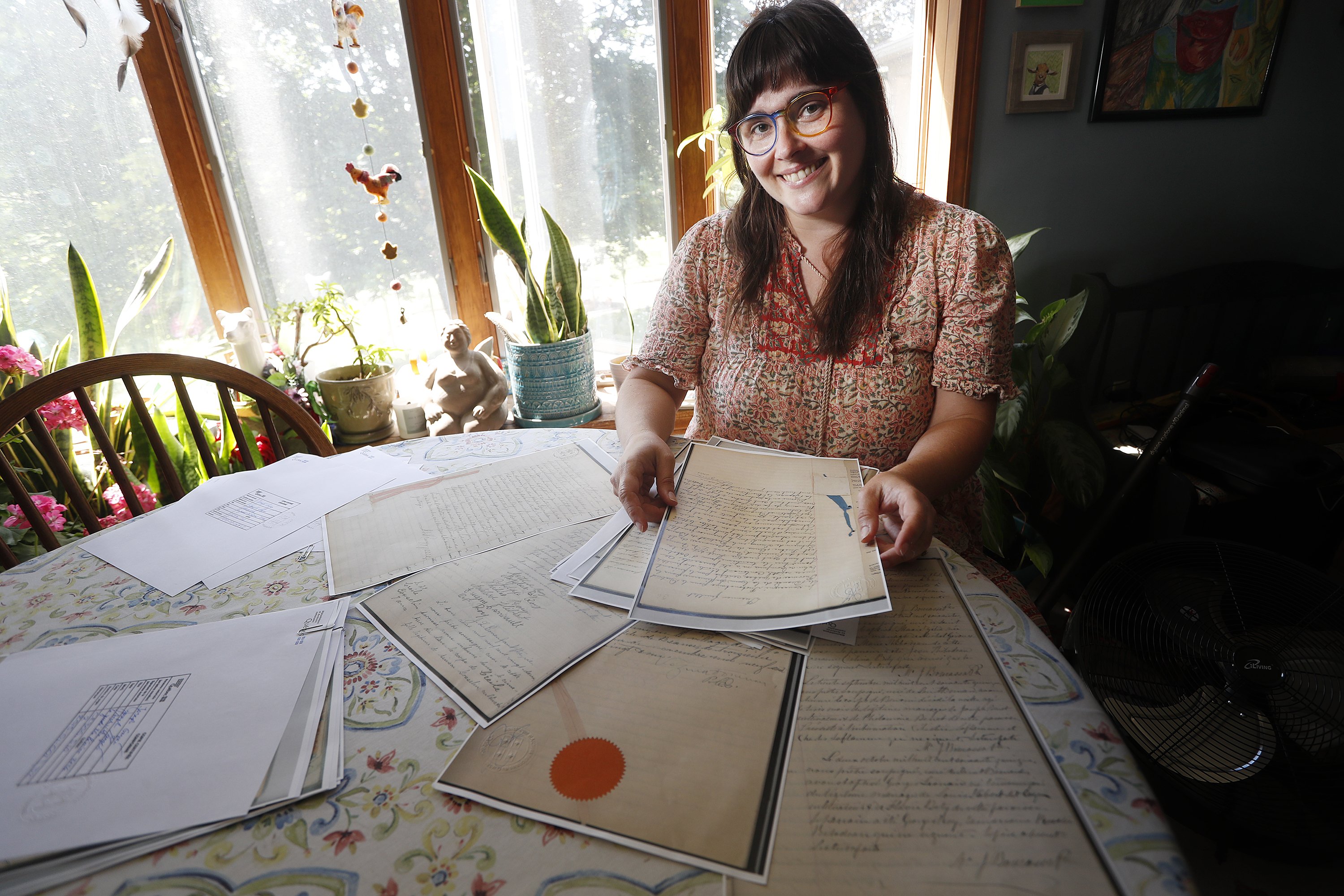
Taylor Poulin, 38, is a French teacher living in Pownal. She’s been going through the application process with her father and sister. Her father was of the generation that was not taught French and she learned it “in defiance of what happened to [him].”
Of the actual application process, Poulin said it has been a lot of logistical work, but it’s been exciting, too.
“It’s kind of like this whole lost side of half of who I am that is very rewarding to discover, to rediscover,” she said.
Poulin said she thinks many people have a “grass is always greener” feeling about Canada. But while she admits she and her husband “absolutely love it,” she recognizes “it’s not perfect. Nowhere is perfect.”
Lacroix at the University of Maine-Fort Kent said most people he’s spoken with don’t have immediate plans to move to Canada.
But, he said, some are no doubt exploring citizenship “with a wink and a nod to the political climate in the United States.”
Even Pinette admitted that a large secondary motivation for him was the current political climate. We’re “really seeing for the first time that more privileged people, like me, I’m white, like white people are experiencing what it’s like to be surveilled,” he said.
Pinette said, historically, many people left Canada to come to the U.S. for better working conditions and the chance at a better life. Now, he wonders if some Americans might be turning to Canada for the same reason.
POLITICAL CLIMATE
Sam, 46, is certainly politically motivated. She asked that only her first name be used out of fear of backlash for speaking poorly of the U.S. political climate.
She moved to Aroostook County about three years ago “with the thought that (I) might have to move to Canada.” A single mom of multiple neurodivergent girls, she is concerned about her children’s futures.
“They’re moving toward trying to institutionalize the disabled,” she said, referring to Trump administration efforts. “I don’t feel like I can do too much to stop it … without endangering my children.
“So if you can’t do anything to stop it, what’s your next obligation? Just to no longer be part of the system that is doing bad things?”
Another Maine applicant, who also asked not to be named to protect her family, worries about her 17-year-old son, who will soon have to enter selective service. While she does not think the draft will come back, “a lot of things have happened in the last 18 months that people said would never happen.”
“There should be concern that so many people want to leave what is supposed to be the greatest country in the world,” she said.
Poulin said more of her students’ families are applying for citizenship for their children’s college applications. Even if not a citizen, college in Canada is significantly cheaper. But she also said that most of the people she knows who are applying are doing so because they or their children are queer and they are “safety planning.”
Gia Drew, executive director of Equality Maine, spoke to the complicated duality of both wanting to be a civically engaged American citizen and feeling the need to protect one’s own safety. Drew has seen an uptick in people inquiring about leaving the country and said an increasingly large part of her job is being aware of the political climate of other countries.
“I’ve also seen an uptick of folks who are interested in leaving other states and coming to Maine,” said Drew.
Reaction from Canadians about the surge of interest in citizenship appears mixed. Poulin said she has seen some concern about Americans changing the existing demographics.
Pinette, however, said Canadians he has interacted with are glad they can provide a safe haven for those that need it and are happy their country is being recognized as inclusive.

We invite you to add your comments. We encourage a thoughtful exchange of ideas and information on this website. By joining the conversation, you are agreeing to our commenting policy and terms of use. More information is found on our FAQs. You can update your screen name on the member's center.
Comments are managed by our staff during regular business hours Monday through Friday as well as limited hours on Saturday and Sunday. Comments held for moderation outside of those hours may take longer to approve.
Join the Conversation
Please sign into your Press Herald account to participate in conversations below. If you do not have an account, you can subscribe here. Questions? Please see our FAQs.