
On Jack Malcolm’s first day as a freshman at Tulane University he was handed a key to his dorm room, told to move in, then given an evacuation plan and told to get out.
The 2005 Cape Elizabeth High School graduate had arrived on campus Saturday, Aug. 27, with his parents and a rental car full of belongings. The weather was beautiful and everyone was in a wonderful mood, said Susan Shea, Jack’s mother. Hurricanes and evacuations were the last thing on her mind.
Instead of the typical first day orientation activities, Jack, his family and the hundreds of other incoming freshman and their families were given three options by the university’s president: The families could take their children home with them for a few days until Hurricane Katrina passed; they could go on a short vacation; or the students who remained would be evacuated by bus to Mississippi State University. Classes were still slated to begin Thursday, Sept. 1.
Since classes would start in five days it didn’t make sense for Jack to fly back to Maine, and at that point no one was overly worried about Hurricane Katrina. So, Shea and her husband Michael left Jack and all his belongings in his dorm room and returned to their hotel in New Orleans, intending to wait out the storm there. Shea felt a little bad leaving Jack, but “there was never a single worry about my son’s well-being.”
Jack was one of about 600 freshmen, about half the class, who were going to be evacuated to MSU in Jackson, Miss. The evacuation was pre-planned at Tulane, using a system that had been used successfully many times before. Most of the freshmen who lived within reasonable distance returned home with parents or went on a short vacation. The students to be evacuated were mostly those who traveled long distances to get to Tulane and had no other options.
The carloads of belongings the incoming freshmen and their families had just carried upstairs and deposited in bare-walled dorm rooms were left behind. Jack left his laptop, printer, stereo and Playstation behind, as well as most of his clothes and all his school supplies.
He was told to leave nothing of value near the windows and take with him only a bag big enough for four days of clothing and the necessary toiletries. Jack slid an iPod into the bag as well. Everyone assumed they would be back on campus in time for the beginning of classes the next day, Sept. 1.
Meanwhile, Jack’s family got back to their hotel room and discovered the hotel was insisting everyone evacuate. So, slightly disgruntled because they still didn’t think the hurricane was that big a deal, Shea and her husband left the city that night in their rental car and headed west on I-10, the major artery out of New Orleans.
The traffic was “kind of bad,” Shea said. But, when they were a few miles outside the city the eastbound lanes were opened up to westbound traffic. Everyone was heading out of the city and no one headed in.
They ended up 80 miles west in Baton Rouge where eventually, after much searching, they found a Ramada Inn with a vacancy. The atmosphere in the hotel was friendly, Shea said. Fellow evacuees from New Orleans chatted with each other on their balconies and Shea and her husband were even invited to have jambalaya with one family.
She had lived in earthquake country before and preferred that to what these people were experiencing. “It’s nice to be prepared and out of town,” Shea said. “But the waiting was horrible.”
Jack and his fellow freshman spent their first night at college sleeping on a gym floor at MSU. Jack said the atmosphere was laid back, just a bunch of new college students meeting and joking about the hurricane. Tulane had bought the local Wal-Mart out of all the pillows and blankets they could get their hands on, to make the night more comfortable for the evacuated students.
Sunday morning, Jack woke up and saw reports on the Weather Channel that were discussing Hurricane Katrina and people began to take the storm more seriously. Cell phone coverage still existed, so Jack spoke with his family Sunday morning.
He had decided he wanted to get out, after thinking about how many weeks he might have to stay in that gym if New Orleans got destroyed. Luckily, during the evacuation he had met a fellow Maine student from Blue Hill whose parents were coming to pick him up and drive him home. Jack decided to hitch a ride to Maine.
Shea and her husband set out to look for a flight home Monday, leaving their hotel in Baton Rouge, where the Federal Emergency Management Agency would set up operations. Hurricane Katrina hit the coast that morning. Shea remembers one phrase repeated over and over again on the news that day: “It was the best of the worst-case scenario.”
What struck Shea the most about all the evacuated families from New Orleans that she had spoken with at the hotel was their biggest worry wasn’t their homes or belongings: “What they were really worried about was their jobs.”
Tulane University is the largest private employer in New Orleans. Shea said she was worried about how those employees would get by. “It’s the jobs New Orleans needs as much as anything else,” she said.
Shea and her husband finally found a flight home from Memphis, Tenn. The whole time in their rental car the news was getting worse.
Jack beat his parents back to Maine, arriving Tuesday after a two-day drive north. He wasn’t sure what he was going to do now that his chosen college was closed indefinitely and had no way to contact him, New Orleans had been evacuated and was under water and all his belongings sat in a dorm room – in what condition he didn’t know.
He got his old job back selling ice cream at Kettle Cove Take-Out and Dairy Bar, met up with friends he had already said goodbye to and looked at his options. There weren’t many until Bates College offered a semester, free of tuition, to any Katrina “orphans” from Tulane, Loyola or other Gulf Coast schools.
Jack will have a fall semester at college after all. He hopes to return to Tulane in the spring.
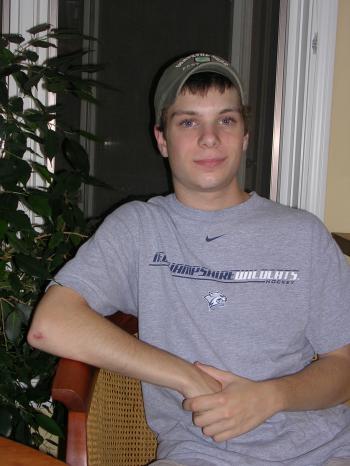 2005 Cape Elizabeth High School graduate Jack Malcolm was evacuated from Tulane University in New Orleans his first day of his freshman year. He and his parents had seperate, but equally interesting, paths home to Maine.
Comments are no longer available on this story