
Cape Elizabeth fourth-grader Ysanne Bethel made sure to spit in her hands before holding the salamander the students in Ingrid Stressenger’s fourth grade class had found under a rotten log.
For most of the students in the class the salamanders were the highlight of a Tuesday field trip to the 82-acre Robinson Woods in Cape Elizabeth.
The students of Mrs. Stressenger’s class traipsed along one of the trails, being stopped along the way by Suzanne McGinn, co-chairman of the Cape Elizabeth Land Trust’s Education Committee, to learn about the food web or how animals and plants adapt to their environment.
She points out a rotten log, which provides a home for mushrooms, salamanders and bugs, or a vernal pool, which she explains is special because it only exists in certain seasons and creates a unique habitat for certain indicator species in the spring.
The field trip was a part of an educational program designed by the Cape Elizabeth Land Trust in collaboration with the fourth-grade teachers at Pond Cove Elementary School. A different land trust member takes each fourth-grade class on these nature walks. In addition to this autumn walk, the classes will return with their land trust guides in the winter and spring.
Fourth-grader Jesse Mayo, a self-proclaimed herpetologist, spent most of his time searching for salamanders under rotten logs. “I’ve liked lizards since I was one when my mother gave me my first dinosaur book,” Jesse said.
Some students were not satisfied with salamanders. “I’ve been hoping to see a porcupine,” John Kennealy said. He put a “porcupine encyclopedia” on his Christmas wish list even though he doesn’t think one exists.
McGinn stops the group of students at a large pine tree bristling with thick, dead branches and covered with large oval-shaped holes.
“Do you know what created those holes?” McGinn asks the group.
“A woodpecker,” many of the students yell out. McGinn goes on to tell them about what kind of woodpecker it was and why the woodpecker was making those holes – to get to the bugs. She also imparts a bit of little-known trivia: Because the heads of woodpeckers are so hard and stand up to so much pounding they were studied by people to improve the design of football helmets.
At one spot McGinn plays a game with the class to illustrate how a food web works. The students formed a circle and McGinn gave the end of piece of yarn to one student. The ball of yarn was passed around as one student linked whatever animal, plant, fungus or nutrient they had said with whatever the next student said.
Soon the blue yarn was creating an intricate web in the middle of the circle. One student said it looked like a big spider web. Once everybody held a piece of the yarn, McGinn yanked one section of it to illustrate how one little disturbance in the web can affect everything.
The favorite part of the trip for Ysanne Bethel and Daniela Salavar was holding the salamanders.
“The salamanders really liked me,” Ysanne said. “Maybe you spit on your hands more than other people,” suggested Daniela.
Elise Flathers said she liked holding the salamanders as well, but she also liked those “mushrooms that smoke.” Emily Wasserman agreed, but said she also enjoys just walking through the woods.
The nature walks designed by the land trust are the first attempt by the organization to expose children at Pond Cove to the land trust and the natural treasures that are right in their backyard.
“To be able to give them some exposure to the land trust while they’re at Pond Cove is wonderful,” McGinn said. “To foster an appreciation of what they have in their backyard is better in the long run.”
McGinn said Robinson Woods contains the only place where vernal pools are preserved and monitored every spring by the Maine Audubon Society, the only old growth forest in town and “species you don’t see anywhere else in Cape Elizabeth.”
Stressenger said the new collaboration with the land trust gives the students an appreciation for what they can find in their own backyard. She said the classes used to occasionally take field trips to Maine Audubon in Falmouth, but “why go there when we have this great trail system right here in our own town.” She also said that the new curriculum is tied to the Maine Learning Results.
The land trust is also creating a resource center at Pond Cove that will be available to teachers for use in their ecology and science curriculums.
It will include books, videos, posters and even some endangered species items provided by the federal government for educational purposes. The items include a carved ostrich egg, a walrus tusk and a python belt, “just crazy things that were basically confiscated at customs,” McGinn said.
 Fourth grader Ysanne Bethel, right, passes a salamander to her classmate Elise Flathers on their nature walk through Robinson Woods.
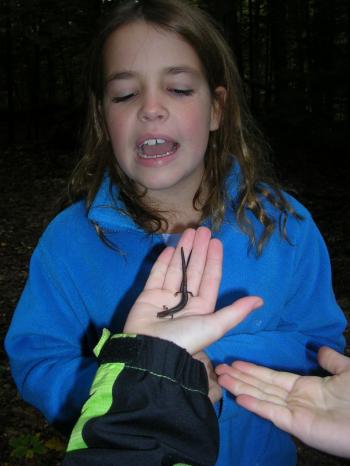 Fourth grader Nina Flight looks at a salamander in the hand of one of her classmates.
Comments are no longer available on this story