
When Ed Gillander brought his shrubs home from Vermont in the 1950s, they were just knee high. Last month they stood above his head lining the front yard of his Cape Elizabeth home like soldiers guarding a fort.
Today, they’re more like soldiers wounded in battle, standing crookedly – slightly mangled from being dug up after 50 years and then replanted – backwards.
This is just some of the fruit borne from the $5.4 million sewer reconstruction project in Cape Elizabeth. The exstensive project begun in early May will take all summer. The town will rebuild sagging, root infested and misaligned sewer pipes, replace damaged manholes, and reconstruct roads in the process. Seventeen areas in town will see repairs to their roads and sewers.
Gillander and other residents in the Elizabeth Park neighborhood feel as though the town could have done a better job notifying residents of the impacts of the project.
Cape Elizabeth Town Manager Mike McGovern said the town sent out notices to all residents informing them of the project and also held at least two informational meetings for each neighborhood undergoing reconstruction. The project has been divided into three sections, the Southern, Central and Northern regions, each handled by separate construction companies. In all, the project will cover 17 problem areas.
McGovern said the meetings were “lightly” attended and that he hasn’t heard any complaints or additional questions from residents since the project began in early May.
Elizabeth Park resident Dan Reed said there were few details about the scope of the work released to the residents.
Reed endured a sewer flooded with waste-water in his own home during the project.
Ironically enough, Reed, an engineer, recently returned from Massachusetts where he was supervising a similar sewer project. Glitches like sewer back-ups and other unpleasantries are often unavoidable, he said. “Filthy dust all day long, that’s stuff you expect,” he said.
However, open communication with the residents about potential changes to their property is integral to any well received project, he said.
With the road widening in his neighborhood, Gillander does not know if he’ll even be able to keep his hedges. Nobody can seem to answer that question for him.
“I still don’t know what I’m going to lose due to the new width of the road,” said Gillander. The Elizabeth Park neighborhood roads will also be repaved during the sewer restoration.
According to OEST, the South Portland engineering company who constructed the sewer work plan, the work in the Elizabeth Park neighborhood will continue until fall. OEST posts a weekly blog update for the sewer project on www.oest.com.
Gillander said the town’s education process was inadequate. “They should have been more clear,” he said. “There was no explanation of road widths or people losing their hedges.” He feels it was the town’s responsibility to notify people about project details.
McGovern maintains the town upheld its responsibility to the residents. “We have invited people over and over to come look at the plans…we’ve invited them to meetings. If they don’t come, I don’t know what we’re to do,” said McGovern.
When Gillander left his home that day, his hedges were standing tall, but when he came home later they were laying on the sidewalk. “I wasn’t here the day they did it…They didn’t ask permission,” he said.
Husband and wife Doug Wilber and Susan Farady were relieved when the construction company was finished digging up their stretch of sewer and road. Their lifestyle was hindered as they unexpectedly lost water, were subject to an impromptu inspection and sacrificed some limbs all in the name of the project.
“It’s a comedy of errors,” said Wilber.
Farady endured the inconveniences with little complaint because she realized the project is necessary, but she was perplexed when she glanced out her window and saw a man in a hard hat approaching a tree in her front yard with a chainsaw. “They were starting to chop the tree down,” said Farady.
Farady ran outside and interrogated the workers. They replied that they needed to chop off a few limbs for the project. So she let them, but she and Wilber would have appreciated more open communication between the town, construction company and residents. “You just wish you could get a little advance notice,” said Wilber.
McGovern said people should anticipate temporary changes while the roads are being dug up. He suggested residents approach on-site construction supervisors if they have concerns or questions about the project.
When Gillander found his hedges uprooted, that’s just what he did. Unfortunately, at this point he doesn’t anticipate it reviving his plant life. Though the Dearborn company crew amiably replanted the hedges, Gillander said the damage is so extensive, they’re “hardly worth saving.”
McGovern said he realizes the construction is interrupting people’s lives. “During the project, it’s not going to be pretty,” he said, but it is a necessity.
When OEST drafted the sewer plan in 2004, they identified several problems, which the new project will remedy: cracked pipes, defective manholes, sagging sewer lines and root blockages amongst others. They also found that while some parts of the system are only a year old, other parts are 100 years old.
Gillander recognizes the need for the project but is displeased about the process and said his neighbors are too. “If you find anybody here who’s satisfied, I’d be surprised,” he said.
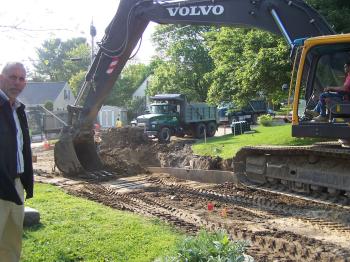 Cape Elizabeth resident Dan Reed could not access his driveway Tuesday night due to the gulley carved out by Dearborn construction for the sewer reconstruction project in the Elizabeth Park neighborhood.
Comments are no longer available on this story