
Christine Rousselle falls asleep and wakes up to the gadgets that surround her – literally. She uses her iPod as an alarm clock.
Rousselle, a sophomore at Scarborough High School, is a typical teenager, overloaded with extracurricular activities. From hockey to Key Club, dance class to debate team, Rousselle never stops. And she is equipped with everything she needs – whether it’s to keep in touch or capture the moment – while she’s on the go.
“I carry my life in my purse,” Rousselle said as she rustled through her bag. From within a mountain of makeup emerged a cell phone, a digital camera and an iPod – all things she carries around with her at school.
“His name is Scott,” she said of her iPod, which she keeps in a bright pink case. Rousselle, 15, got her first iPod in eighth grade. “Scott” is her third.
Rousselle and members of her generation seem to have a more personal relationship with technology than the generations that have come before them. Last month, Maine Public Broadcasting aired a program called “Generation Next,” for which journalist Judy Woodruff spent a year traveling around the country interviewing the 16- to 25-year-olds who make up this age group. The Currrent is also looking at the lives of teenagers in Scarborough, Cape Elizabeth and South Portland. In an ongoing series of stories over the next few months, The Current will take a deeper look at the interests, concerns, passions and trends of the communities’ teenage residents.
Of teenagers ages 12 to 17, 87 percent use the Internet and about half are online every day, according to a 2005 study conducted by the Pew Research Center, based in Washington, D.C. The same study found that 45 percent of teenagers own cell phones and one-third have used one to send a text message.
Two-thirds of teenagers use intant messaging, and of those, half do it every day. Though overall, Internet usage has increased since the last study, conducted in 2000, the recent study indicates that teenagers still spend less time communicating through the use of technology than they do interacting face-to-face through social activities outside of school.
Woodruff, in an interview last month, said one of the things she learned about the young adults in this generation is that they are “defined by technology.” Whether it is a cell phone that holds an entire network of numbers or an iPod that carries music collected over the span of a decade, electronics contain of both practical and sentimental value for teenagers.
The inclination of teenagers to keep these prized possessions close at hand has caused schools to implement rules and regulations regarding the use of the new technology. Rousselle said she had used her iPod more, but teachers began putting restrictions on in-class use. Principal Pat Conant said that regulating iPod use is up to individual teachers. There is a school-wide rule that cell phones must be turned off during school hours. Rousselle used to use her cell phone to text message throughout the day, but her phone no longer has the capability.
“My mom took it off when she found out I was texting in biology,” Rousselle said.
Though excessive use of technology has led to the implementation of some new rules and regulations, there are other ways in which students have used their knowledge of modern technology for more than entertainment.
In today’s high school classrooms, presentations are enhanced by PowerPoint tools. At home, students can collaborate on assignments or seek homework help from their peers through instant messaging online. In one particularly creative moment, Rousselle used her digital camera to snap a picture of notes written on the blackboard when she didn’t have time to write them down.
Rousselle admits to the fact that talking to friends online and checking Web sites like facebook.com – a social networking site that connects people who attend the same school – slows down her studying, but her Internet usage stems from a genuine interest in the events that surround her and a desire to be a part of them.
“There’s security in feeling connected,” Rouselle said, and that doesn’t just mean to her social network. Every time Rouselle opens her laptop, the first thing she does is scroll through the latest news stories. “There’s a whole world out there,” she said, “and I want to know what’s going on.”
Though Rousselle’s parents have put restrictions on her Internet use, she claims she’s “on the same as anybody else.”
Alex Whittemore, a junior at Scarborough High, will be the first to admit his use of computers – and electronics in general – far exceeds the norm.
While his parents fill their home with collectables, like woven baskets and old scales, Whittemore, 16, stocks the basement with computer parts. As far as fully assembled, functioning computers go, he has eight. “This is not what you’ll usually find,” he said.
Though Whittemore has delved deeply into his hobby of fidgeting with gadgets, don’t mistake him for a stereotypical computer geek. Like Rousselle, he participates in a wide array of extracurricular activities, like Academic Decathalon, Environmental Club of Scarborough, skiing and lacrosse.
And Whittemore insists he uses his iPod and cell phone just like any normal teenager would. However, just using it is not enough. Whittemore said his cell phone has been “open and in shambles on the counter” several times. He also likes to “poke and prod” around the software in his iPod.
Despite the overflowing bins of computer parts that are stored in the basement or the amount of electricity used by her son’s several computers (he’d like to buy them a solar panel), Whittemore’s mother, Bethany, is not concerned that her son spends too much time with his technology.
“In the way we always used to be on the phone, these kids are on the computer, having conversations online,” Bethany Whittemore said.
However, she hasn’t always been comfortable with her son’s Internet usage. A few years ago, Alex Whittemore met a friend online who lived in Columbia. The two shared an interest in technology and have remained friends by talking to one another online.
Bethany Whittemore said she was initially wary of the relationship because she didn’t know whether her son’s friend was who he claimed to be – a 13-year-old boy. Since then, Whittemore has become convinced that the boy is, in fact, a teenager like her son, but she said she understands why parents are sometimes afraid of their children’s online activity.
“It’s a different outlet, and it’s sometimes hard for parents who aren’t fluent in it,” she said. Though she admitted that there are always extreme cases, it’s not realistic to “blame the computer.”
Alex Whittemore said he has some peers who could be considered extreme in their use of the computer, particularly online gamers who spend up to 30 hours per week at their hobby, but he doesn’t think it’s necessarily a bad way for these teens to be using their time.
“My friends who play video games aren’t the ones who get stoned on weekends, or after school, for that matter,” he said.
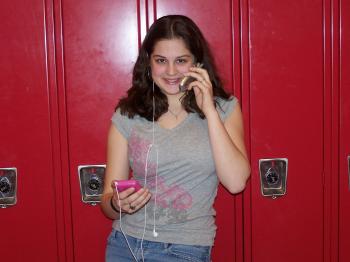 Christine Rousselle talks on her cell phone and listens to her iPod. She says she is a typical teenager in her use of technology.
Comments are no longer available on this story