
Got wildlife?
Every year, the Center for Wildlife typically treats more that 1,500 birds, mammals and reptiles representing more than 100 species.
Anyone who finds an injured animal should keep it in a warm, dark, quite place away from humans or pets, and then immediately contact the center at 361-1400.
For more information, log on to www.yorkcenterforwildlife.org
When Linda Woodard was teaching a canoe tour group about the hazards of leaving fishing line in the marsh, she never expected they would get to see its effect first hand.
On June 30, as Woodard, director of the Scarborough Marsh Audubon Center, led a group of about 30 people on a full moon canoe tour around the marsh, she spotted fishing line in the water. She told the canoeists about the danger it poses to wildlife when fisherman cut their snagged lines. As Woodard pulled the line into the canoe, it became apparent that the line already had a victim – an American Herring Gull was attached to the line by a hook on the end.
The evening cruise soon became a rescue mission, as Woodard jumped out of the canoe and scooped up the bird. One member of group rushed home to get her beagle’s crate to house the bird. Woodard monitored it overnight and brought it to the Center for Wildlife in Cape Neddick in the morning.
According to veterinarian Dr. Gerry Beekman, who took an X-ray, what he saw was “very dramatic.” The bird had two hooks – one that was dissolving in its stomach and another than was stuck in its esophagus.
“The bad deals are the ones that get hung up,” said Beekman, who started the Center for Wildlife in his back yard in the 1980s. Though now Beekman mainly works with felines at Coastal Cats, his clinic in York, he still helps out with creatures that come into the center when he’s needed.
Beekman said he made a small incision and removed the hook from a hole in the side of the bird’s neck. The hook in its stomach will dissolve on its own, he said.
After the operation, the bird returned to the center and was administered antibiotics. When it was well enough, the bird got the chance to play in the center’s pool enclosure and take some test flights.
“The wound healed beautifully,” said Lorisa Ricketts, rehabilitation supervisor at the Center for Wildlife. Ricketts said she was already confident that the bird would be able to fly before it was successfully released back into the marsh on July 11.
“He was ready to go,” she said.
According to Ricketts, the center sees a few cases each year – mostly in the summer – where wildlife gets snagged on fishing equipment. She said there is a bulletin board with all of the objects that the center dislodges from animals.
“It’s unfortunately a common sort of thing,” she said.
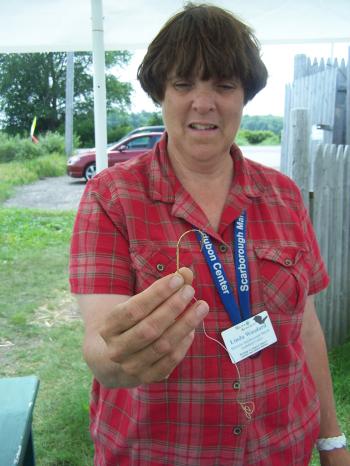 Linda Woodard, director of the Scarborough Marsh Audubon Center, holds the hook that was lodged in the esophagus of an American Herring Gull.
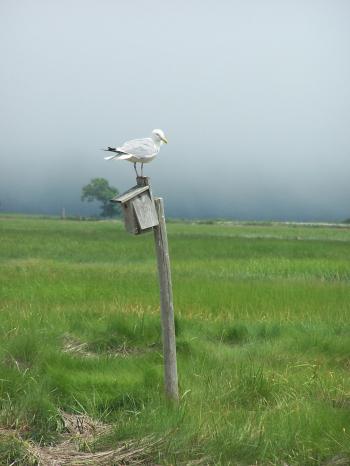 An American Herring Gull perches on a birdhouse before taking its first flight after surgery to remove a hook caught in its throat. The wounded bird was discovered by members of a canoe tour on the Scarborough Marsh.
 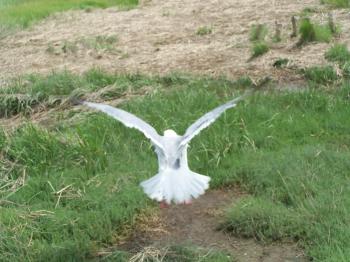 An American Herring Gull tests out its wings before taking its first flight after surgery to remove a hook caught in its throat. The wounded bird was discovered by members of a canoe tour on the Scarborough Marsh.
Comments are no longer available on this story