
South Portland resident Phil Gaven placed a mail order for honey bees in 2008 and set off to share with neighbors the exciting news that he planned to keep a backyard hive and harvest the sweet rewards.
But then a homeowner in Gaven’s densely developed Willard Beach neighborhood raised concerns that her young son might be allergic to bees.
Gaven quickly put the word out to friends and associates that he needed to find a surrogate home for his brood – and fast. A colony of Russian bees and a queen would be arriving any day.
It turned out not to be a problem. Brett Bigbee, an avid gardener who lives nearby, soon volunteered his yard, though the two men had never met.
Bigbee, who grows vegetables and has a few fruit trees, wanted to reap the benefits of having pollinating bees without the responsibility of tending to them.
Just like that, Gaven was back in business as South Portland’s first and only registered beekeeper.
In 2008, the South Portland City Council spent several months developing rules to regulate beekeeping in South Portland, after a resident complained about a backyard hobbyist, who later moved his hive out of town.
The issue became contentious, with some councilors raising questions about safety from swarming bees. But numerous people stepped forward at council meetings to support the idea, as did the Maine State Beekeepers Association.
Today Gaven is the only resident to register a backyard hive. He is required to meet numerous conditions on the setup of the hive and care of his bees. But it is worth the work, he said.
“I always thought that was an interesting and unusual pastime. A couple of years ago I read at length about the plight of honeybees and colony collapse disorder and decided I would like to be part of the solution,” said Gaven, a first-time beekeeper.
Gaven, who refers to himself as the neighborhood bee ambassador, has had early success with his unusual pastime.
Last fall, he collected 29 pounds of goldenrod honey from his hive, although veteran beekeepers had cautioned to expect a much smaller harvest, if anything at all, when starting a new hive.
“I am trying to keep the hive without using any pesticides or antibiotics, which requires that I be attentive to what’s going on inside the hive and proactive about finding natural remedies if the hive encounters disease or pests,” said Gaven, who also raises chickens at his home.
Gaven has no plans to sell the honey, though he tries to give it away as a goodwill gesture to friends, neighbors or just about anyone who comes by with questions.
Ross Little, who lives near Gaven, describes his friend and neighbor as “a remarkable man.” Little said he uses Gaven’s honey in his tea.
“It’s the best honey I ever tasted. Phil is a good friend, which makes it all the more special.”
Little admits that he thought “Phil was over the top and nutty as a fruitcake” when he first proposed the idea of keeping a beehive.
“I thought it was a crazy idea. Here we are living in this densely packed neighborhood,” he said. “But Phil made it work.”
Gaven said he is discovering new uses for his honey all the time, explaining that it has anti-bacterial properties. Some people say that honey works as well as Neosporin ointment for scrapes, he said.
Bigbee works in his garden just few feet away from Gaven’s hive. He pays the honey bees little notice. “I guess you would say we respect each other,” he said smiling. “We give each other space.”
Bigbee said he has not noticed the bees working a lot in his garden so far, though he has watched several make a “beeline” to collect nectar from trees and flowers in neighboring yards.
Gaven wears protective clothing to protect himself from stings but described bees as docile and not aggressive. He said that honey bees tend to collect nectar within a 6-mile radius of the hive.
Gaven’s passion to raise chickens for eggs and bees for honey comes from his interest in community-based farming.
He is a vocal critic of “the industrialized model of monoculture agriculture” in the United States. “Neighborhoods like ours become an ideal place for honey bees to thrive,” he said.
Gaven said that while beekeeping does not require extensive knowledge of bee biology, he has been inspired to read a lot on beekeeping history and the important role bees play in food production.
“Without learning anything about the bees’ life cycle and the local environment, one could keep a beehive, follow a yearly set of instructions, and generally have a healthy hive and a harvest of honey,” Gaven said. “I choose to learn everything I can about the bees, and the hive, and the environment around them because it interests me personally.
“Right now, bees face dozens of challenges from pests and diseases that have been imported from around the globe. Without a human tending the hive, the chances for survival of a colony for more than a couple years are quite slim,” he said.
Gaven notes that fellow hobbyists joke that beekeepers develop their pastime because of the bees and quit their hobby because of the honey. A healthy hive produces an abundance of excess honey.
“I probably have a little honey almost every day,” he said.
Gaven said one of his most enjoyable roles is showing his hive to visitors. “I like when newcomers come by to visit the hive and we stand around, as Yeats put it, ‘alone in the bee-loud glade.’ ” The bees come and go and pay very little attention to us.”
 Phil Gaven holds a tray of honeybees as he looks for the queen bee. Last year, he collected 29 pounds of honey from the hive.
 Phil Gaven stands next to the hive where he raises Russian honey bees. Gaven is the first and only registered beekeeper in South Portland.
 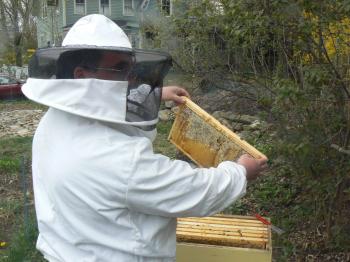 Phil Gaven checks the health of his honey bee hive, which is located in the Willard Beach neighborhood.
Comments are no longer available on this story