
Cape Elizabeth farm joins trend of community supported fisheries
Community supported agriculture works for lettuce, so why not lobsters?
That’s the thinking behind a new initiative by Alewive’s Brook Farm in Cape Elizabeth that gives customers the opportunity to buy lobster “shares” that will support the lobstering side of the business at the family-owned farm.
Consumers are increasingly familiar with community supported agriculture shares — or CSAs. Consumers pay a farmer in winter for a share of that farmer’s vegetable crop in the summer. Getting payment upfront gives the farmer the financial backing to be able to grow the vegetables that go to consumers.
Now, at Alewive’s Brook Farm, customers can become a lobster shareholder for $300 and then get delicious dividends from June 1 to Sept. 30 in the form of $325 worth of fresh lobsters and clams.
The deal is not just a bargain for consumers. The money invested upfront also will help the lobstering Jordan family that owns the vegetable farm – and the other Cape Elizabeth lobstermen whose catch the family also sells at their farm stand. They’ll use the money to pay for traps, gear and other fishing expenses.
“It helps the community by helping the lobstermen,” said Caitlin Jordan, the farm’s business manager who initiated the farm’s new Community Supporting Lobstermen, or “CSL,” share offer.
Although the Jordans have their own name for their initiative, what they have created is also known as a community supported fishery or CSF. Community supported fisheries – which apply the community supported agriculture model to seafood – are a small but growing trend in Maine.
Growing interest
There’s strong customer demand to buy community supported fisheries shares, according to Adrienne Lee. She’s a farmer from Jefferson, and organizer of the community supported agriculture fairs held around Maine each winter for the past few years.
“I think there’s a huge interest in the greater Portland area for sure,” she said. Customers are as eager to get locally caught seafood as they are to get locally grown vegetables, she said.
However, she said, while fishermen were invited to the annual community supported agriculture fair held in Portland this February, none were available to come to the fair, although some attended a similar fair in Brunswick.
That’s because, so far, there’s a scarcity of Maine fishermen involved in community supported fisheries.
However, a group called the Northwest Atlantic Marine Alliance is now working to promote community supported fisheries in Maine.
“Southern Maine is a big priority for us,” said Brett Tolley, a community organizer with the alliance. The nonprofit group, based in Gloucester, Mass., has a mission of restoring and enhancing the marine system so that it is healthy, sustainable and able to support an abundance of diverse marine life as well as human uses.
Tolley said that community supported fisheries have social, economic and environmental advantages.
When local fishermen develop a large shareholder base, they forge a direct connection between themselves and their customers, he said. Those customers gain a better understanding of the challenges fishermen face and can serve as a political base of support to help local fisheries succeed, he said.
Also, through community supported fisheries, Tolley said, fishermen learn that there is a market for high quality fish caught in an environmentally friendly way.
“It’s an incentive to fish in a sustainable way,” he said.
He said the alliance is learning from experience how community supported fisheries work best.
“CSFs are effective when a group of fishermen work together,”Tolley said. “In southern Maine, we made the mistake of thinking that the fishermen could do it individually and that is not sustainable at all. There is a lot of work involved and a cooperative, community-based approach is critical to sharing the workload and the burden.”
He pointed to Port Clyde Fresh Catch as a “great model of a sustainable CSF.”
Port Clyde Fresh Catch is run by a group of fishermen that form the Midcoast Fishermen’s Cooperative. Port Clyde in 2007 began the first community supported fishery program in New England, according to the alliance.
Jessica Libby, business manager at Port Clyde Fresh Catch, said the program started with a small number of shareholders that grew to 320 last summer. She said it’s hoped that the number will increase again this summer, because Port Clyde will be offering crab meat and whole-cooked lobster in addition to the variety of wild-caught Maine fish that they have offered previously.
She said the fishermen in the co-op harvest their catch using environmentally sustainable fishing methods that do such things as reduce bycatch, or unintentionally caught fish.
“We’re not only trying to create a better market structure for fishermen, we’re also trying to preserve fisheries,” Libby said.
Shares at Port Clyde cost $20 per week for an amount of fresh seafood that Libby said can vary from approximately 1.5 pounds to about 3 pounds, depending on what seafood is offered that week and its market price. Libby said customers can’t specify in advance what they want. “It’s the catch of the week,” she said. “It’s basically what we have available.”
Customers can sign up for as many shares as they want for as many weeks as they want during a 16-week period running from June through September.
They also can choose from a wide variety of locations throughout Maine to pick up their deliveries. In southern Maine, the locations include Brunswick, Freeport, New Gloucester and Windham. Most of the pickup locations are at farmers’ markets. In Windham, for example, pick up will be at the Lakes Region Farmers Market on Roosevelt Trail on Saturdays from 8 a.m. to 12 p.m. from June 12 to Sept. 25.
A unique take
At Alewive’s Farm in Cape Elizabeth, the Jordans say their new “community supporting lobsterman” approach is a unique take on the community supported fisheries idea.
For one thing, the shares customers buy are just for lobsters and clams, not fish.
Also, there will be one convenient pickup location: at the farm at 83 Old Ocean House Road, seven days a week from 9 a.m. to 6 p.m., June 1 to September 30.
The Jordans already have a retail operation at the farm, where they sell the farm’s fresh produce. They also have large tanks where they sell lobsters.
Jodie Jordan and his wife, Patricia, run the farm with the aid of their four children, Tucker, Caitlin, Casey and Lincoln, who range in age from 29 to 20. The farm’s Web site reads: “Alewive’s Brook Farm: Where Family is Everything.”
Besides being farmers, everyone in the Jordan family is a lobsterman, according to 20-year-old Lincoln, who is earning a degree in horticulture to help run the farm.
Caitlin, 26, who is a lawyer as well as the farm’s business manager, came up with the idea of the farm selling lobster shares.
She said she’s hoping that with lobster prices low, on par with steak, the share plan will encourage customers to buy more lobster.
“You eat hamburgers and steak once a week, why not make lobster a routine?” Caitlin said.
And getting a share doesn’t mean you have to eat $325 worth of lobsters or clams at one sitting or even each week.
“They don’t have to take it all at once,” Jodie said. People can get just one or two lobsters at a time or 10 or more for a dinner party.
Shareholders also can take lobsters with them when they go on a trip. And if they have out-of-town guests visiting them, Caitlin said, having the lobsters already paid for eliminates arguments with guests at the cash register over who should pay. “That’s already been taken care of,” she said.
The seafood will be sold at market price, and shareholders have the entire summer to decide when they want to get it.
The Jordans’ initiative involves not just them but other lobstermen. The family says that shareholders will be not only “supporting the lobstering efforts of Alewive’s Brook Farm but many other Cape Elizabeth residents who sell their lobsters at the farm.” Buying a share, the Jordans say, guarantees that those lobstermen will have a place to sell their catch.
Alewive’s Brook Farm is a member of the Cape Farm Alliance, of which Penny Jordan of Cape Elizabeth is president.
Jordan runs the William H. Jordan Farm at 21 Wells Road along with her siblings. The farm sells community supported agriculture shares each year.
Jordan said she was delighted to learn that the Jordans at Alewive’s Farm — she’s a distant cousin of the family – are now offering the lobster shares.
“I think it’s fabulous, I really do,” Jordan said. “The more we can do individually and collectively to create opportunities for farms and fisheries in our state, the more viable both industries will be.”
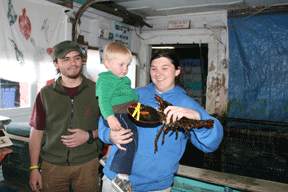 Caitlin Jordan of Alewive’s Brook Farm shows a lobster she has pulled out of a lobster tank in the farm’s retail store to her nephew, Sam, while her brother, Lincoln Jordan, looks on. The farm in Cape Elizabeth is now offering customers the opportunity to buy “shares” of lobster and clams. For $300, customers will get $325 worth of seafood they can pick up at their convenience all summer. The money will help the Jordans and other lobstermen pay for their fishing expenses. (Staff photo by Tess Nacelewicz)
Comments are no longer available on this story