
SCARBOROUGH – In less than an hour Sunday, more than 30 volunteers at Pine Point Beach picked up close to 1,000 cigarette butts and 325 pieces of plastic and other discarded items on a one-mile stretch of the beach around Hurd Park.
“We know from previous events and the tallies from national and international cleanup efforts that cigarette butts are the No. 1 thing picked up” at beaches, said Scarborough resident Peter Slovinsky, a member of the Surfrider Foundation of Northern New England, a local chapter of a national organization that aims to protect and preserve oceans. That group joined the statewide 2010 Maine Coastweek for beach cleanup duties.
Old soda bottles, food wrappers and plastic bags were also among the items volunteers have been removing from beaches across the state this week. Slovinsky said the Surfrider Foundation of Northern New England developed a partnership this year with Healthy Maine Partnership for the theme of “No Butts on the Beach.”
“Cigarettes also discarded on land end up on our streets, in our sewers, in our rivers and then on our beaches,” said Slovinsky.
Slovinsky said he saw this first hand last month when a cleanup of a one-mile section of Old Orchard Beach yielded 3,000 cigarette butts.
A citizen proposal before the Scarborough Town Council Ordinance Committee targets this problem. Black Point Road resident Sharman Kivatisky approached the Town Council about adopting an ordinance to make all beaches in Scarborough smoke free, similar to the statewide smoking ban in state parks and beaches.
Slovinsky agreed that such an ordinance could help, but the best way to keep beaches clean is through education, he said – informed people will think twice about what they haphazardly throw out and where it could end up.
As part of the educational push, Slovinsky said it was important to engage local students in these cleanup events because “students are already interested in environmental advocacy through their schools and will be the ones leading us into the future.”
To that effort, Slovinsky reached out to environmental groups at Scarborough Middle School and Scarborough High School to generate interest in cleaning up the beach. A number of students from both schools, he said, took part in Sunday’s cleanup.
“The focus needs to be on education,” he said. “The easier you make it for people to understand, the more likely they will be to change their practices.”
In past years, Slovinsky said, it wasn’t uncommon to find rubber bands from lobstering, random plastic pieces, paper and plastic bags and other discarded trash.
“Whatever you can think of, you’ll find during one of these cleanups,” he said.
Peter Milholland, the citizen stewardship coordinator for Friends of Casco Bay, is familiar with what could be found washed up on the shore through his previous participation with statewide cleanup efforts, especially at Bug Light Park in South Portland.
“Bug Light is an area we have been doing coastal cleanups at for 15 years now,” said Milholland, who will organize a cleanup effort on Saturday, Oct. 2, from 10 a.m.-noon, on behalf of Friends of Casco Bay. “We have indicated Bug Light as an area to do cleanups year after year and want to continue to keep that area clean and make the space a better and cleaner spot for people to enjoy.”
He said the cleanliness of the park has improved substantially in recent years. It was not uncommon years ago, he said, to find bags of household trash. The trash, while still substantial, has decreased, he said.
Lots of cigarette butts and cigarette ash are found both on the walking path near the water and the parking lot above the park, he said. Lobster trap ropes, lumber from nearby docks and Styrofoam are typically found in rocks by the water. The trash found by the parking lot commonly includes food wrappers and soda cans, said Milholland, who added that controlling the trash left on beaches requires a simple, carry-in, carry-out approach for both beachgoers and passing boaters.
According to the Ocean Conservancy, a Washington, D.C.-based advocacy group for a healthier ocean ecosystem, during the 2009 International Coastal Cleanup, 1,810 volunteers combed 116 miles of Maine coastline looking for trash and debris. In total 53,676 items were found, including 3,279 plastic and paper bags, 3,933 plastic and glass bottles, 3,366 food wrappers, 1,149 buoys or floats, 3,301 pieces of rope, 673 lobster/crab/fish traps, and 27,384 cigarette butts
“The problem,” Milholland said, “is a lot of marine species see this trash as food and end up ingesting it, which causes all kinds of problems.”
Fishing lines, nets and rope, Milholland said, can also pose a risk to marine life as they can strangle and choke them. The Ocean Conservancy indicated it could take 600 years before fishing lines decompose in the water. Plastic grocery bags can take up to 20 years, aluminum cans up to 200 years and plastic bottles up to 450 years.
David Critchfield, chairman of the South Portland Conservation Commission, said his group decided to participate in Coastweek this year by cleaning up Spring Point after hearing about how successful the Friends of Casco Bay have been in keeping Bug Light Park clean. Critchfield said the topic was brought up at a recent Conservation Commission meeting and generated unanimous support of the commission members.
“We’ve got members who are very interested in hands-on conservation efforts,” he said.
The cleanup efforts will primarily be focused on the beach, the jetty leading out to the lighthouse and the surrounding area. The effort, he said, could include parts of Willard Beach, as well.
Environment Maine, a statewide environmental advocacy group, has listed Willard Beach as among the top 10 worst beaches in terms of water quality.
Critchfield said he hopes that in the long term, groups continue to commit to cleanup efforts on South Portland beaches with the possibility that a team of volunteers could be responsible for each beach in the city.
The Bank of America has, through its environmental outreach efforts, taken on the responsibility of cleaning up 15 beaches across the state through Maine Coastal Cleanup Week.
“Beyond Bank of America’s commitment to the environment, we do these cleanups because it is fun and a great team-building experience, but also because we frequent these beaches. We take our families there. We picnic there,” said Cindy Polk, who is organizing Bank of America’s involvement in the event, which included a Sept. 28 and Sept. 29 cleanups at Ferry Beach in Scarborough.
“We really want to give back and keep the beaches clean,” she said.
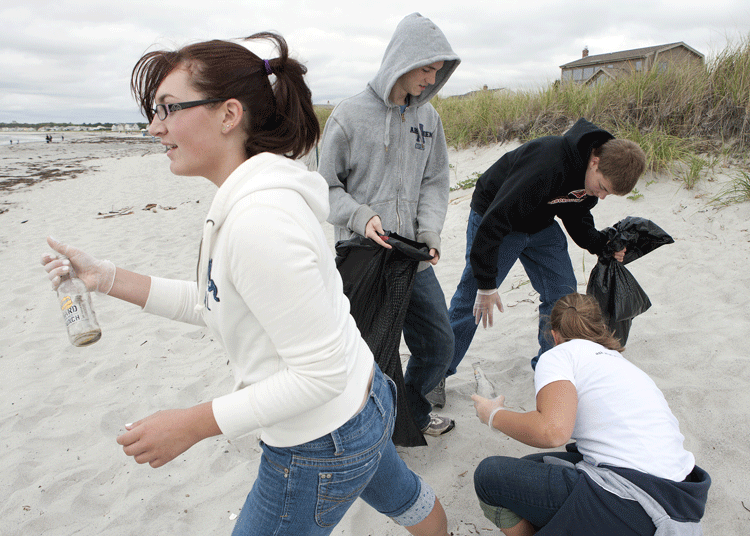 The party was over a while ago, but the liquor bottles remained, buried in the sand at Pine Point Beach in Scarborough. Rachel Hatem reaches for a trash bag as fellow Scarborough High School juniors Michael Diclemente, DJ Farley and Laura Hirshberg dig out the rest during a cleanup event on Sunday. (Photo by Rich Obrey)
Comments are no longer available on this story