
WINDHAM – The town of Windham is starting to get serious about what it has long brushed under the carpet: issues of winter maintenance on private roads.
Windham has a total of 128 miles of private roads that have a public right of way. In 1994, the town established a policy stipulating that the town would provide winter maintenance – namely plowing services – to all private roads with a public easement that existed in the town at the time.
However, as the years have gone by, issues have arisen regarding winter maintenance. Commodity prices on materials such as salt and sand have increased exponentially. The number of town-accepted private roads is multiplying with urban sprawl, forcing the town to spend more on plowing and vehicle maintenance. Also, and probably more importantly, some grandfathered private roads have been allowed to deteriorate by road associations that can’t afford expensive road reconstruction projects such as culvert installation, tree and vegetation removal, or ditching.
In an effort to prepare for ever-increasing urban sprawl and ensure plowing and emergency response is safe and quick for residents along these private roads, town leaders have been meeting for more than a year to discuss how to handle the growing issue.
The issue is a sensitive one, especially with much of Windham’s tax dollars generated by private road residents who feel they already get little in return for their taxes. But other residents don’t particularly want to see their taxes spent maintaining the hundred-plus miles of private roads either.
So, with this as a backdrop, town leaders are finally addressing the complicated and long-ignored issue in hopes of finding a middle ground that has a minimal impact on taxes and increases public safety.
Task force
The group assigned to find a solution for eventual consideration by the Town Council, the Roads Policy Task Force, has been debating the issues for more than a year. Council liaison John MacKinnon said the task force’s recommendations would come before the full council in coming weeks as the group reaches consensus and makes recommendations.
According to MacKinnon, the group has three initiatives. The first is creating a page on the town’s website that would serve as a “resource library” for road associations and those residents who live on private roads who have yet to form an association. The webpage would instruct residents on how to form a road association and give tips on proper maintenance of a dirt road.
Secondly, with so many existing road associations having to buy materials on a constant basis to reconstruct and repair their roads, the task force hopes to organize collective bidding for materials such as dirt and crushed rock. By buying in bulk through a central clearinghouse such as the Greater Portland Council of Governments, road associations can save money, MacKinnon said.
Lastly, the task force is proposing the establishment of a new committee that would visit each grandfathered private road and evaluate whether it meets standard, which would differ for each road, MacKinnon said. Only public easement roads, which are roads on which the public can legally travel, would be subject to the new regulation. Private roads, which are often essentially long driveways with one or two houses, would be exempt from the review process since they don’t currently receive winter maintenance by the town, per the 1994 policy.
The road review committee would be made up of the public works director, the fire/rescue chief, a council representative and several residents. The committee would review a third of all public easement roads each year and suggest ways the road can be improved to provide safe passage for both residents and emergency responders.
“This will be a benefit to homeowners,” MacKinnon said. “The committee would oversee implementation of a work plan and bring the road up to a safer level. All the association has to do is show they are working on improving the road. It’s not like all the work has to be done at once, in other words. But if they do nothing at all, the consequence would be removal from the list of roads the town plows in the wintertime.”
Origins
Windham, along with many other Maine towns with camps situated on winding, narrow dirt roads, has had trouble delivering public safety services to such locations.
In December, former town Councilor Donna Chapman voiced strong disapproval at a council meeting regarding a letter she and other Batchelder Road residents received from the town’s public works director, Doug Fortier, regarding the state of their private road. The road had been declared impassable by Pine Tree Waste and the town, Fortier said, was warning Chapman and other residents that fire/rescue crews could have difficulty accessing their homes in the event of an emergency due to the condition of the road.
Chapman, who pays $3,300 a year in property taxes, was shocked to receive the letter and wondered how many other residents around town have received similar letters. She said her road association has been “dysfunctional” at times and struggles to maintain the roadway, which has drainage issues, some caused by run off from a nearby hill. Money to pay for road upkeep is also a concern, especially as the economy takes it toll.
“We have a dysfunctional road association, and that does make (road repair) difficult,” she said.
Chapman’s taking umbrage to the letter may be the first of many bad reactions if the council pursues the policy of forcing associations to improve their roads, with the town’s threat of cutting off plowing services as a consequence if they don’t.
“I expect we’ll see some reaction, but the goal is to have a flexible policy, because every road is different,” MacKinnon said. “It’s not like we’re going to impose a certain standard that all roads must meet. There are roads out there with houses right on the travel way, making a standard impossible. My road, Haven Road, is in the same boat. So this is going to be very road specific, with the goal of bringing each road up to a safer level.”
MacKinnon said the policy might take effect as soon as next winter if the council moves forward with the proposal, meaning road associations with failing roads will have to start making improvements this summer.
According to Fire/Rescue Chief Charlie Hammond – who says he has “a lot of stories” trying to access homes down winding private roads from his 40 years on the Windham Fire/Rescue Department – those improvements can be as simple as removing tree branches that prohibit the larger rescue vehicles from accessing homes.
“Currently, we have private roads a lot like driveways. In some situations, they’re not wide enough for us,” said Hammond. “Now, someone who is having a medical emergency, or there is a fire, it’s going to take us extra time to get there because of these roads. We always end up getting there, but it may take some extra time.”
Hammond said the delay can be “nerve-wracking” when a call comes in for a propane leak or something similar that needs immediate attention.
“The trucks have gotten longer and higher over the years, and that becomes an issue on some of these roads,” he said. “There’s a road in Windham with a bend so tight we have to do a several-point turn just to keep going. That all takes time. A few days ago, actually, Tower 3 got caught on a street sign and mailbox going down one of these roads. So it’s rough on the vehicles and costs us time getting places, especially in the winter when roads narrow up.”
Road associations speak up
The larger road associations in the North Windham area, which have hundreds of homes that collectively pay millions in tax dollars, have voiced frustration in years past over having to pay property taxes and not having adequate plowing. The last thing they want is for the town to stop plowing their roads altogether because a private contractor is unwilling to take on the responsibility, or to see tax-cutting measures claim the dollars that have traditionally been spent on winter maintenance.
Chuck Hennessey, a member of the task force, president of the Sandbar Road Association and resident of the road since 1976, would like to see all roads in town eventually taken over by the town for year-round maintenance.
In the meantime, he sees a need for roads meeting some type of standard. Basics such as poor drainage and roadside trees can be dealt with, he said, using money from a town-established escrow account to pay for road upgrades over time.
“A portion of my tax dollars now go to upkeep public roads such as, let’s say, Albion Road, to pick one public road in town. My taxes go toward making that road a safer road. But none of my tax dollars go to pay for my road. A lot of Windham residents live on roads that never see a dime of town money,” Hennessey said. “What I’d like to see is each road eventually taken over by the town. We can do this little by little by getting the road up to standard and then slowly, using an escrow account, having the town accept the road.”
Hennessey said his association got together in the 1990s and decided it would pave the nearly 2-mile-long Sandbar Road. Now fully paved at 18-feet-wide, the paving cost $43,000 per mile. Despite the paving, Hennessey says there are still issues to deal with, such as downed trees, which the public works department would fix if Sandbar Road were an accepted public roadway.
“They used to (accept and take over responsibility for private roads) back in the day,” Hennessey said. “You talk to the old-timers and they say the town would take a road over every year. But as the budget got tight, that stopped in the early 1960s. I just think we need to bite the bullet. But I also understand some people don’t want the town involved with the roads.”
Another road with an association that has to pay for upkeep of its road, the Mt. Hunger Shores Road is classified as a private road with public easement but is more of a full-fledged public road, residents there say. The road is the only access road for Little Sebago Lake’s lone public boat ramp, making it a busy road especially in the summer.
“It is a frustration,” said the Mt. Hunger Shores Road Association’s president, Priscilla Cutts. “The state gives us about $1,000 a year but the traffic coming down the road headed for the ramp costs us a lot more than that. And we, the property owners, pick up the costs of maintaining the road.”
Cutts said the association’s annual dues are $150 and the association spends about $15,000 annually on road maintenance.
Cutts, who has run for council in the past and is also on the task force, says Windham has to figure out soon how it will handle the influx of new roads.
“At some point, and the town is trying very hard to figure this out, we can’t continue to let people put in more roads that aren’t up to standard. We have to decide what constitutes a private road. We need a simple, anybody-can-understand definition. If it’s a driveway, it’s a driveway,” she said.
While the bigger topic for debate revolves around how associations can improve their roads without breaking the bank and stay in the good graces of the town, the more immediate concern, MacKinnon said, is with collective bidding for road repair materials. MacKinnon said interested road associations should contact Fortier at Public Works.
“That’s something we can start doing immediately, in order to save money,” MacKinnon said.
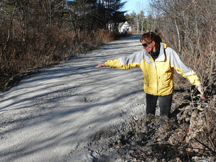 Donna Chapman, a resident of the private Batchelder Road off Anderson Road in South Windham and a former town councilor, is one of many private road dwellers in the town that are concerned about a proposal to require road associations to bring their roads up to a safer level if they want continued winter plowing and quick public safety response. The Town Council is scheduled to begin deliberation of the matter in coming weeks. (Staff photo by John Balentine)
Comments are no longer available on this story