
A poisonous plant, known as giant hogweed, has been found growing beside Albion Road in Windham near the intersection of Route 302.
It is one of four new sightings in Maine, including one in Sebago, of the phototoxic plant known to cause severe skin reactions if the plant’s sap, once it comes in contact with a person’s skin, is exposed to sunlight.
According to state horticulturalist Ann Gibbs, giant hogweed was introduced to America during the Victorian era in the early 1900s. The plant, which can grow up to 14 feet tall and has a thick hollow stalk and resembles Queen Ann’s lace, is an ornamental flower and is native to Russia. However, people need to be careful handling the plant, Gibbs said, since its sap can cause blistering more severe than poison ivy.
Blindness is also possible if the sap comes into direct contact with the eye, Gibbs said, so people should carefully remove the plant making sure not to touch the sap.
“I’ve gotten so many calls in recent weeks on this, but I don’t want people getting scared. It’s been in Maine for a very long time. But if people think they have it growing in their yard, they can send me a digital photograph making sure to take a closeup of the leaves and stem,” Gibbs said.
Her email address is [email protected]. More information on giant hogweed is available at www.maine.gov/agriculture/pi/pestsurvey/pestinfo/gianthogweed.htm
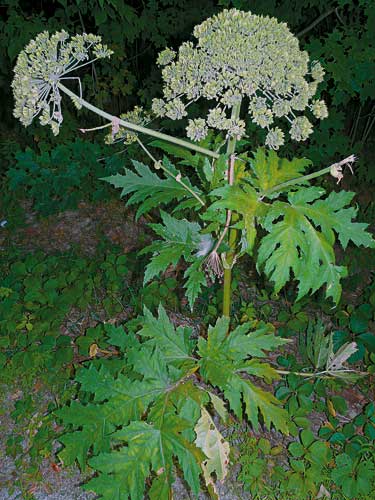 Giant hogweed, seen here growing beside Albion Road in Windham,
Comments are no longer available on this story