
WINDHAM – Local business leaders were beaming with enthusiasm this week as they described the grand-scale vision for Sebago Farms, saying the massive greenhouse project could transform not only Windham’s economy, but its reputation, as well.
The indoor fish- and vegetable-harvesting operation, proposed to be spread across 72 acres in North Windham, was unveiled at Monday’s Planning Board meeting, to rave reviews.
“It’s a million-and-a-half feet of greenhouses – 37 acres of greenhouses on a 72-acre parcel – so it’s just an incredible size,” Windham Economic Development Director Tom Bartell said. “And on the site walk it was unbelievable, we went from end to end and we were, like, holy mackerel, this is huge.”
“We’re going to become known as the home of Sebago Farms,” Bartell said.
The proposal has been put on a fast track in Windham, with Planning Board members agreeing to additional meetings to accommodate der Kinderen’s timetable. The proposal would need to pass through the Town Council as well if any zone changes are necessary.
If approved, Sebago Farms would employ 170 local people and sell hydroponically grown leafy greens, tomatoes and fish to regional restaurants, institutions and supermarkets as far away as New York.
Sebago Farms’ owner, John der Kinderen of Arundel, presented the project to the Planning Board Monday night, saying he is seeking an “accelerated timeline” so the operation can be up and running by the end of the year.
Der Kinderen, who said he is retired but wouldn’t go into his professional background in an interview after the meeting, said the project is proposed for a site adjacent to Genest Landscaping in the Quarry Ridge Business Park off Enterprise Drive, near the Raymond line.
The site, owned by R.J. Grondin Construction Co., has been reclaimed after being mined as a gravel pit operation for more than a decade. Seeking to buy the 72-acre parcel outright, der Kinderen said the purchase and sale agreement with the Grondins is still being finalized.
Despite the size of the project, the proposal is being touted as a “green” operation with very little waste, or impact to abutters or the environment. Der Kinderen approached Windham because Grondin’s site was ideal for the project. The land is near a natural gas pipeline and Route 302, and it is situated above the North Windham aquifer, which can provide the requisite water for the greenhouse.
“We have been doing a site search to locate this facility in southern Maine,” der Kinderen told the Planning Board. “We have gone through a number of sites. We were looking for some particular characteristics that this facility requires, those characteristics being a large-enough parcel with minimal wetlands impact, a parcel that was developable in a reasonable amount of time, access to good transportation, access to natural gas and a welcoming community. We have done quite a search. We’ve gone through more than a dozen sites and we have come to Windham.”
The site would have three greenhouses, the longest of which would 2,000 feet long, or almost a half-mile.
“All of these greenhouses would be very highly controlled,” der Kinderen said. “They’ll be temperature controlled, nutrient-controlled, environmentally controlled, so we will not be using any insecticides. We will not be using any growth hormones. We will not be using any antibiotics. These will be just pure products coming out of this facility, which will be shipped fresh.”
The only thing to rival Sebago Farms in Maine is Backyard Farms in Madison, which produces tomatoes. Sebago Farms would grow its tomatoes and greens on floating mats in large pools. The fish, Arctic char and steelhead trout, would develop in 48 smaller pools within one of the greenhouses.
Despite the competition, der Kinderen said, the potential market for what would essentially be organic vegetables is thriving, and that he is looking to build similar facilities throughout Maine.
Der Kinderen said the facility would use 2,000 gallons of water an hour for the hydroponic growing process, most of which would be lost to evaporation. Natural-gas powered generators would pump the water and produce electricity to control the environment. Even the emissions from the engines would be used in the growing process, he said.
“The energy that is being produced is being produced by engines that come from Austria. They’re very highly tuned, very efficient to extract almost all of the energy possible from the natural gas,” der Kinderen told board members. “So the electricity will be used in the houses, and so will the heat that comes from those engines, and so will even the exhaust that comes from those engines. The carbon dioxide will be used within the greenhouses to encourage growth.
“The waste that comes out of these facilities will all go directly into a bioreactor that immediately processes that waste so there’s no accumulation whatsoever. It all goes down to the bioreactor, gets processed and turned into high quality organic fertilizer that then gets reused in the greenhouses. And if we have any excess, it will be shipped out as a product.”
Larry Eliason, vice president of the Windham Economic Development Corp. and a local commercial real estate broker, couldn’t be happier for the economic stimulus and ripple effect that could come to the North Windham commercial sector.
“We’re excited about this project because we’ve been working on attracting and retaining business, changing zoning and ordinances to be more business friendly,” Eliason said. “This is going to have a big impact on attracting new investment in our community. It’s going to help a lot of the small mom-and-pop businesses in the community with the employees and visitors that come to this new facility.
“And it’s going to attract more investment and businesses to that business park,” Eliason continued. “This project is really going to put Windham on the map. And we’re going to try to help expedite and problem-solve as the process goes on.”
Barbara Clark, executive director of the Sebago Lakes Region Chamber of Commerce, headquartered in North Windham, is equally enthused.
“I think it’s very exciting,” Clark said. “I think it’s a great business bringing jobs to our region. I think it’s a diverse business, a different type of business coming in here. And I’m very exited to know they’ve chosen our region. I think it’s wonderful.”
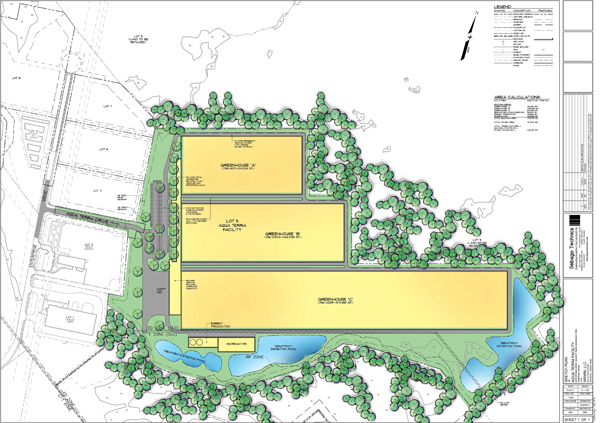 Sebago Farms, as proposed, would consist of three greenhouses,
Comments are no longer available on this story