
GRAY – When talking about history, there’s always a little mystery, and such is the case with one of the houses being featured in this weekend’s Historic House Tour of Gray, sponsored by the Gray Public Library Association.
The Merrill house at 150 Mayall Road, built in 1766 (or perhaps 1760, as the town’s property records have it), is the oldest wood-framed house in Gray. It dates to before the American Revolution and served as the home of the town’s first Baptist minister, the Rev. Nathan Merrill.
Merrill built the home with help from neighbors (who lived in log cabins, none of which have survived) and eventually died in the house after slipping on a granite step. The house was handed down through the years and has been inhabited since 1968 by the McKeen family – Don, Priscilla and their five grown daughters, one of whom is a manager at Gray’s landmark Cole Farms Restaurant.
A more intriguing mystery than when the house was built lies in its basement, a cellar that features an 8-by-10-foot section lined with 8-inch-thick granite, mined nearby when the house was constructed 250 years ago.
The basement room was completely separate from the cellar until 1986, when McKeen removed one wall to expand the basement and shore up the foundation for a bathroom remodeling job. A trap door in a first-floor bedroom, with a bed serving to hide the door in the floor, was the only way in and the only way out for the home’s first two centuries.
Theories abound when it comes to the once-hidden room.
“Gray had a number of Indian attacks and two were pretty significant,” said Nancy Wilson, longtime member of the Gray Public Library Association and main organizer of the Sunday’s historic home tour. “So it could have been from Indian attacks since the settlements were attacked back in that time, back in the 1700s. Or it could have been a part of the Underground Railroad, no one really knows. It’s a mystery room, only accessible by trap door.”
While Don McKeen knows much about the history and craftsmanship of the Colonial Cape Cod-style home, having rebuilt much of it himself, he knows little about the origins of the granite room.
“Our thoughts were it was either to hide slaves or hide from the Indians, and we figured in reality it was probably hide from the Indians, because I don’t even know if this was on the actual trail for the Underground Railroad. So that’s our thoughts on it, but we don’t have any actual proof,” McKeen said.
It seems clear the room, which when McKeen first accessed it featured a primitive ladder made out of boards set at a 45-degree angle, couldn’t have served as a root cellar, he added.
“It wasn’t used as a root cellar because you couldn’t get to it,” he said. “There was a trap door under the bed so they were hiding it from someone. And there were no windows or anything through it.”
Another organizer of the historic house tour, Gray Public Library Association President Julie Sheets, has her own thoughts on the granite room.
“To put a stone floor in a cellar that had no other use is a lot of work that obviously had another purpose,” Sheets said to McKeen during a visit to the house last week. “I think you have the very first safe room – a panic room.”
McKeen nodded and said, “Yes, the first bomb shelter,” joking about the forethought Rev. Merrill must have had for not only Indian attacks but 20th century Soviet nuclear assaults.
While the granite room is no longer closed in, visitors during the house tour will likely be impressed with what’s left of it: massive slabs of granite on three walls as well as on the floor. The McKeens use it for storage now.
The rest of the house is a treasure, as well. Entering through the main door, visitors will take a right into the main living area and kitchen, which feature ceilings with original beams and floorboards, some of which show the original whitewash. McKeen says the beams were crafted with an adze, which is a chiseling type of tool featuring a 4-inch-wide flat blade at the end of the handle.
“These were all handcrafted with an adze, which gives you an appreciation for their abilities,” McKeen said.
The handy McKeen used an adze to replicate the hand-hewn beams when recently making a new corner post-and-beam.
“They were two short pieces, nothing compared to these other beams,” he said. “They used to make them 25 feet long. It’s amazing.”
While the home’s interior is mostly wood, and highlighted by shiplap wallboards that McKeen removed from exterior walls and repurposed for an interior remodeling job, the main attraction is a central chimney that feeds three fireplaces in three separate rooms. And McKeen, who owned Don McKeen Masonry for years building and repairing fireplaces and chimneys, knows exactly how many bricks there are in the massive chimney.
“I’ve got 6,200 bricks in there. I ought to know, I laid every one of them,” he said.
The chimney had fallen into disrepair and McKeen, at the prompting of his wife, decided to put his masonry skills to work.
“When we moved in there was just a big 8-foot-square block of brick with three or four flues that went up. It was built with brick and cement. And we were here quite a while and one day the light bulb went off and we took it down,” McKeen said. “Took six days to take it down and about three weeks to put it back. So we built a Rumford fireplace, which is basically what they did back then, and we wanted a functional Dutch oven, so we built that.”
There’s also a wood stove in the fireplace, which McKeen said wouldn’t have been there in the 1760s, but the wood stove throws out much heat, reducing their oil consumption.
“We kept quite a bit the same, but you’ve got to make it livable,” McKeen said.
McKeen, born and raised on the Mountain View Road in West Gray and a lifelong resident of the town, is looking forward to showing his house to whoever arrives for Sunday’s house tour.
“We like old places obviously or we wouldn’t be living in one. And there’s a lot of people I know who have driven by, and we’ve done it ourselves, gone by an old house and say, boy, I’d really like to see what that looks like on the inside,” he said. “But you can’t do that since they’d call it breaking and entering, so when Nancy [Wilson] mentioned it, we were more than happy to do it.”
House tour
The McKeens’ 1766 house is one of seven historic homes featured on Sunday’s tour. Other homes include several Perley family homes, one of which was designed by famed architect John Calvin Stevens, as well as the main house at what was once the town’s poor farm.
“There’s a lot to see. We have a lot of fine homes in Gray,” Wilson said. “People will learn a lot about their town.”
Sheets believes the historic home tour will not only benefit the library’s attempts to raise money for an expansion, but will also help fulfill the association’s secondary purpose of educating residents about the culture and historical significance around them.
“I think a lot of people in Gray, you never think driving to work or driving to wherever you’re going, you never think about these things. And there’s a lot to celebrate and a lot of these semi-hidden treasures,” Sheets said. “There are a lot of truly wonderful treasures in the town of Gray with historic homes and really terrific people.”
Sheets said the house tour is part of an effort to raise money to decrease the amount Gray taxpayers will have to pay to upgrade the library on Hancock Street. Voters on Nov. 6 approved a maximum contribution by the town of $1.5 million to the project. The association and library’s board of trustees have pledged to raise $250,000, which would help pay down some of the $1.5 million the groups expect to spend of the project. A recent development, Sheets said, has made those efforts a little less daunting.
“We’re very fortunate. We actually received information the other day that the KIM Fund, which stands for Kids in Maine, has pledged a $100,000 matching grant,” Sheets said. “So when we raise $100,000, it will suddenly become $200,000 overnight. It is really amazing.”
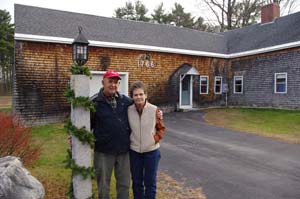 Don and Priscilla McKeen have lived in their home at 150 Mayall Road in Gray since 1968. The home has stood since 1766, and will be among seven featured in a historic house tour of Gray set for this weekend.
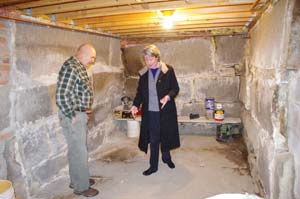 Homeowner Don McKeen and Gray Public Library Association President Julie Sheets discuss the granite-encased room in McKeen’s basement. The once-secret room, only accessible through a trap door, will be open to visitors on Sunday’s historic home tour of Gray.
Comments are no longer available on this story