
WINDHAM – School and municipal leaders in Windham are seeking state funding to introduce sidewalks on the school campus in Windham Center in hopes that it would improve pedestrian and bicyclist safety.
According to Bill Hansen, facilities director for Regional School Unit 14, several sets of proposed sidewalks are part of a long-range plan to improve safety on the network of roads coursing through campus. As funding becomes available, either from state, federal or local sources, Hansen eyes four areas that would be improved by installing crosswalks and sidewalks.
The first priority, for which the school and town have already submitted a grant application to the Maine Department of Transportation, is to install a sidewalk from Windham Center Road to the stadium entrance near the Windham Primary School. The project would cost about $137,200, with the grant providing $102,900 and the school providing the remainder. Hansen said the school should know in spring whether it has qualified.
“There is a very high need to put in a sidewalk because of the activities that occur there on the weekends, during the week, for all the different athletic events,” Hansen said. “If you come to our campus during the spring, the fall or the summertime, it gets great use. And we’re proud of that – it’s a good thing that the community is using the site – but there is not a real easy way to park your car and then walk to an event because there are no sidewalks whatsoever.”
Hansen also said spectators will stand at the edge of Stadium Drive overlooking Field 9, which is at the intersection of Windham Center Road and Stadium Drive, and watch games while vehicles pass close by.
Hansen said the grant would help pay for sidewalk along Stadium Drive as well as two raised crosswalks leading from a parking lot that would be built on the former Strout property along Windham Center Road. The raised crosswalks would also act as a traffic-calming measure.
While the grant would only provide enough money to complete the Stadium Drive upgrades, Hansen said future sidewalks would run from Windham Center Road to Field Allen School, between fields 2 and 3 along the road that leads from the middle school to the primary school, as well as another sidewalk that would extend from near the tennis courts out to Route 202. Once the system is established, Hansen’s long-range goal is also to erect kiosks that provide visitors a map of the campus at each of the entrances as well as a mileage guide for walkers or runners.
In support of the new sidewalks is the Windham Active Lifestyles Coalition, WALC, which is headed by Martin Shuer. Shuer said the sidewalks will improve on-campus pedestrian safety and connections between surrounding areas and the campus. Shuer is advocating that local leaders expand upon last summer’s widening of Windham Center Road and next summer’s River Road widening by seeking funding to improve the conditions on outlying roads.
“There’s great connectivity between the efforts that the school department is making on behalf of its students, staff and visitors to the campus by improving or installing missing or deficient infrastructure for public safety and how it links to the abutting town and state roadway infrastructure on Route 202, Windham Center Road and River Road, and ultimately Pope Road and Park Road, that create other connections from the school campus in Windham Center to those surrounding neighborhoods,” he said.
Windham Town Manager Tony Plante says the effort to better integrate surrounding roads is something the town, which is limited in its highway funding, is considering.
“As part of an overall effort, it makes sense to have the linkages from the school campus to a system off campus for the rest of the community,” Plante said.
Plante gives credit to the WALC group for advocating a stronger connection between the school campus and town roads.
“We’re all part of the same conversation,” Plante said. “The school is a separate governmental entity but there is coordination going on between the town and the schools through the vehicle of the Windham Active Lifestyles Coalition. And I think that’s been a good venue for bringing together the schools and the town and other parties, representatives from MDOT, from Opportunity Alliance, over community wellness, pedestrian and bicycle safety transportation and safety.
“So I think in a relatively short period of time, this group has helped bring a focus to pedestrian and bicyclist issues more than they ever had been. So, I think that in itself is a success, and we need to keep working on making improvements where they make sense.”
Those improvements will take time, and in a sluggish economy where budgets are tight, money to expand roadways to improve safety may be hard to come by. Federal and state grants, therefore, play a key role.
“It’s going to take time,” Plante said. “Windham has relatively little in the way of bicycle and pedestrian infrastructure and as we work on road projects, as we work through our own planning projects, it’ll take time but we need to pick away at it, and already there’s been progress.”
The Opportunity Alliance, formerly known as the People’s Regional Opportunity Program, has been working with the WALC group and town and school officials to promote pedestrian and bicyclist issues in Windham. Zoe Miller, who directs the Healthy Lakes Region Healthy Maine Partnership for the alliance, helped write the grant for the sidewalk improvements along Stadium Drive.
“It’s a great opportunity to get some funding to make the school campus and the area of town around it more pedestrian and bicycle friendly,” Miller said.
Eying future linkages between the school and the surrounding community, namely a sidewalk that would lead from the entrance of the high school to the skate park and community garden along Route 202, Miller said more work needs to be done between the school and town.
“So how kids are using the campus and how they’re connecting safely, it needs to be a coordinated effort,” Miller said. “And that’s the direction they’re going in, and applying for the funds is a way to do that.”
The ultimate goal for Miller, beyond safety and connectivity, is active living.
“I think there’s a lot of potential health outcomes and quality of life outcomes for people and so certainly getting kids to be able to walk and ride their bicycles to school, or even walk between school and after-school activities, means kids are walking more, and as a result, they’re less likely to be overweight or obese and they’re moving their bodies and there are all sorts of benefits to that for their cardiovascular health and actually for their academic performance,” Miller said. “And being able to be active when you’re young is a critical element of forming that lifelong relationship with physical activity.
“So I think the more we can make that change in our communities, to have it be safe places to walk and bicycle and skateboard and rollerblade, is a good thing.”
Helping Miller write the grant was Stephanie Joyce, nutritionist for the school district. Joyce sees kids walking on the roads around campus and hopes soon a sidewalk will be in place. She sees that opening a door to greater mobility for students both on- and off-campus.
“Even though we’re a rural community, I think people assume kids can’t walk or bike to school, but I think a lot of it is just the barriers that are in place,” Joyce said. “You can think of the majority of our roads around campus here, there is little to no shoulder. It’s really not a safe place for kids. It doesn’t mean kids aren’t walking around, though because after school, they’re certainly walking to the library, or we’ll see them walking to the corner store or to the skate park down the road.
“So, I think for us it was just trying to see what are some of the things we can put in place to make that safer.”
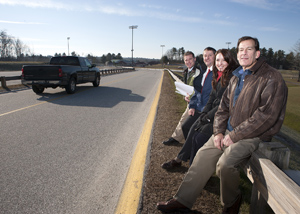 If Windham High School receives a state grant, the section of the Stadium Drive behind the school athletic complex is slated to get new sidewalks that will make the area less dangerous to pedestrians, officials say. Working on the project are, from left, Dwight Anderson of DeLuca-Hoffman Associates, a civil engineering firm in South Portland; Bill Hansen, director of facilities for RSU 14; Stephanie Joyce, RSU 14 school nutrition supervisor; and Martin Shuer, chairman of the Windham Active Lifestyles Coalition.
Comments are no longer available on this story