
SOUTH PORTLAND – More than 350 people – by all accounts a record crowd for a municipal meeting in South Portland – flocked to the Community Center Monday for a City Council workshop on the as-yet-hypothetical prospect of pumping diluted bitumen, or “tar sands,” into the Portland Pipe Line Corp. terminal.
According to Mayor Tom Blake, no council meeting has drawn more than “80 or so” people since at least the 1970s.
Long thought to be “garbage crude,” bitumen is not pumped from underground but surface mined and boiled loose from the sandstone it saturates. As traditional sources of crude oil have dried up, and as technology has improved, bitumen has become financially feasible to extract. Alberta, Canada, has one of the world’s largest deposits.
However, bitumen has the consistency of peanut butter – its pejorative comes from the product’s resemblance to tar – and cannot be pushed through pipelines unless it is heated or diluted with other materials. Because of these additives, the heavy metals naturally present that may be concentrated by the extraction process, and its presumed corrosiveness, tar sands are a target of many environmental groups. One local contingent, 350 Maine, calls it “the dirtiest fuel on the planet.”
On Nov. 29, pipeline giant Enbridge filed an application with Canada’s National Energy Board to reverse the flow of one of its major lines to carry “heavy crude” oil out of western Canada. According to environmental news service EcoWatch.org, which posted a story the next day, “It is widely understood this filing is part of a larger oil export plan to move tar sands out of Alberta, east through Montreal and down to Maine.”
The Enbridge filing sent environmental activists here on the warpath. They expanded protests that began gestating last summer by staging demonstrations and rallying residents against the possibility of tar sands entering Maine via the 62-year-old Portland Montreal Pipe Line artery, which runs 236 miles from Montreal refineries, through Vermont and New Hampshire and past Sebago Lake, to the company’s home base in South Portland.
In recent weeks, voters in Casco, Bethel and Waterford have adopted resolutions opposing the transport of tar sands through their communities. Portland also has considered asking for tougher environmental reviews while, last week, Raymond selectmen voted 3-2 against a similar resolution.
On Feb. 27, Maine’s two U.S. representatives, Chellie Pingree and Mike Michaud, signed on with 17 other members of Congress, urging the Obama administration to require a new federal permitting process and “thorough environmental review” if the South Portland pipeline, built to pump up to 25 million gallons of crude per day, moves to carry tar sands.
Although he said he’d “love to” move tar sands through his facility, Portland Pipe Line president Larry Wilson stressed throughout the meeting, which lasted nearly five hours, that “we have no project.” Tar sands are not even flowing into Montreal yet, he said, let alone South Portland.
Portland Pipe Line Corp., a wholly owned subsidiary of Montreal Pipe Line Ltd., offloads crude oil from up to 2 million barrel tankers at a time at its South Portland pier and pumps it to Montreal for refining, as it has since 1941. The company has 23 tanks that can hold up to 3.5 million barrels, two pipelines – an 18-inch and a 24-inch – which cross under Broadway and eight pump stations in South Portland. In 2008, the company filed a site plan review with the Planning Board to upgrade pump stations and install a third pair of vapor stacks at its facility near Hill Street. However, Wilson intimated the recession killed the deal behind that project, which would have resulted in “reversing the flow” and taking in heavy crude from Montreal, he said. The permit expired and Portland Pipe Line has nothing else in the works at this time, said Wilson.
Still, that did not seem to matter much to Dylan Voorhees, clean energy director for the Natural Resources Council of Maine, who opened Monday’s meeting with a 30-minute presentation on the dangers of tar sands.
Much of Voorhees’ address focused on the 2010 spill of more than 1 million gallons of tar sands crude from an Enbridge pipeline into the Kalamazoo River in Michigan. That spill, he said, “fouled 38 miles of the river” and has cost $800 million to clean up, to date.
In statements that closely mirrored the two-page “talking points” and “stop the smoke stacks” stickers his group handed out to attendees at the door, Voorhees also pointed to the 70-foot stacks that would be used to drain heat and vapor from the tar sands following transport across the pipeline.
“Emissions from these smokestacks would include sulfur dioxide, carbon monoxide, nitrogen oxides, particulate matter and especially volatile organic compounds,” he said, taking care to point out that all eight public schools in South Portland are located within a 5-mile radius of the stacks, which would presumably be built on Pier 1, near Bug Light.
Voorhees also zeroed in on the age of the pipeline, which Wilson said can last “indefinitely” given care and maintenance, along with his repeated assertion that “tar sands pipelines spill more frequently than regular oil pipelines.”
Toward the end of the meeting, after more than two hours of audience commentary, when city councilors finally got their crack and Councilor Patti Smith honed in on Portland Pipe Lines’ financial ability to respond to an accident, company treasurer David Cyr pushed back on the night’s most common theme.
“There’s a presumption tonight that the probability of having a spill because you have oil sands crude running through a pipe is much, much greater than the probability of a spill with conventional oil is simply wrong,” he said. “It’s false. There’s no evidence to support that whatsoever.”
Earlier in the meeting, John Quinn, executive director of the New England Petroleum Council, drew catcalls from the crowd when he quoted from a recent statement from the U.S. State Department on another proposed tar sands line, the Keystone XL pipeline from Alberta to the Gulf Coast.
“Tar sands oil is the same as conventional heavy crude and any risk of spills are rare and small,” he said.
Audience reaction prompted Blake to issue a reminder to be respectful, and for the most part the crowd was, matching the raucous two-minute standing ovation for Voorhees with polite claps for pipeline officials and supporters.
Still, there was an undercurrent of tension and accusations of hypocrisy on both sides. Quinn wondered aloud how many protestors drove to the meeting, noting that 70 percent of Maine gasoline is refined in New Brunswick using tar sands. Meanwhile, a sign noting that a table of Poland Spring water was “courtesy Portland Pipe Line Corporation” was defaced with the message, “Serving water in plastic bottles is a blatant message to us all about how you are out of touch concerning the environment. Shame on you.”
Most of the audience members spoke to environmental concerns, including Bob Foster, a resident of Simmons Road (and not the same Bob Foster running for City Council.)
“We chose to live in this community 23 years ago because of the proximity to so many wonderful resources that we don’t want to see jeopardized by tar sands,” said Foster. “The possibility of spills here or near Sebago Lake is something I would not like to see happen. We need to focus our attention on non-polluting alternatives and not petroleum.”
South Portland resident Frederick Lancaster complimented Portland Pipe Line on the fact that he had never heard of the company until the recent tar sands debate, suggesting that it would previously have taken an environmental disaster to propel the company into the news.
“That’s good, because having heard of you, that would have been a problem,” he said.
Still, Lancaster said, there are reasons for concern.
“Every day when we look in the newspaper there are dramatic pictures of a climate in crisis,” he said. “The planet is sick. We need to start to move away from petrochemical basis. It’s going to take a long time to do that but we have to start because we are all in this together.”
“We were the first community to pass a resolution against tar sands,” said Casco resident Peg Dilley, a member of the energy committee that recommended that action. “The Crooked River in Casco is one of the biggest providers of water that goes into Sebago Lake, where you all here get your water, and right by that goes this 60-year-old-plus pipeline to big stacks in Portland Harbor burning off benzene so ‘Oh, Canada’ can poison our waters and lands getting tar sands all through the country.
“We can’t sell them our lobsters without a fight but we can bring their toxins here,” said Dilley. “This is an important time for Maine. This is something that will affect Spaceship Mother Earth for a long time. We stopped the nuclear trash from coming to this area. Please stop the tar sands.”
Supporters of the pipeline, such as Cianbro Corp. marine supervisor Bill Van Voorhis, Ben Gore of the Maine State Chamber of Commerce and South Portland Historical Society director Kathy DiPhilippo, steered clear of environmental issues, remarking instead on the company’s accident-free history as its long tenure a “responsible corporate member of this community.”
Stressing that she was speaking for herself and not the historical society, DiPhilippo noted the safety consciousness of pipeline employees by noting how much care and attention they donated to helping move the society office and museum.
“I found the employees of Portland Pipe Line to be tremendously safety-conscious, community-conscious and professional,” said DiPhilippo, noting that engineers “showed an overabundance of caution” when developing a safety checklist for the 2010 move of the 10-ton brick building.
Monday’s meeting was for informational purposes only, said Blake. The council took no action and answered no questions.
“Tonight, we were here to listen,” said Blake, adding that similar sessions could be held, even before Portland Pipe Line submits any application, should events warrant.
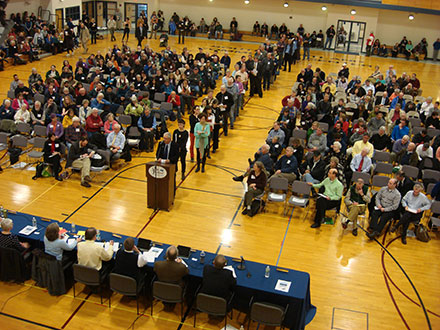 South Portland residents and non-residents alike line up for a “citizen’s comment” period that, even with each speaker limited to two minutes, lasted two hours and 15 minutes Monday, during a City Council workshop on the prospect of so-called “tar sands” being pumped into Maine from Montreal.
Comments are no longer available on this story