
WINDHAM – The South Windham Fire Company has served as a symbol of Windham-Gorham cooperation for 100 years.
WINDHAM – The South Windham Fire Department began operation in 1913, when the village of South Windham was the town’s booming economic engine as well as it’s heart and soul.
A century later, technology has improved drastically and fire trucks and firefighter gear have made tremendous advances. But men and women are still fighting fires using equipment based at the South Windham station, which has been “manned by men and women from Windham and Gorham, from Day One,” as lifelong Windham resident Ernest Nichols writes in his history of the department.
Regionalization and consolidation, terms modern politicians employ as a way to spur savings at the local and state levels, has long been a reality at the South Windham station – a working, thriving model of cooperation for the last 100 years.
“We only had one fire company for both sides of the river,” said 77-year-old Nichols, a 25-year veteran of the South Windham Fire Company. “So they talk about consolidation? But we have long had consolidation between Windham and Gorham.”
Nichols, a former machinist at S.D. Warren in Westbrook whose father and grandfather served in the South Windham Fire Department, researched the history of the fire company, pulling information from Windham and Gorham annual reports as well as Portland newspapers. Nichols also collected photographs from local historical societies. His “History of the S. Windham Fire Co.” was completed in 2004. One packet is on permanent display at the Windham Historical Society.
Inside are written histories of the chiefs who served through the years, the equipment used, copies of Portland Evening Express and local newspaper stories about fires, and several write-ups and photographs from town reports.
Nichols, who lives near the corner of River Road and Route 202 and has always resided in South Windham, except for the one year he lived on the other side of the bridge in Little Falls, is a former captain and deputy chief of the South Windham Fire Company. He served from 1956-1981. The current chiefs of Windham and Gorham, Charles Hammond and Robert Lefebvre respectively, each served under Nichols. Both praised Nichols for compiling the information for posterity’s sake.
“Ernie is a historical artifact. And I think it’s very good that he has documented the history of the South Windham Fire Department, which is now a company within the unit,” Hammond said.
“Ernie’s always been dedicated, even after he retired as the deputy,” Lefebvre said. “Several years ago, we had a structure fire on Labor Day weekend in Little Falls, and with a call company a lot of times manpower is short on holidays. I was really short on manpower and putting guys in the building, and I turned around and saw Ernie on the sidewalk and said, ‘Ernie, how about running the truck?’ I put him on an engine supplying water for a fire, and he did a great job.
“So he’s got a wealth of knowledge and was a real good firefighter, and you never lose that.”
Working together
Lefebvre became chief in Gorham in 1984. In 1985, Hammond took over as Windham’s first full-time fire chief. Both say the station at South Windham is a model of municipal cooperation.
“I think one of the things I am most proud of through the years is being associated with regionalized concepts. LePage can come in and do what he wants but there were working examples of regional cooperation and communication long before, and South Windham Fire Company is one of those examples. In fact, the first fire chief in the town of Windham was a man from Gorham,” Hammond said, referring to W.C. Jordan, the owner of a blacksmith shop.
Cooperation has only grown through the years. Hammond said Gorham and Windham share equally in the maintenance and upkeep of the building as well as a mechanic who fixes the apparatus. In 2003, the two towns split the purchase of a tower truck.
“People I encounter tell me we are the envy of cooperation and collaboration,” Hammond said. “We’ve got a fire truck down there that cost $700,000, Tower 3. It’s an aerial platform. Gorham paid half of it and we paid half of it. And $350,000 is less than the price of an engine nowadays and each of us paid that and we got a piece of specialized equipment.”
Members of the company are residents of Windham and Gorham, and they use both towns’ vehicles to respond to fires or emergency medical calls in all areas of Windham and Gorham.
Lefebvre said the two departments also share the cost of heating the station, firefighter training costs and protective gear.
“So it’s far more than mutual aid, it’s a partnership,” the Gorham chief said. “They literally belong to both departments. The guys have personnel records in Gorham and they have personnel records in Windham. And if those people respond into Gorham I pick up the payroll and the worker’s comp. If they go to Windham, then Charlie picks up the payroll and the worker’s comp. All the same people, we just share the cost.”
Long history
The station started out as the South Windham Fire Department in 1913, the only organized station in town. Now it is one of four stations within the Windham Fire-Rescue Department.
In 1934, the town built the North Windham Fire Station, and in later years the East Windham station on Falmouth Road and the central station on Route 202 near the school complex in Windham Center.
In 1913, the South Windham Fire Department, according to records Nichols could find, consisted of a hose storage house located in a building near what is now Little Falls Landing senior retirement home. Since the Androscoggin Pulp & Paper Mill was in full-scale operation at the time, additional fire hose was also stored there. In 1913, South Windham also installed a working hydrant system with water pumped from Sebago Lake, Nichols said.
In 1934, the hose house was replaced with a much larger brick building. The old hose house was moved across the river and served as the South Windham Public Library until last year, when the private owners decided to close it. The Windham Historical Society is now in possession of the historic building.
Brick for the new station built in 1934 was manufactured at the nearby men’s reformatory along River Road, now the Maine Correctional Center, and labor was provided by the federal Works Progress Administration. Both Gorham and Windham shared the costs of running the station.
In 1937, the hydrant system and additional firefighting equipment from the paper mill, now known as the Keddy Mill, came in handy when an early-morning fire on March 11 ripped through the three-year-old South Windham station. Nichols, a child at the time, said his mother would tell stories about it.
“My father was a fireman at that time,” Nichols said. “But I remember my mother saying this fire was so bad it lit up my bedroom because it was in the early morning.”
A replacement three-bay station was soon built in similar brick-style, and Windham and Gorham bought new apparatuses. Ten years later, the station would play a pivotal role in what is known as the Great Fire of ’47, when drought allowed wildfires to burn out of control. Whole areas of Maine were wiped out including much of Mount Desert Island. One fire worked its way from Hollis and Waterboro in western Maine down to the ocean in Biddeford, where it extinguished itself.
“During the forest fires of 1947, this was like a war zone,” Nichols said. “Communication was very poor. The only communication [in this area] was at the South Windham firehouse and that was a telephone and a military two-way radio from Fort Williams. They had communication between South Windham and the fire scene. So, if you came in from Brunswick with a truck, they’d say report to South Windham, and at South Windham they’d give you further orders onto the fire scene. It played an important part in the fires of ’47, and Harley Freeman stood out as a leader.”
Freeman was chief at the time, and adeptly used whatever and whomever he could find to fight the raging wildfires.
“In 1947, guys like my father had got out after the war to make room for returning guys, but when this happened Harley Freeman called back all the people who had got out and put them as officers on trucks,” Nichols said. “They were even using L.C. Andrew lumber trucks as fire trucks. They were putting big portable pumps on the back of them, packing hose on each side, and they’d go on to the fire scene, to Hollis and Waterboro, down that way.”
In 1966, the station was replaced with a modern four-bay station, which remains to this day. In 2003, after the two towns purchased the oversized aerial truck, one of the bays was enlarged.
In June, there may come more changes for the South Windham Fire Company. The town of Gorham is set to vote in a referendum that would construct a public safety building for police and fire at the Little Falls School, about a half-mile from the South Windham Fire Station. If the $6.3 million proposal is approved, Windham and Gorham trucks would move to the new station and Windham, which owns the South Windham station building, would decide its future use.
Wherever the company is stationed, its history will not go lost, thanks in large part to Nichols. While he’s been retired from service since 1981, Nichols said he hasn’t lost his interest in the fire company. He owes that interest to his family’s long involvement.
“John Nichols, my grandfather, and my father, Donald Nichols, and my brother, Donald Nichols, they were all in the fire company, so it’s a tradition. When you got old enough, it’s what you did,” Nichols said. “And it still goes on. My boy, David, is deputy chief in Windham. He’s a full-time Portland fireman and he’s deputy chief in the town of Windham. It’s a tradition.”
 Historian and retired Deputy Fire Chief Ernie Nichols has written about the history of the South Windham Fire Company. Photo by Rich Obrey
 Only Windham residents of an older vintage will recognize this building not as the old library at Little Falls, but in its original application as the hose house for the first South Windham Fire Station. Photo by Rich Obrey
 In 1973, the South Windham Fire Company consisted of about 30 firefighters and five junior firefighters. Capt. Ernest Nichols, who compiled a history of the company in 2004, stands at right. Also pictured are, from left, front row, Rod Wyman, Ben Gagnon, Tim Dolby and George Libby. In the second row are Chief Dick Libby, Deputy Chief A. MacDonald, Bob Wescott, Ron Drown, Ken Parker, Jerry Larrivee, Tim Welch and Roland Libby. Back row, Randy Emery, Bob Clark, Charlie Hammond and Lt. Ray Rioux. Hammond, who is chief of the Windham Fire-Rescue Department now, began his service in South Windham in 1970. Courtesy photo
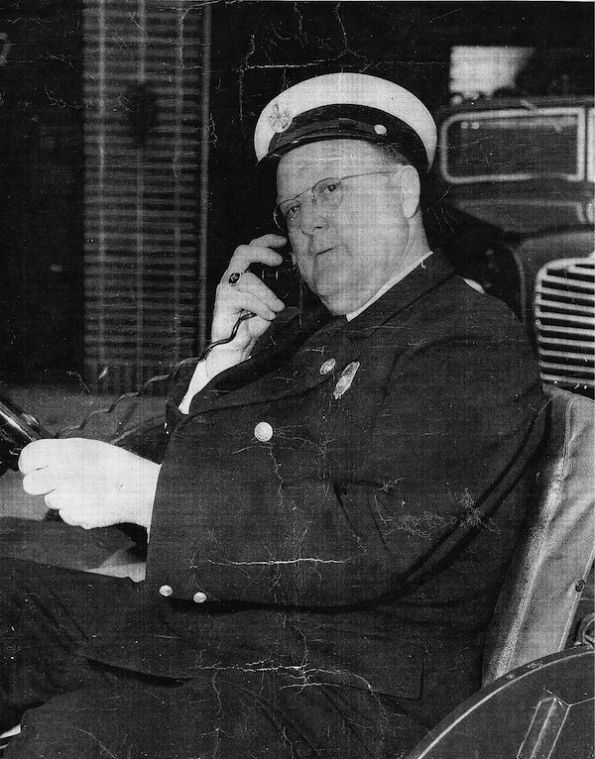 Harland Freeman served as chief from 1943-1951. He helped coordinate fire crews during the Great Fire of 1947, which destroyed much of Hollis and Waterboro and points west of Windham. Freeman operated Freeman’s IGA in Little Falls. Photo courtesy of Ernest Nichols
 The South Windham Fire Station was built in 1934 and employed four emergency apparatuses. Two years after this photograph was taken, the station burned. A woman living in the building at the right, which served as the South Windham Post Office, detected the early-morning fire and notified a worker at the Androscoggin Pulp & Paper Mill located across the street. The worker blew the steam whistle alerting crews to respond. Photo courtesy of Ernest Nichols
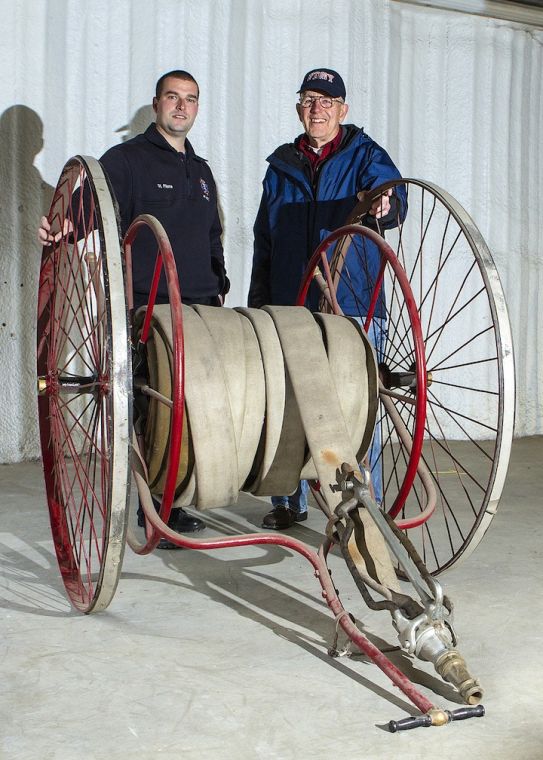 Historian and retired Deputy Fire Chief Ernie Nichols, right, and firefighter/paramedic Adam St. Pierre inspect the only piece of equipment still in existence from the original South Windham Firehouse, a hose and hose reel now collecting dust in the North Windham Fire Station. Photo by Rich Obrey
Comments are no longer available on this story