
DURHAM – The slums of Kenya may be worlds away from Durham, Maine, but one local resident is helping to improve the lives of hundreds of orphans in the African country.
The Kakamega Orphan Project was started in 2002 by Kakamega native Dorothy Selebwa, who visited various Quaker meetinghouses in the Northeast to bring attention to the plight of Kenya’s AIDS orphans. Sukie Rice of Freeport, a teacher and chorale director and a member of the Durham Friends Quaker group, was so moved by the plight of these children two continents away, she decided to start a fundraising effort to support the feeding campaign.
“It was one of these trumpet call kind of things,” said the 67-year-old Rice from her home she shares with husband. “You don’t even bother saying no.”
Along with two other Durham Friends, a faith-based community rooted in the pacifist and community-minded spiritual tenants of Quakers, Rice started the Friends of Kakamega and visited the western Kenyan city of 75,000.
“Kenyans have always dealt with orphans and poverty, but because of AIDS it had become so overwhelming,” said Rice. “We felt that this is a universal problem and something that does not have borders.”
To help the effort, the Durham Friends Meeting and Friends of Kakamega hosted its annual Kenyan Orphan Project Benefit Dinner on June 29 at the Durham Quaker Meetinghouse.
Rice cites the “incredible integrity” of the Kenyan people, woman in particular, as the reason she felt comfortable being involved.
“Sometimes you don’t know where the money is going, but they know where every penny goes,” said Rice.
According to information provided by Rice, the organization focuses primarily on a group of 48 orphans who live at a care center, where the children receive adult supervision, three healthy meals a day, educational sponsorship guaranteed through high school, health care and other basic needs. The children range from age 8 to 18, and include both boys and girls. However, the majority are younger girls, who are the most vulnerable group of orphans.
Along with the 48 residents, about 50 needy children in the neighborhood, mostly orphans, come to the center’s dining hall for a midday meal during the school week.
The orphans all bring individual stories of hardship to the center, whether it be parents who died of AIDS or one boy who lost his family in a car accident, said Rice. Despite the tragedies, the orphans often support each other and don’t dwell on the past. Instead, they live in the “here and now,” said Rice, who has been to Kenya close to 20 times.
Every summer a group of 10 to 12 North American volunteers travels to the Orphan Care Center in Kakamega. These volunteers are mostly from Maine, but also from other parts of the United States and Canada; their ages range from high school sophomore to retiree. In Kenya, they meet the children and help out with homework, English and daily life, developing bonds with the children. The focal point of the trip is a summer-camp type experience with the children as “campers” and the volunteers running activities as “camp counselors.” Sports, woodworking, singing, dancing, sewing, and other activities fill the days with many opportunities for fun.
Mitch Newlin, a 19-year-old from Brunswick who will attend Bates in the fall, is planning on embarking on his third trip to Kenya in two weeks. He became involved as a member of the Durham Friends and described his experience in Africa as both educational and awe inspiring.
“We go there to help the Kenyans, but they end up helping us in so many ways,” said Newlin. “The kids have never experienced anything like this and neither have the counselors.”
Along with the language barrier – Kenyans speak Swahili, any number of tribal dialects and English – negotiating the government requires patience and often hard currency.
“Bribes are just a way of life,” said Newlin. “For instance you may get pulled over for a phantom broken taillight and can either pay the fine or, if you refuse, they’ll break the taillight anyway, which is even steeper fine.”
According to both Rice and Newlin, Kenyans will not smile for a picture, leading many to assume that the children are dour and without joy.
“Nothing could be further from the truth,” said Rice. “They are extremely happy, energetic people. I do have to tell them to smile because it really helps with sponsorship efforts.”
For Brunswick resident Gaetan Davis, a senior at Smith College in Northampton, Mass., her experience as a volunteer in 2009 enhanced her desire to study international sustainable development.
“It was a way to get my foot in the door and have a hands-on experience,” said Davis, 22. “It was such an incredibly positive experience. They gave me so much more than I could ever give them. It definitely confirmed what I wanted to do in life.”
According to the Friends of Kakamega website, the fastest-growing component of the project has been home-based educational sponsorships. Due to the large amount of orphans in the Kakamega area, it is only possible to admit children from the most severe cases of need to the care center, but even then, it may only be possible to provide space at the center for one out of four or five orphaned siblings. To try to fill the gap between those who are helped and those who are not, the neediest children for whom there is no space at the care center are offered home-based sponsorships. Usually, these children are staying with poor relatives or other guardians that have taken them in after their parents’ death. To date, 80 children are sponsored in such a manner. An individual child is paired with an individual sponsor in the United States and Canada through Friends of Kakamega, and through this international friendship the child’s school fees and supplies, mattress, blanket, food budget, and other forms of basic assistance are put together.
According to Rice, the most personal way to get involved is to sponsor an individual child with a primary school sponsorship running $200 per year.
“It really is less than a dollar a day,” said Newlin.
The cost also includes a stipend for food and other necessities that will be used by the guardians or relatives to care for the sponsored orphan and his/her siblings. High school sponsorship is $400 per year, which includes the same necessities, as well as the much higher fees for secondary education.
“A high school education is really the ticket out for these kids,” said Rice. “It separates the haves and have-nots in a really profound way.”
 Dorothy Selebwa, left, and Sukie Rice in the Kenyan town of Kakamega. Inspired by Selebwa’s fundraising efforts to help orphaned Kenyan children, Rice started a chapter of Friends of Kakamega through the Durham Friends Meeting.
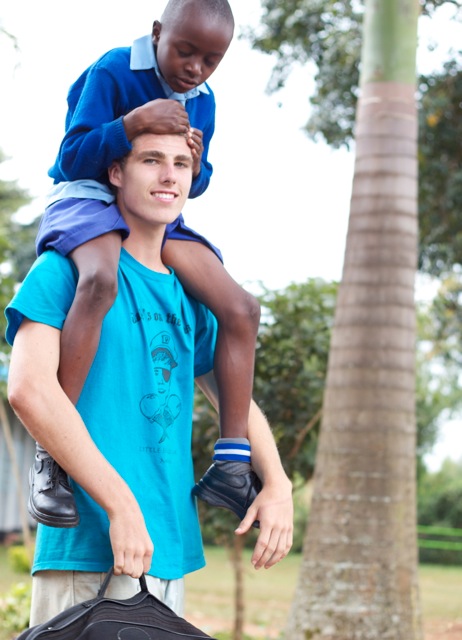 Mitch Newlin, a member of the Durham Friends Meeting, gives a ride to an orphan in Kenya last year during his second trip to the country as part of the Kakamega Orphan Project. The local chapter of the organization was started by Freeport resident Sukie Rice and has helped hundreds of orphans in the western Kenyan city receive basic health care, education, and nutrition.
Comments are no longer available on this story