
SOUTH PORTLAND – When the historic preservation advocacy group Greater Portland Landmarks issued its second annual “Places in Peril” list Sept. 25, it did something a little unusual with its listing for South Portland.
Rather than cite a specific historic building in jeopardy of being lost, such as last year when it called attention to the South Portland Armory, the group declared the entire city in danger of succumbing to the ravages of time.
“There are currently no protections for historic architecture in South Portland,” read the Places in Peril press release. “The city’s historic structures are threatened by new development, loss through demolition or deterioration, and neglect.
“It is an area with fascinating historic buildings, many of which are largely unknown to the broader public. However, there are currently only three historic buildings listed on the National Register of Historic Places.”
“And two of those are lighthouses,” added Hilary Bassett, executive director of the group, last week.
The two lighthouses are Portland Breakwater Light, more popularly known as Bug Light (listed in 1973), and the Spring Point Ledge Light Station (listed in 1988). The State Reform School Historic District on Westbrook Street was listed on the National Register in 1985, while the sole example of residential construction in South Portland, recognized in 1986, is the Seavey-Robinson House, a mid-19th century Gothic Revival home at 580 Ocean St.
Despite the relative inattention paid to South Portland by the National Register, the city has many examples of historic architecture worth preserving, says Bassett. South Portland had seven distinct villages in 1895, when Cape Elizabeth split off in a dispute concerning the cost of water lines. Cape kept the name, as the original intent was for South Portland to get annexed by its namesake across the Fore River, until voters there rejected the idea. Given the history of those seven neighborhoods – from the Knightville business district, to the working class fishing community of Willard Beach, to the comparatively opulent Ferry Village where the Portland ferry docked before construction of the first bridge across Casco Bay Bassett says there is no one representative historic building style her group is aiming at.
In fact, Earle Shettleworth Jr., director of the Maine Historic Preservation Commission, who has for years given presentations on South Portland, has often said the city has the “greatest diversity in housing stock” in the state.
“We wanted to list all of the wonderful historic resources in the whole city, because there are so many of them,” said Bassett. “The neighborhoods are particularly great. Ferry Village is loaded with interesting residential and other buildings that span 100 to 150 years, from very early Capes all the way up to 19th-century Victorians. The same is true of the area around Willard Square and of Meeting House Hill, which has some wonderful homes around that great church at the top of the hill.”
Bassett said the impetus for naming the entire city as imperiled was the hope of kick-starting a historic survey of South Portland homes, such as can be found in Portland.
“Without something like that, all we know is from just driving around and coming across interesting places,” she said.
Although listing the entire city rather than a specific building might be seen as a black eye of sorts, a number of prominent local history buffs don’t see it that way.
“I see it as a good thing,” said Kathryn DiPhilippo, executive director of the South Portland Historical Society. “Anything that helps to focus attention on the need for historic preservation is a positive.”
“I take it as a compliment,” said Mayor Tom Blake, who teaches a class on local history at Southern Maine Community College. “We have something nice here. They’re just saying that we need to try and keep it.”
Still, DiPhilippo cautions, “We are not Portland,” and that the preservation tactics used there may not play well on this side of the bridge. Both also say that a listing of the entire city as a place in peril should not necessarily be taken as a signal that the city is falling apart.
Diane Coit, who lives in an 1882 home on High Street with a French-style Mansard roof, one of a few of its type in South Portland, agrees. Her home, built for Ferry Village apothecary Albert H. Thurrell, has boasted a Greater Portland Landmarks plaque for nearly 20 years.
“In the last 10 years, I’ve actually seen a lot of home owners in this area showing pride and really taking care of their houses, and preserving the historic integrity of their properties,” he said.
Coit and her husband, Kim, are one example, recently preserving a pre-automobile era carriage house on their lot – a four-month labor of love, considering how much simpler it would have been to knock it down and throw up a modern garage.
“We both like the idea of preservation,” she said. “We liked the look of the building itself and wanted to keep it to go with the integrity of the house, the moldings and the doors and that sort of thing. I think it [the Greater Portland Landmarks list] is wonderful.”
Blake said that after the November elections, he will push the council – assuming he wins re-election – to take up a proposal for a historic preservation ordinance. That could make it harder for homeowners to tear down or renovate older homes. However, it could also make it easier for them to apply for historic preservation tax credits that can fund up to 25 percent of historically accurate reconstruction costs.
DiPhilippo feels the greater threat to the character of South Portland’s historic neighborhoods is in-fill development, in which new homes are plugged into side lots, and construction of palatial homes along the coast, which forces the building of even taller homes behind them, so homeowners can maintain their ocean views.
“I don’t think the answer is that we need to do what Portland has done,” she said. “They have historic districts and a historic preservation committee that you have to go to for approval if you want to do something to your home in that area.
“But what I think that we should do is educate people. It would be really great if we could help people here in South Portland be more aware that they may have a historic home, and that that home has a certain architectural style.”
Along that line, the South Portland Historical Society and Greater Portland Landmarks will team up to present an educational seminar next spring focusing on the Willard Square neighborhood, which will be next year’s subject of the annual neighborhood exhibit at the historical society museum at 55 Bug Light Road.
“We’ve talked about this being an ongoing program,” said DiPhilippo. “If it continues, we’ve talked about in 2015 doing Meeting House Hill.”
Other places on Greater Portland Landmarks’ 2013 “Places in Peril” list are Fort Gorges in Casco Bay, and, in Portland, Western Cemetery on the city’s West End, Lincoln Park, located between Congress and Federal streets, the Neal Dow house at 714 Congress St., the Ingraham Carriage House on High Street and the Union Station Clock in Congress Square Plaza.
According to most accounts, it was the 1961 demolition of Union Station on St. John Street that jump-started historic preservation efforts in the region.
The South Portland Armory, on last year’s Places and Peril list, was not called out this year, said Bassett, because her group tries to highlight a different selection of buildings and places each year. Fore River Soundstage, which leases the armory, successfully completed a $10,000 crowdfunding campaign in June and used the money to make repairs to the roof of the historic structure.
A CLOSER LOOK According to data provided by the South Portland Assessor’s Office, these 16 homes, the oldest in the city, are all that remain of pre-1800 residential construction. However, many of the dates are best guesses, given the lack of historic documentation. Kathryn DiPhilippo, executive director at the South Portland Historical Society, points out that the 1700 construction date of 667 Sawyer St. is particularly dubious, given accounts of all area homes being burned to the ground in a 1703 Indian raid, and not rebuilt until 1717, at the earliest.
Address Year Style Condition
667 Sawyer St. 1700 Antique Good
42 Beach St. 1725 Family Conver. Average
445 Preble St. 1750 Cape Cod Very Good
27 Pillsbury St. 1751 Conventional Excellent
913 Sawyer St. 1760 Cape Cod Good
108 Stillman St. 1775 Antique Good
510 Preble St. 1780 Antique Excellent
24 Myrtle Ave. 1780 Cape Cod Excellent
325 Preble St. 1780 Cape Cod Excellent
33 Myrtle Ave. 1780 Cape Cod Excellent
26 Beach St. 1780 Conventional Good
254 Cottage Road 1780 Antique Very Good
995 Sawyer St. 1780 Antique Good
145 Fickett St. 1785 Antique Good
96 Willow St. 1790 Family Conver. Excellent
6 Pine St. 1790 Colonial Average
 Kim and Diane Coit, on ladder, are renovating a 19th century carriage house on their Ferry Village property. The historic building is one of many in South Portland that was recently cited as a Place in Peril by Greater Portland Landmarks.
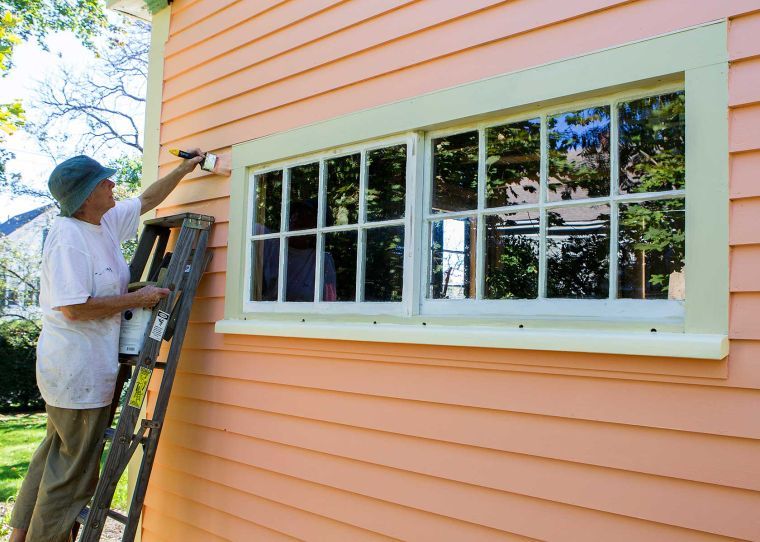 Diane Coit paints the carriage house at her High Street residence last week. All of the historic structures in South Portland were recently designated Places in Peril by Greater Portland Landmarks.
 The original hinges for the Coits’ carriage house doors are still usable.
Comments are no longer available on this story