
WINTHROP – Barbara Walsh is a Pulitzer Prize-winning journalist and writer of non-fiction and children’s literature, who has worked for newspapers and magazines in Florida, Massachusetts, Maine, New Hampshire and Ireland. She also has taught journalism at Florida International University, University of Southern Maine and University of Maine at Augusta. Walsh was among those on the reporting staff of the Eagle-Tribune in Lawrence, Mass., winning a Pulitzer Prize for journalism in 1988 for a series about the Massachusetts prison system. Walsh, 55, who is married and the mother of two children, has also worked as an international speaker for the U. S. State Department.
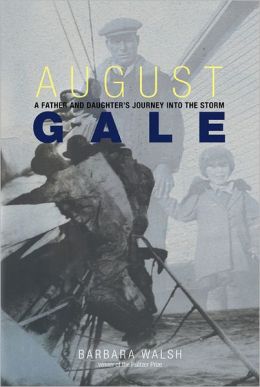
On Thursday, Oct. 24, Walsh, who lives in Winthrop, will be reading from her latest book, “August Gale: A Father and Daughter’s Journey into the Storm,” at the Freeport Community Library. The book was part of a joint “Community Read” program with Merrill Memorial Library in Yarmouth. Walsh recently spoke with the Tri-Town Weekly about why she wrote the book, what it was like to win a Pulitzer Prize, and her writing process.
Q: For those who don’t know, what is the book about?
A: “August Gale: A Father and Daughter’s Journey into the Storm” is about the gale that killed several of my Newfoundland seafaring ancestors and my grandfather, a man who created his own tempests. The 1935 hurricane was the worst tragedy to strike Marystown, a small Newfoundland outport where my grandfather was born. Twelve Marystown fishermen and two boys died when a “divil danced on the water.” In the community of 300, the storm left 42 children without fathers. Every home lost a dad, an uncle, a brother or a son. My grandfather, Ambrose Walsh, created his own heartache. After leaving Marystown in the mid-1920s and settling in Staten Island, N.Y., Ambrose abandoned my father, uncle and Nana twice, only to start a new family in California. There were a lot of similarities between the children who lost their fathers in the hurricane and my dad, whose father abandoned him. They both shared a sense of loss and grief.
I often wondered which was worse: To lose your father in the roiling sea or to be deserted on a cold November night by a man who was your hero, your idol for the first 11 years of your life.
Q: What compelled you to write it?
A: I had been a journalist for more than 20 years when I saw the movie “The Perfect Storm.” The film really resonated with me because of my love for the sea and my Irish ancestry. A few years later, I told my dad, “I want to write books.” When he asked what kind, I told him, “Sort of like ‘The Perfect Storm.’”
He explained that I had a story like that in my family and he began telling me about the 1935 August gale that killed several of our ancestors. That night he offered to get in touch with his father’s family, which stunned me. For 50 years, my dad refused to talk about his father. Ambrose had abandoned my dad, uncle and Nana twice. For much of my life, Ambrose was a taboo topic. That winter evening’s conversation launched a nine-year journey for my father and me, as we researched the storm and the grandfather I never knew.
Q: As a journalist, was it difficult to essentially report on such a personal part of your family history?
A: Reporting and writing “August Gale” tested me more than any other story in my newspaper career. I had never written about family. Writing about my father’s childhood pain overwhelmed me. I agonized for nearly a decade while I researched and wrote about the 1935 August gale and my grandfather. I feared that the book would hurt my father, but he loved it and is one of my biggest fans. He has handed out more than 2,000 “August Gale” bookmarks at book stores, the golf course, airports, pizza parlors and even to telemarketers.
Q: What was it like for your father to experience or relive that part of his life?
A: The book has eased some of my father’s bitterness. Though he won’t ever forgive Ambrose, he is now able to talk more about his childhood and the stories he buried for much of his life. In my eyes, my father has never been more courageous than when he decided to share his past with me. He trusted me to tell this story and share it with the world. I cannot imagine a greater gift. “August Gale” also resonated with my Newfoundland relatives and the families of the Marystown fishermen who died in the gale. Many cried when they read the book. They had heard countless stories about the hurricane, but “August Gale” pulled the threads of their legacy together, preserved their history forever.
Q: Can you describe your writing process? Are you a 9-5 writer?
A: When I was on deadline writing “August Gale,” I wrote about four hours a day and then spent a few more hours at night rewriting. I locked myself in my writing room and did not answer phones or emails. I thought about my chapters, sentences, characters every waking hour, and I dreamt about the book each night. My daughters claim I was so obsessed that I didn’t feed them for a whole year.
Q: How did winning a Pulitzer change you as a journalist? Did it encourage you to take more chances?
A: I was 27 and a rookie when my editors at the Lawrence Eagle-Tribune assigned me to the Willie Horton story. Horton was a first-degree killer who escaped while out on a weekend pass from the Walpole, Mass., top security prison. It turned out that many killers and rapists were getting furloughed on the weekend – unsupervised. Ultimately, our investigation into the prison program changed lives, laws, affected a presidential election and earned our newspaper a Pulitzer Prize. The Horton story also taught me that journalists have tremendous power and responsibility to inform, to tell stories that need to be told. It also taught me not to give up on my dreams.
Q: What are you working on now?
A: I am looking for another dramatic non-fiction story. I have some ideas, but have not fully committed on one topic yet. I want to be sure that I can live with the story for several years as I research and write it. I’m also trying to write another children’s story about Jack, my coonhound. We rescued him after he was abused and left to die in the Tennessee woods. The book would continue the theme of writing about our family dogs. My “Sammy in the Sky” book is about losing our dog Sam. I was lucky enough to get painter Jamie Wyeth to illustrate the story.
Q: Where do you live?
A: I live on a lake in Winthrop. When I’m not writing, I’m on the water, kayaking, swimming or staring at the blue-green waves.
A CLOSER LOOK
Barbara Walsh, author of “August Gale: A Father and Daughter’s Journey into the Storm,” will speak at the Freeport Community Library on Thursday, Oct. 24, at 7 p.m., co-hosted by Merrill Memorial Library in Yarmouth as part of a joint “Community Read” program.
 Author Barbara Walsh and her father, Ronald Walsh, at a recent book signing for “August Gale: A Father and Daughter’s Journey into the Storm.” Walsh will be signing and reading from her book next week at the Freeport Community Library.
 August Gale
Comments are no longer available on this story