
SOUTH PORTLAND – The dream of creating a world-class concert venue on the South Portland waterfront, stymied by the city’s ongoing tar-sands debate, has struck a new note with the proposal this week to hold events on land owned by prominent developer John Cacoulidis.
The project, known as the Liberty Ship Pavilion, envisions a 6-acre outdoor event area along with parking for more than 2,000 vehicles in what has been described as a dry run at stealing away a bite of the economic pie enjoyed by Bangor’s popular Waterfront Concert Series.
Last year, a University of Maine study found that the economic impact of Bangor’s open air Darling Pavilion amphitheater has totaled more than $30 million since it opened in 2010.
With that in mind, South Portland Assistant City Manager Jon Jennings last fall unveiled plans for a 10,000-seat concert venue, to be located on land the city leases from Portland Pipe Line Corp. between the Liberty ship memorial in Bug Light Park and the pipeline pier in Casco Bay.
The idea was to fell a few trees and erect a temporary stage that would be up from Memorial Day until Labor Day in hopes of rivaling Bangor’s Waterfront Park. With a picturesque view of Casco Bay, it was hoped the site might draw A-list musical acts, while also doubling as a performance arts space for outdoor theater and school commencement exercises. The idea, said Jennings, was to fuel the local economy by making South Portland a destination location in places other than just the Maine Mall.
“I’ve been to a lot of places and Bug Light Park is one of the most beautiful on earth,” said Jennings, at the time. “Staging something there can really draw people in, again and again, because it is so beautiful, and because to get there you see what a wonderful city we have, with great neighborhoods and amazing restaurants. This is something that can have real, tangible, economic impact.”
However, as a vote on the controversial Waterfront Protection Ordinance neared, the city decided to pull back, adopting a wait-and-see attitude while the tar sands issue ran its course.
“Portland Pipe Line did not say no, it was really more of a city decision,” said Jennings, at the January meeting of the South Portland Economic Development Committee. “With all things tar sands, including the moratorium and the cloud of a potential lawsuit, we just decided, at least from our perspective, to let that process play itself out.”
In the meantime, Jennings reached out to Cacoulidis, who owns 32 acres located between Bug Light Park and the Gulf Oil tank farm, a site often described as South Portland’s largest and most significant piece of undeveloped property.
“It’s a beautiful piece of land that’s just been sitting here for years and years,” said Jennings. “The good news is that he has agreed to spend a considerable amount of his personal money to clean up the property for the idea of it being a place where we could have concerts, entertainment and other public events.”
Jennings said events on the Cacoulidis property could be a dry run of sorts for the proposed stage on Pipe Line property.
“It will frankly test whether we have the capacity in that part of the city for this type of thing,” said Jennings. “Mr. Cacoulidis is very motivated in this, and I have forwarded all of the concert promoters who contacted us to him, with the caveat that we are still going to control the size and scope of these events as a city.”
“All you have to do is look at Bangor, where this kind of thing has been a huge success,” said Ed Palmer, general manager of the South Portland Marriott at Sable Oaks and a member of South Portland’s economic development committee and a Greater Portland Economic Development Corp. board member.
“I think this is a great way for us to test the waters without any exposure,” he said.
On Tuesday, Stephen Doe, a senior project manager at engineering firm Sebago Technics, was scheduled to present the Liberty Ship Pavilion plan at a workshop session of the South Portland Planning Board. That meeting took place after the deadline for this week’s print edition of the Current.
However, a Feb. 7 letter from Doe explained the purpose of the application for a special exception permit.
About 23 acres of the property, which Cacoulidis acquired from Irving Oil through his holding company HHH LLC in August 1999, will be used for the concert venue, wrote Doe.
Cacoulidis, a New York developer and owner of Hope Island in Casco Bay, famously proposed in 2002 to build twin 640-foot towers on the same Cushing’s Point site, connecting them to Portland by a cable car that would run across the harbor. That development never gained traction and the property, largely unused since the World War II shipyards were dismantled, has been fallow ever since.
According to Doe, Cacoulidis will remove all remaining above-ground building foundations on the property, fill the in-ground foundations, and remove what few structures remain, while also clearing brush, debris and dirt piles. The result, wrote Doe, will create a clean, level space, some of which will be dusted with lawn seed. About 6 acres on the water between Bug Light Park and the Gulf Oil tanks will be used for the event site, while another 11 acres, accessed from 149 Front St. between the tanks and two buildings on Madison Street, will be used as parking for up to 1,600 vehicles. Handicapped parking for 150 vehicles will be closer to the stage, on land located behind the South Portland Historical Society building.
Another 250 parking spots will be provided at the Allagash International plant on Madison Street, which Cacoulidis bought through another company, HHH1, in March 2013. In October, Cacoulidis swapped his other Madison Avenue building with the Soucy family, owners of Port Harbor Marina, for land they owned behind the Allagash building. That gave Cacoulidis a contiguous 32-acre property, while the Soucys got a better location for boat storage. However, a site map provided with Doe’s Feb. 7 application shows Cacoulidis also counting 150 spots at the Soucy site among additional off-site parking areas. A Jan. 31 email from Port Harbor president Rob Soucy in “excited” support of the project also offered up spots at the marina’s 130 Breakwater Drive complex for additional parking.
Doe’s letter also notes that Cacoulidis has obtained permission for offsite parking from Southern Maine Community College and Portland Pipe Line, using areas dedicated to cars during last years’ Color Run event, which drew 5,000 runners to South Portland’s east end.
According to City Manager Jim Gailey, last year’s repaving and striping of East Broadway compliments the concert plan and will help to ease some of the traffic congestion experienced during the Color Run. With three lanes now available, including the center turning/bike lane, two lanes can be dedicated to inbound traffic before concerts, with one outbound lane. That configuration would then be reversed when concerts let out, he said.
According to South Portland’s assistant city planner, Steve Puleo, a possibility also exists that concertgoers could leave their cars in parking garages across the Fore River in Portland and hop a ferry to the show.
Still, for all that is involved in making it happen, Jennings said, the Liberty Ship Pavilion is likely to be a short-term solution to the city’s long-term concert plans.
“Mr. Cacoulidis wants nothing to do with this on a permanent basis,” he said. “He wants to develop his property, and he doesn’t see a concert stage, or beer festivals, or anything else.”
One benefit, however, is that if Cacoulidis decides to stage a beer festival, it would not be subject to the same city prohibitions on alcohol that kept Sea Dog Brewing from setting up a beer garden in Bug Light Park during last year’s inaugural Buy Local Festival.
Still, what might come after the concerts remains to be seen.
“It is temporary in the sense that we hope Mr. Cacoulidis will ultimately do a redevelopment of the site worthy of a 32-acre, Portland waterfront piece of land,” said City Planner Tex Haeuser.
Cacoulidis has had and reportedly continues to juggle other possibilities for the site. Jennings’ predecessor, Erik Carson, was working with Cacoulidis on a convention center/hotel proposal, while other city officials have more recently spoken of industrial uses, including a crane-and-canal system to benefit Allagash’s worldwide distribution of high-end valves. Meanwhile, before his departure from the Greater Portland Economic Development Corp., executive director Tom Turner had said he was working to turn that area into a foreign-trade zone, to take advantage of tax credits and spur development.
“There have been, just since I’ve been around, half a dozen different concepts for that property,” said Jennings, who was hired to be South Portland’s assistant city manager and economic development director in February of 2013.
Tom Moulton, from real estate firm The Dunham Group, who is listed as Cacoulidis’ spokesman on the Planning Board application, did not return calls placed Monday and Tuesday requesting comment. Dave Cyr, treasurer and spokesman for Portland Pipe Line, also did not return calls.
Puleo said in a Feb. 7 interview that following Tuesday’s workshop, the Planning Board would begin formal review of the Cacoulidis project at its Feb. 25 meeting.
It is not known at this time what events might be staged at the site, he said.
“There are some details that can’t really be ironed out until the facility is approved for this type of use,” said Puleo. “One of the problems from what we understand of the applicant’s proposal, without having a venue approved, it’s hard to book acts, especially when they’re booking sites now for summer and fall. But it’s possible the site can be open this year, say, between June and September and, in that time-frame, there are probably at least a couple of large-scale events that could take place.”
Puleo said city staff already has seen and commented on an initial sketch plan, which led to alterations in advance of Tuesday’s Planning Board meeting. According to Haeuser, the board can establish conditions of approval for the project, as a special exception use for community and outdoor activities in the Shipyard District zoning area.
“Typically special exceptions are projects that require something less than site plan approval,” said Haeuser, “You’re not getting into things like stormwater runoff management so much. Instead, you’re focusing more on hours of operation, the landscaping, things like that.”
“It is a matter of establishing those elements that are under the Planning Board’s special exception authority,” said Puleo, “which is to make sure these outdoor display uses are not going to impact neighbors and that health and safety issues are recognized and appropriately located.”
Puleo said that despite the property’s industrial past, there are no hazardous materials to consider.
“They’ve been doing a lot of cleanup over the years,” he said. “It’s been used most recently as a contracted snow dump area.”
Work on the Liberty Ship Pavilion could begin as soon as this year’s snow melts, said Puleo.
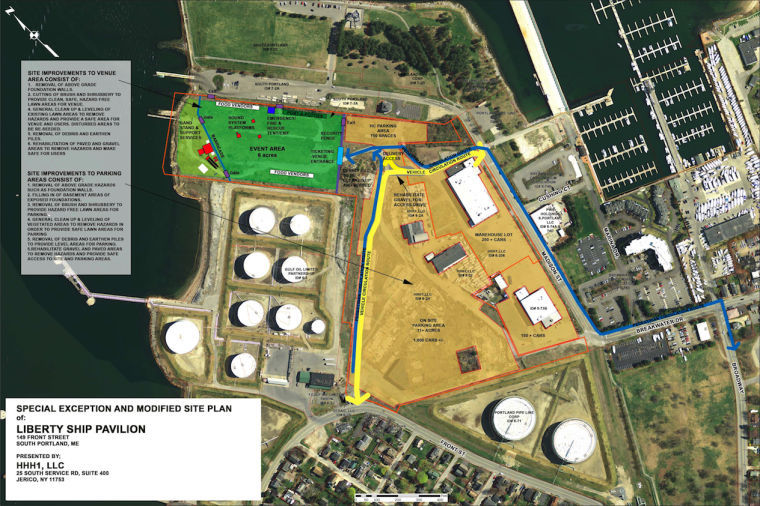 An aerial photo of 32 acres owned by John Cacoulidis near Bug Light Park shows the 6 acres proposed for use as the Liberty Ship Pavilion, for the staging of concerts and other events, as well as 11 acres to be used for parking for more than 1,600 vehicles.
Comments are no longer available on this story