
FREEPORT – The Freeport Shellfish Conservation Commission, which for months has been discussing a regional approach to the invasive green crab problem, has decided it would be better for Freeport to go it alone. The commission voted April 10 to ask the Town Council to establish the position of a Freeport shellfish coordinator, at a cost of $85,000.
Town Manager Peter Joseph said that the Town Council will consider the request as part of its 2015 municipal budget deliberations, which begin on May 6.
Commission member Walter Coffin suggested the change from a regional approach, which would be more expensive to the town without help from Brunswick and Harpswell, a strategy the commission had been discussing. Coffin amended the original proposal, which had been crafted in part by the Maine Clammers Association, with input from consultant Sara Randall. He said that a shellfish coordinator run by the town, rather than by a Casco Bay board, would give Freeport more control of the task at hand.
“I’d rather see us spend a little more and get what we need,” Coffin said.
Chad Coffin, president of the Maine Clammers Association, has led the charge for a regional coordinator. At the same time, he has stated consistently that time is not on the side of the clammers. As soon as Walter Coffin, his cousin, proposed that Freeport go it alone on a shellfish coordinator, Chad Coffin was on board.
He said that by going it alone, Freeport could get a shellfish coordinator on the job a year earlier than if Brunswick and Harpswell were in the mix.
Chad Coffin said earlier that a shellfish coordinator who would lead the charge against green crabs should replace the position of shellfish warden, held by Tom Kay.
“We need a shellfish coordinator, not a warden,” he said. “Enforcement is not the problem.”
Joseph said earlier that the commission’s request would be an important one in the town’s budget deliberations.
“It will be a new program coming during budget season,” Joseph said, “so it could be complex.”
According to Joseph, a shellfish coordinator’s job would be more of a scientific one.
“If there is support for a regional position, then both (jobs) might be in order,” Joseph said. “If it’s just a town resource coordinator, I don’t know if there’s two positions there.”
Kay, who earns $44,206, according to the town office, works in the Freeport Police Department, enforcing state statutes and the town’s shellfish ordinance. Kay also tests the town’s tidal areas. He oversees the opening and closing of shellfish harvest areas, examines the size of harvested shellfish, checks the licenses of harvesters and works with the shellfish commission with conservation of the resource.
A shellfish coordinator, according to the document that Randall developed, would “prioritize and focus resource allocations.” Resource protection – in this case, protecting shellfish from predators such as green crabs – would be a primary focus. The shellfish coordinator also would work as a liaison between the scientific community and the shellfish commission and secure resources, in part by writing grants.
Randall wrote the entire job description within the context of a regional concept. That included protection of shellfish spawning habitat along the New Meadows Lake Estuary in West Bath, a responsibility that might not be part of a Freeport shellfish coordinator’s duties.
Brian Beal, who managed last year’s $100,000, town-commissioned green crabs study, will return for a follow-up study this spring, thanks to a $200,000 University of Maine grant. Beal and his volunteers will further study means of combating the invasive green crabs, which are thought to be responsible for depleting the shellfish stock.
Addressing the shellfish commission last Thursday night, Beal said that the Freeport study helped him go after the university grant. He hopes to correct mistakes made last year, most notably the breakdown of fencing that was erected along the shores of the Harraseeket River, to determine how effective fencing is in keeping the crabs out of an area.
“The town’s initial funding led to the state grant,” he said. “Fortunately, we get to do what I call a ‘do-over’ this year.”
Beal recalled that last year, trapping resulted in the capture of 13,065 pounds of green crabs. “We’re going to get an earlier start this year, around the first of May,” he said.
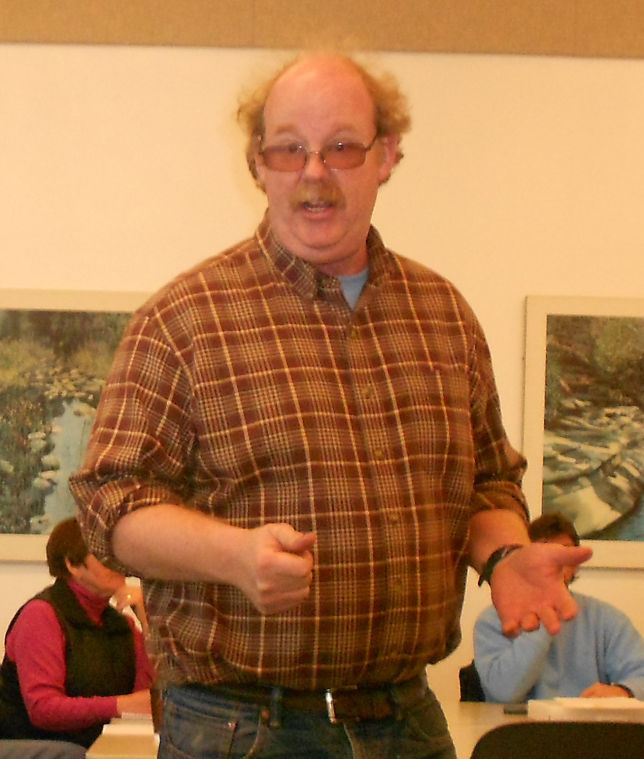 Brian Beal, who is studying the green crab problem, speaks last Thursday during a meeting of the Freeport Shellfish Conservation Commission.
Comments are no longer available on this story