
RAYMOND – As Boy Scout officials Eric Tarbox and Scott Martin rode in a golf cart toward the Camp Hinds entrance off Plains Road in Raymond last Friday morning, they were flagged down by four smiling National Guardsmen, one of whom held a small snake.
“It’s a garden snake,” Martin informed the reservists, who laughed as they continued to amble down the road.
The military has occupied Camp Hinds, and, so far, things are pretty relaxed.
The reservists are on site as part of the Pentagon’s Innovative Readiness Training program, a Clinton administration initiative that is designed to provide, according to the Department of Defense, “real-world training opportunities for our service members and units to prepare them for their wartime missions while supporting the needs of America’s underserved communities.”
This year, hundreds of military engineer reservists serving their annual two-week training rotations will come to Camp Hinds, where they will improve program areas, sports fields and roads, laying the groundwork for large construction and repair projects, including a new dining hall to be built next year.
Last week, the first rotation, Illinois’ 126th Civil Engineering Squadron, arrived on site. More than 30 of the reservists spent the week digging a leach field and installing a septic system, among other training tasks. Then, on Monday, two dozen Marines from the 6th Engineer Support Battalion in Portland, Ore., arrived to begin clearing trees and undergrowth for a new parking lot, as well as the construction of a new access road.
According to Mike Schenck, the Innovative Readiness training chief for the 4th Marine Logistics Group in New Orleans, the two-week training rotations help reservists improve skills, in case they are ever deployed. The majority of the 420 engineers that will come to Camp Hinds this year will return home afterward, although a few Marines may deploy to combat zones abroad, Schenck said.
According to Schenck, who arrived at Camp Hinds on March 16 to organize the effort, the Camp Hinds training is a “choice assignment” for Marines and other reservists. The Camp Hinds project is one of 21 Innovative Readiness Training programs ongoing in the United States. Schenck said that the last training program he worked on was in Newtok, Alaska, where reservists relocated a village suffering from flooding and erosion.
“For them to get to come out here and experience this culture, it’s a good thing for the Marines,” Schenck said. “It’s beautiful, especially in the summer. They have a choice. They can go to the Mojave Desert or they can come to Camp Hinds, Maine. I have a lot of friends, let me put it that way, with people trying to get onto this, because they know I’m working the manning documents.”
Schenck said that the military conducts similar training exercises at bases around the country. Working at Camp Hinds, where reservists have no context, more closely resembles the spontaneity of combat, Schenck said.
“When you’re at a home site training, sometimes they tend to be a little canned,” Schenck said. “Out here, we don’t know if we dig in what situation we’re going to hit. We have to be prepared to deal with it. Very realistic, I would put it. We can’t fib anything.”
The other benefit, Schenck said, is that the engineers will see the emotionally gratifying benefits of their construction.
“Engineers like to know that their labor results in something positive and here they can see it,” he said. “They’re going to be able to see Boy Scouts walking down the road that they built, that they weren’t able to do. They’re going to be able to see Boy Scouts shooting on the rifle ranges that they constructed. I’m speaking as an individual that’s a neat thing.”
The final training rotation will complete work on Aug. 2. Schenck said that the military plans to leave equipment at the camp during the fall and winter. If the Pentagon continues to approve the Boy Scouts’ annual applications, the military is likely to hold training exercises at Camp Hinds for five years in total, Schenck said.
“It’s pending the budget process, obviously, but conceptually we are here for five years,” Schenck said. “We can’t foresee if there’re circumstances that would come up that would take us away from here, but absent that, we’re going to be here for five years.”
The Boy Scouts’ initial application was approved last fall, according to Eric Tarbox, executive director of the Pine Tree Council. According to Tarbox, the joint task force of military engineers will provide labor, construction equipment and fuel for the project, while the Boy Scouts will provide materials, including concrete, wood, electrical wire, Sheetrock, and paint. Tarbox estimated that the military’s help would save the Boy Scouts roughly two-thirds of construction costs.
“The troops have to have their two-week training,” Tarbox said. “The military is going to spend money to train each of these soldiers, sailors, airmen and Marines for two weeks every summer, no matter what. Why not have them spend that money to train here, and Maine receive the benefit of this training, instead of going out to the Mojave Desert and push dirt around?”
The town of Raymond is poised to get in on the action, as well. Pending approval of the town’s budget, a bond issue, and an application to the Pentagon, the military reservists could assist Raymond with four public works projects, including the construction of a recreational complex on Farwell Drive, a gravel road just off Egypt Road.
If the town is able to put forward roughly $800,000 for materials and the Pentagon approves the application, military engineers will construct a 19-acre park and recreation complex on Egypt Road, with six to seven athletic fields, tennis courts, a basketball court, a dog park and nature trails. The three-year construction project, which would begin in 2015, would be worth about $4.3 million, according to town officials.
Tarbox, who helped connect Raymond and Pentagon officials last fall, said that he would be happy to help other municipalities and nonprofits seek military assistance with construction projects and other improvements.
“If they’ve already made a huge effort and expense to set up living quarters and work with us and have a good base of operations, why wouldn’t we and they see who else can be helped in our community?” Tarbox said. “They’ve already made the big financial commitment to move all this gear here.”
 With Eric Tarbox, executive director of the Pine Tree Council, watching from behind, Technical Sgt. Jeff Hollenkamp, left, and Master Sgt. Rob Blum wire generators last week for living and recreation quarters for military reservists visiting Camp Hinds in Raymond this summer. The construction battalion reservists will be living at the Boy Scout camp while they serve their two-week annual rotations.
  Master Sgt. Rob Blum, Technical Sgt. Jeff Hollenkamp, and Airman First Class Josiah Kozeluh wire generators for the military’s new training site at Camp Hinds in Raymond.
 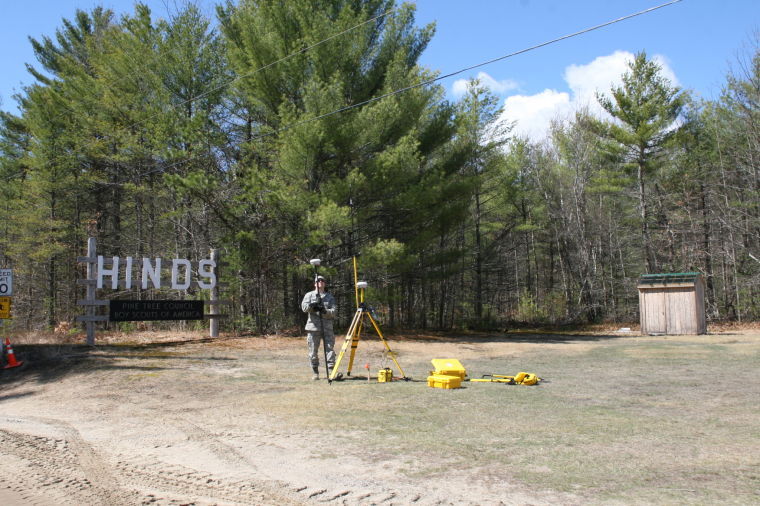 A National Guard road surveyor sets up equipment at the entrance to Camp Hinds off Plains Road in Raymond.
Comments are no longer available on this story