
WINDHAM – When Peter Morgan conducted an inventory of the roughly 200 Civil War graves in Windham’s 27 cemeteries, he found about 90 graves where the traditional Grand Army of the Republic marker was badly worn.
“Many of them were broken or rusted, corroded, or unreadable,” said Morgan, a member of the Windham Historical Society.
The Grand Army of the Republic was a fraternal Union Army veterans’ organization that wielded considerable influence over the Gilded Age Republican Party. The organization, which was formed in 1866 and dissolved in 1956, was one of the first organized political advocacy groups in American history. The GAR medals are traditionally planted in the ground next to the Civil War veterans’ graves, signifying service in the Union Army.
Aware of the plight of Windham’s markers, Manchester School teacher Sabrina Nickerson enlisted her fifth-grade class in an effort to replace 23 the markers – one for each student. On Tuesday morning, after raising $452 toward new markers, each of Nickerson’s students walked across Route 302 to the Arlington Cemetery, and replaced one of the decrepit markers with a brand new one.
The project of replacing the markers has been three years in the making and is a joint venture between the Windham Historical Society and American Legion Field-Allen Post 148, with funding support from the town of Windham and Nickerson’s class. According to David Tanguay, adjutant of Post 148, the markers were designed by Brian Brigham of Windham, who interned at the Windham Historical Society last summer. The pattern work and casting was done through Auburn Stove Foundry of New Gloucester, Tanguay said.
On Tuesday, with the help of Morgan, Nickerson, and several members of Post 148, Nickerson’s students, one by one, replaced the markers, taking notes about the gravestones as they went along. Zach Bearor, 11, replaced the marker at the grave of Jason Wakefield, a Union soldier. After planting the marker into the ground, Bearor wrote down Wakefield’s birth and death dates: March 9, 1822, and May 25, 1864.
As he walked toward the next grave, preparing to watch a classmate plant another marker, Bearor said he felt good about the project.
“I want to respect them because they saved us,” Bearor said. “They let us be free from slavery.”
Nickerson characterized her students’ reaction to the ceremony as “solemn and sensitive.”
“It was one of the best educational experiences I have ever had with students, so special I will always remember the looks on their faces, and how they really seemed to appreciate what these men did for their country,” Nickerson said. “I thank them for their cooperation, their hard work, and the reverence they showed by honoring these soldiers with a GAR marker today.”
Mel Greenier, the commander of Windham-based Post 148, spoke to the students just before they replaced the markers. Greenier said that the Grand Army of the Republic and the American Legion share similar principles.
“We follow what they started,” Greenier said.
Karle Learned, vice chairman of Post 148, said that Nickerson’s students were unusually curious about Civil War history.
“It’s just been an enjoyable experience for us through Ms. Nickerson and her class to see the children are so interested in this project, because most children are not interested in something that happened 150 years ago, but these kids are very enthusiastic,” Learned said. “It’s part of their history, and they want to know about it. They just seem to be eager to learn, and it’s just great to see that.”
Greenier, a Vietnam veteran, also spoke to Nickerson’s class earlier in the year about why he had joined the Army as a young man.
“I was 18 years old, and I wasn’t going to go to college,” Greenier said. “I was a farm boy from Caribou. I really didn’t have any direction, but I was very patriotic. I was a third generation in my family that was an Army soldier.”
To Greenier, it appears that his patriotic ethos has resonated with at least one of Nickerson’s students.
“There’s one little boy that when I saw him in the hall he saluted me,” he said. “That was kind of cool.”
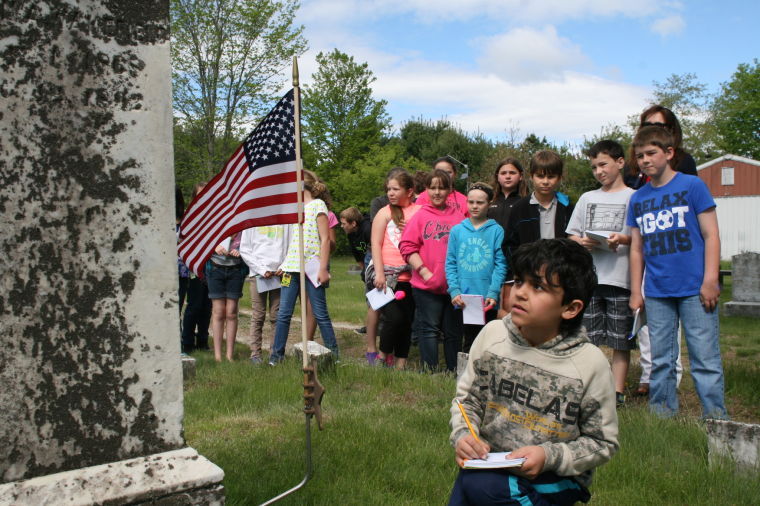 Manchester School fifth-grader Zach Bearor, 11, replaces the marker at the grave of Jason Wakefield, a Union Army soldier buried at Arlington Cemetery in North Windham. After planting the marker into the ground, Bearor wrote down Wakefield’s birth and death dates: March 9, 1822, and May 25, 1864, which was exactly 150 years ago on Sunday. Bearor and his classmates replaced 23 markers in all earlier this week, one for each student.
 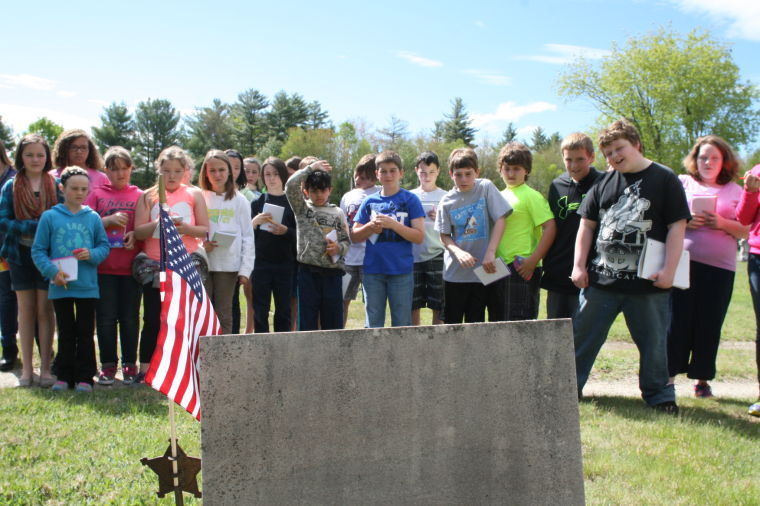 Sabrina Nickerson’s fifth-graders prepare to replace the Grand Army of the Republic grave marker of Wesley C. Herrick, who lived from 1841 to 1925.
Comments are no longer available on this story