
FREEPORT – On a snowy winter day back on March 13, Louis Morin was standing at the top of the stairs in his Freeport home when he became aware something bad was happening.
It all transpired quickly – and it was bad.
“I got a severe headache out of nowhere, and my knees just buckled,” Morin said last Friday, just one day after returning home to live for the first time since that episode. “I knew I was having a stroke right away. The phone was downstairs, so I crawled backward down the stairs and called 911.
“I barely had the time to talk. What stands out for me is that I called in my own stroke.”
Morin, 48, had suffered a massive stroke. He laid on the floor while a rescue team banged down the door of his home, which was locked. Rescue workers took him to Maine Medical Center, where he was hospitalized for three weeks.
“A blood vessel had broken and bled onto my brain stem,” Morin said. “Doctors told my relatives I was non-responsive for about 24 hours. They kept me nearly unconscious for about two weeks, to let the brain rest.”
Morin then stayed at New England Rehabilitation Hospital of Portland until April 9, and then lived at the New Harbor home of his older brother, Daniel Morin, and wife, Cyndi, who happens to be a nurse.
Along the way, Morin lost his job as the director at the Franco-American Heritage Center in Lewiston, due to concerns that he would be unable to work for a prolonged period. He still lacks feeling in portions of his right arm and leg. But Morin is darned happy to be where he is, both in terms of location and recovery.
“Everything that happens has good and bad in it,” Morin said, as he went about his first full day back at home. “That’s how I feel about the stroke. You can either whine and complain or thank your lucky stars that you’re alive.”
The National Stroke Association says that a stroke occurs when a blood clot blocks an artery or a blood vessel breaks, interrupting blood flow to the brain. Stroke is the fourth leading cause of death in America and a leading cause of adult disability. According to New York Times health writer Jane E. Brody, “although a vast majority of strokes occur in people over age 65 (the risk is 30 to 50 per 1,000 in this age group), 10 percent to 15 percent affect people age 45 and younger (a risk of 1 in 1,000).”
Dan Morin vividly recalls the day his brother suffered the stroke.
“It seemed like the information had to be wrong,” Dan Morin said. “It was certainly nothing I expected to hear.”
He teamed up with his wife to care for his brother during the past 31?2 months.
“She’s a midwife,” he said. “She helped with medical information. She was a translator for a lot of things.”
Dan Morin said he noticed a great improvement in his brother’s health when he went off the ventilator at the hospital.
“That was kind of the turning point when he said, ‘OK, the road to recovery,’” Dan Morin said.
When Morin moved in with his brother, he began home therapy and helped himself along the way, as well.
“He would take long walks up and down a hill,” Dan Morin said. “He started networking with people. This was a good opportunity for him to recuperate. Now we’re at the next step. Being my brother, I always worry a little bit about him – maybe a little more because I don’t get to see him every minute. But he’s got a good network of friends.”
That might be due to the fact that Louis Morin has lived a life somewhat in the public eye. He met a lot of people through his job at the nonprofit Franco-American Heritage Center, where he did everything from soliciting money to marketing to press releases to hosting events.
Ditto for previous positions, including stints at radio station WBLM and Maine Today Media. He’s also written a newspaper entertainment column and played bass in the Grateful Dead cover band, Lazy Lightning.
Morin, who had been at the Franco-American Heritage Center for 11?2 years, learned on April 9 that he had lost his job.
“I had barely regained consciousness at that point,” he said. “It was a bad prognosis, so they made a move. I understand their reasoning and I understand they’re an organization that doesn’t have a lot of money.”
The Franco-American Heritage Center hosted a fundraiser for Morin on July 19.
Mitch Thomas, Morin’s successor, said that the center had received a bad prognosis on Morin.
“The center had already gone a while without an executive director and based on the information they were getting, he wouldn’t be able to return for the foreseeable future,” Thomas said. “The staff was really happy to help him on July 19. It was a great night, a great turnout. We want to help him more in the future.”
Morin readily admits that he was a good candidate for a stroke. At 245 pounds, he was overweight, had high blood pressure and high cholesterol.
“I’ve lost about 30 pounds already, so I’m taking that seriously,” he said. “I was one of the youngest stroke victims at the rehab center. I don’t feel young at 48, but it was nice to be called a young guy again.”
Morin can’t play his guitar yet because he has no feeling in his fingers. He wears a brace on his lower right leg, and he can’t drive yet. He has regained half the function in his right arm, though.
Meanwhile, Morin has racked up considerable medical bills. He has been covered by the Affordable Health Care Act since March 1, but has a high deductible. In addition to the fundraiser at the Franco-American Heritage Center, friends also held another one at Grill 233 in Yarmouth.
“Fortunately, between the two fundraisers, I’ve managed to pay two mortgage payments, and that’s going to help a lot,” he said.
Morin, a Skowhegan native, graduated from the University of Maine with a degree in broadcast journalism. He’d like to get back into that – maybe with a small radio station that features more of an eclectic mix of music than classic rock or oldies stations offer.
“I sort of look at this as an opportunity to do something that’s more in line with my journalism and broadcast skills,” he said. “My dream is to find a low-rated radio station where I can say, ‘What do you have to lose?’”
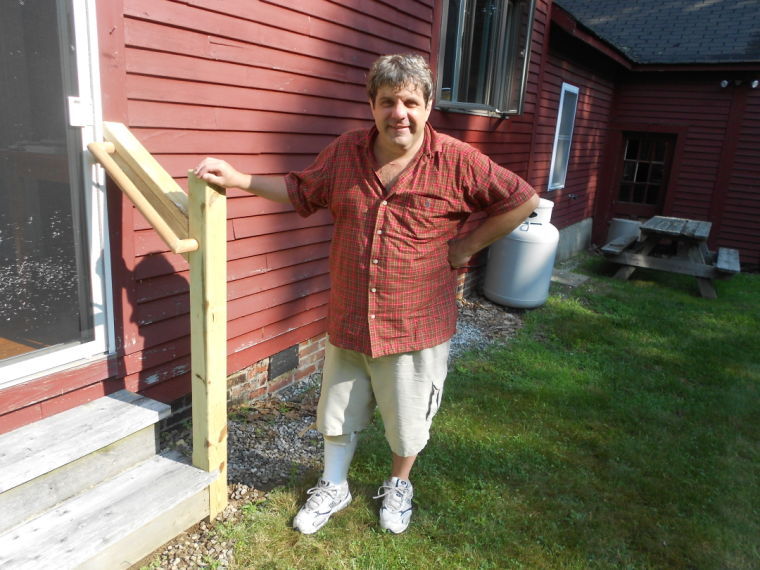 Louis Morin returned to his Freeport home on July 24, more than four months after suffering a stroke there.
Comments are no longer available on this story