
Before sunrise on July 26, the first swarms of cyclists, runners and swimmers, dressed in athletic apparel, will arrive at Southern Maine Community College in South Portland for the state’s largest cancer-fighting fundraiser.
Renee Bunker of Portland, like many other volunteers who make sure the event runs smoothly, will be right there waiting to show the triathletes where they need to go and what they can expect before the starting gun goes off.
“I help check people in and give them a map,” said Bunker, who is in her sixth year volunteering for the Tri for a Cure, set for this Sunday. “I have folks help me get volunteers situated on the course – and then we await the wild rush of athletes to cheer on.”
Every summer, rain or shine, hundreds of volunteers, from traffic coordinators to medical coordinators to race course coordinators, flock to the shore and roadways of South Portland and Cape Elizabeth to help make the Maine Cancer Foundation’s Tri for a Cure a meaningful and successful event.
Without their help, Maine’s only all-women’s triathlon – set to kick off Sunday at 7:30 a.m. at Spring Point Beach in South Portland – would not be possible, says volunteer director Dave Marchese.
Susan Maataoui of Portland, another longtime volunteer coordinator for the Tri, agreed.
“They are such an essential part of what makes this race possible,” she said. “Many of the volunteers are folks whose lives have been touched by cancer.”
In addition, many athletes – this year, there will be 1,350 – often give feedback on how encouraging the volunteers are and how helpful it is to see “the friendly faces,” Maataoui said.
“Volunteers will be standing on every street corner, cheering people on who are getting really tired. The Tri for a Cure is a very unique event because for so many folks who are in the race, this is their first triathlon,” she said.
Dave Marchese, husband of the event’s founder, Julie Marchese, oversees various important race components and has been volunteering for the event since it began eight years ago.
Proceeds from the race – which includes a 1/3-mile swim, a 15-mile bike ride, and 3-mile run – are used to support cancer research, patient education and patient support services in Maine.
“When my wife received the go-ahead to plan the first Tri for a Cure, I also took a vested interest in the success of the event,” Dave Marchese said. “Not only did I want to see the event succeed, but I saw how hard the two founders, Julie and Abby Bliss, worked and I wanted to support them.”
In 2009, Bunker asked Julie Marchese about handing out water to the athletes during the race. But, Marchese told her, “‘I have a different job for you,’” Bunker recalled her saying. “So here I am, years later, still the run course coordinator. I really enjoy it.”
In addition to recruiting around 40 volunteers, Bunker assigns her group to different locations on the course, including stations where they provide water to the athletes.
“I communicate with (the volunteers) throughout the pre-race process by sending out mass mailings,” said Bunker, who participated in all three legs of the race in 2008 in honor of her aunt who died from breast cancer. “I provide information about how to cheer the athletes on with hand gestures, and how to keep everybody safe, and what to do in the event of emergency. Safety is always of the utmost concern.”
On Sunday, 450-500 volunteers – almost half the total number of participants – are expected to show up on race day to help run the event. Volunteer coordinators are assigned to oversee various parts of the race, including registration, medical, swimming, biking, running, spectator flow, vendors, parking/traffic, water stations, the finish line/awards, setup/breakdown and more.
For the first two years, Dave Marchese put in close to 200 hours to help run the triathlon, which aims to raise $1.5 million this year for the Maine Cancer Foundation. Each year since, Marchese has spent about 75 to 100 hours volunteering for the Tri for a Cure, which also includes an Expo Day during which athletes pick up their race packet.
“My support as a volunteer in the Tri for a Cure stems from seeing several of my friends, family and loved ones going through the cancer fight, some of whom lost the battle,” Dave Marchese said.
“Generally speaking, I go to the hotspots when they have issues. If there are any problems on the venue, I am the center of communication,” he said.
There is no real job description or criteria to become a Tri for a Cure volunteer, Dave Marchese said, but volunteers are expected to take the event seriously.
“It’s a job most people can do if they are outgoing and have leadership skills,” he said. “Some positions are harder than others, and we need forceful, intelligent and very efficient people doing those. When we started, the hard part, honestly, was finding enough coordinators to help run the show.”
But in Year 8, the Tri for a Cure has about 15 coordinators whose job is to ensure that every aspect of the race goes smoothly. Event setup begins on Friday morning and continues on Saturday. Breakdown of the event happens around 1 p.m. on Sunday and takes about two hours.
“It’s a big operation on Saturday, and then Sunday is race day,” said Dave Marchese. “Both of those days we are up at the crack of dawn, or earlier. There’s a lot that happens on race day.”
He said several volunteers help the athletes train before the race. The Maine Cancer Foundation organizes swim, bike, run and transition-zone clinics in the months before the event, some for a $15 registration fee.
Other volunteers donate several hours of their time before the triathlon with administrative tasks, like Maataoui, who oversees online volunteer registration from April to July.
“I am the person who interacts (with others through) the website,” Maataoui said. “Potential volunteers sign up on the website, (then) that information goes into a database, and then I take that information off the database and make assignments based on what the volunteer would like to do and also where we need people to be.”
Maataoui, who lost her father to colon cancer, and whose mother is a breast cancer survivor, said volunteers are assigned to more than 15 different areas across race weekend.
“People, when they come to the event, really don’t get a feel for how complex it really is,” she said. “We work really hard to make sure that if people walk up and say, ‘Hey, we heard about you on TV and want to help,’ that we know where the needs are.”
For the first time this year, when volunteers sign up for the event on the Maine Cancer Foundation website, they are able to create a personal fundraising page.
“It’s no longer just for the athletes,” said Maataoui.
According to all the coordinators, a volunteer’s No. 1 job during the Tri for a Cure is to support the athletes, so that they have a safe and memorable experience. Since the opening leg’s ocean swim could be dangerous, many volunteers spend time in kayaks so when swimmers need help or get frightened, someone can assist them quickly.
“A friend of mine has done that a couple of years. She talked about being able to help a woman out in the water who had become very, very anxious,” said Maataoui. “She gave her an opportunity to hold onto the end of the kayak and talked to her for a while, and the woman was able to keep swimming.”
Volunteers who have not signed up and are interested in participating on race day must arrive at Southern Maine Community College at 6-6:30 a.m. Maataoui said volunteers are still needed for monitoring spectator flow, ensuring safety of the athletes, as well as parking and course breakdown.
“I have yet to talk to a volunteer who hasn’t said how inspired they were by seeing the women really push their way through,” Maataoui said. “I think it’s mutual. The athletes really appreciate the fact people take time out of their busy schedules to be there, even to do simple things like holding out a cup of water.”
“A lot of these folks are also cancer survivors, so to be out there cheering folks on who have overcome any challenge, is a neat thing to be a part of,” Bunker said.
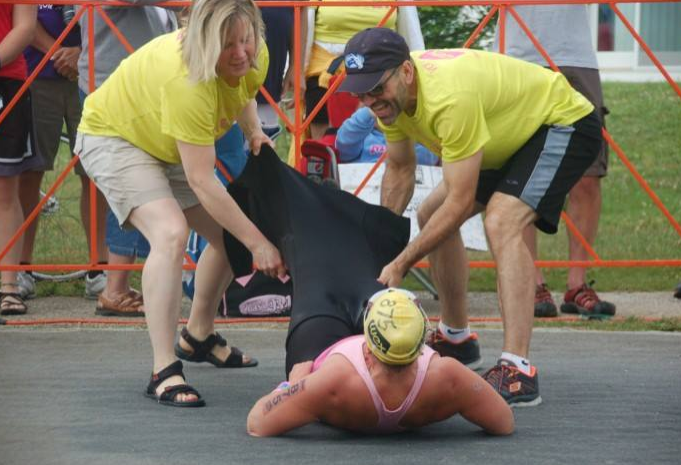 Volunteers during the Tri for a Cure in 2014 help a swimmer remove her wetsuit prior to the bike portion of the race.Courtesy photo by Tom Caron
 Tri for a Cure volunteers, from left, Paul Cormier, Dave Marchese and Krista Hammerbacher Haapala, line up on Spring Point Beach during a past Tri for a Cure event in South Portland. Courtesy photo
Comments are no longer available on this story