
A large algae bloom now visible on much of Willard Beach in South Portland, especially at low tide, has become a cause of concern for neighbors, as well as the Friends of Casco Bay.
This week Mike Doan, a research associate with the friends, told the Current, “a large, sudden bloom like the one at Willard Beach, can be indicative of nutrient loading,” and said that “excess nutrients, nitrogen in particular, can lead to a host of negative impacts.”
Willard Beach resident Rob Sellin, along with several of his neighbors, were worried enough about what they were seeing on the beach to call in the Friends of Casco Bay to investigate last week.
Doan said that while “green algae, in general, is a very normal and healthy component of the seaweed structure along our coast,” the excessive algae on Willard Beach is a sign that something could be amiss.”
Doan said an algae bloom or mat, especially if it gets “large or thick enough, can choke out anything living beneath it,” which is why the Friends of Casco Bay is asking “people who come across a large, green algal bloom like the one at Willard contact us.”
He said it’s too early to tell if the algae growth is due to excess nitrogen, but that “a bloom that large is certainly of interest.”
For the friends, or anyone to determine whether excess nitrogen is causing the bloom, Doan said, “we would need to try to track down the source of the pollution.”
However, he added, “If it is an issue with excess nutrients, the cause is most likely from lawn and road runoff.”
This week Sellin told the Current that, “If you take a walk on Willard Beach, you will see bright green algae, a sign of excess nitrogen, (and) a condition that is not healthy for our bay and our community.”
He’s lived near Willard Beach for the past four years and first noticed the algae last year, but said it was the “huge bloom during the late summer tides” that caused him to reach out to the Friends of Casco Bay.
Sellin added, “Green slime algae blooms are a bad sign,” and argued that “Casco Bay is a special resource for all of us and it needs to be protected and made healthier.”
Doan agreed and said, “Protecting the water quality of Casco Bay is of great importance. In addition to the many environmental and marine resource reasons, the economic value of our communities is intrinsically connected to the health of our bay.”
That’s why “All friends of Casco Bay should be concerned about water quality,” he said. And, Doan promised, “We will continue to monitor the algal bloom at Willard and look to track potential causes if the bloom persists.”
Fred Dillon, the coordinator of South Portland’s stormwater program, said this week that he was not aware of the algae growth at Willard Beach.
However, Dillon said, “Typically, algal growth is driven by nutrient inputs – primarily nitrogen into marine waters” and that “there are numerous potential sources of nitrogen inputs into the bay.”
He also said there are “all sorts of things individuals can do to reduce the amount of pollutants being carried into the bay by stormwater runoff.”
A few of these solutions include “practicing more sustainable landscaping practices” such as using less toxic or non-toxic alternatives for common household products,” Dillon said.
In addition, Dillon said that, “large storm events like the one that occurred last week definitely increase the amount of pollutants that get carried by stormwater into nearby water resources – especially when preceded by an extended dry period.”
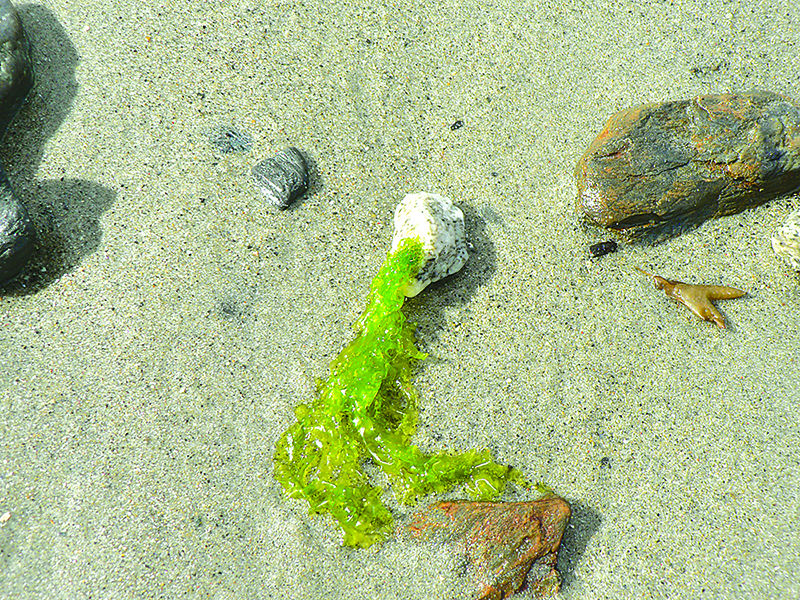 Algae grows on the shoreline at Willard Beach in South Portland.Staff photo by Kate Irish Collins
 This outfall pipe at Willard Beach in South Portland discharges stormwater directly into the ocean.Staff photo by Kate Irish Collins
Comments are no longer available on this story