
Sam Smith, a noted writer and social critic with an equally notable Freeport pedigree, will be among the Freeport authors to read from their works on Friday, Feb. 12, at the Freeport Community Center.
“Eclectica II,” presented by the Freeport Writers Group, is part of the month-long Freeport FebFest. The readings begin at 7:30 p.m. Eclectica II also will include Jonas Werner, Elizabeth Guffey, JoyEl Couch, Monica Kissane, Calvin Hooker, Cole Tamminen and Lillian Haversat. Baked goods and beverages will be available. Those attending are reminded that the event is BYOB, and parental discretion is advised. Admission is up to the up to the the attendees, but $10 buys an anthology of work by the group.
Smith, 78, has written four books, the latest of which is “Why Bother?: Getting a Life in a Locked Down Land.”
He has been editing alternative publications since 1964, including The Progressive Review. Growing up in Washington, D.C., Smith was one of the organizers of the Association of State Green Parties – forerunner of the national Green Party. In the 1970s, he was a co-founder of the D.C. Statehood Party, which held seats on the Washington, D.C., City Council for more than two decades.
Smith also is the son of Eleanor Houston Smith and Lawrence M.C. Smith, who in 1946 purchased the nucleus of what is now Wolfe’s Neck Farm. They operated an organic beef farm there, where they and their six children spent the summer months. The Smiths later bequeathed the property to the American Farmland Trust, and the working farm is now in the hands of the Wolfe’s Neck Farm Foundation.
He moved to Freeport full time in 2009, and is married to historian and author Kathryn Schneider Smith, who has written several books. They have two sons.
Smith answered questions regarding his life and work for the Tri-Town Weekly.
Q: You’ve written four books. The latest is “Why Bother?: Getting a Life in a Locked Down Land.” Can we get a brief synopsis?
A: It was an attempt at discussing how to keep on keeping on even in the sort of times in which we live. In it I noted that it has been rightly said that “hope don’t pay the cable,” yet despair is the suicide of imagination. The task is to bear knowledge without it destroying ourselves, to challenge the wrong without ending up on its casualty list. What was scary about this book, however, was that it came out a few days before 9/11 and the first lines in it were, “Let’s turn off the television, step into the sunlight and count the bodies.” After this book I became a recovering author.
Q: How often does the Freeport Writers Group do this sort of event? Do you get together often?
A: We meet about once a month thanks to our fine leader, Gar Roper. They were kind enough to let a non-fiction writer like me join them. I have never written more than a few pages of fiction before giving up. When I worked for Roll Call newspaper in Washington years ago, I did, however, become their resident poet, but my work was not of a high literary standard. I also once wrote a poem that included the names of all 435 members of the House of Representatives that took up a whole page of the paper. I did cheat at the end, however, writing, “We could write a line that ran” and then listed about 30 remaining members followed by “You see it rhymes, but would it scan?” Fortunately, I gave up this genre.
Q: You’ve been editing “alternative publications” since 1964. How did this come to be, and what was your motivation?
A: It started early. I published a family newspaper that came out at least 20 times during my 13th and 14th years, the first editions being handwritten and the later ones typed in red and black ink. They shared a taste for bad jokes and an awkward emulation of adult journalistic styles. Later I went to Harvard, where I was news director of the campus radio station, had a four-hour weekly talk and music show, was on the college sailing team, played in jazz bands, covered the Cambridge City Council, as well as working for the Harvard News Office and the Fund for Harvard College. This all didn’t fit in that well with the official curriculum, and I graduated magna cum probation. Still I got a good job, working as a reporter for a Washington radio station and a radio news service. By the time I was 23, I had covered presidential news conferences, interviewed Jack Kennedy (right after he announced for president), along with other people like Jimmy Hoffa and Louis Armstrong, not to mention reporting on various murders and fires.
We paid a dollar for each news tip we used and we had regulars like the retired guy who sat listening to police radios all day, then calling us with messages like, “Sam, This is Dan. I’ve got a body for you.” With the draft looming, I went into the Coast Guard where, among other things, I was operations officer aboard a cutter whose duties included aids to navigation and heavy weather search and rescue off the coasts of Rhode Island and Massachusetts. With that over in 1964, I came back to Washington and started a publication called the Idler that morphed into the DC Gazette and then the Progressive Review. I also drifted into activism beginning with handling public relations for local civil rights leader and later mayor, Marion Barry. As our differences grew over time, Marion once told a mutual friend that I was a “cynical cat” – quite an honor given the source. And I started a community paper on Capitol Hill in a neighborhood that was 75 percent black and would, in 1968, have two of the city’s four major riot strips. I had been urged on by an activist minister who was attempting to organize the neighborhood. But we had gotten started a little too late.
On the morning of Obama’s inauguration, I was back near my old office eight blocks from the Capitol. A National Guardsman was standing there with a rifle in one hand and a cup of coffee in the other. I’ve seen this before, I said to myself, and then remembered a soldier with a rifle and a cup of coffee in the same spot after the riots nearly 40 years earlier. It can take a while for things to change for the better.
Q: Tell us a little about The Progressive Review.
A: It was one of the early examples of what would become known as the underground press, eventually including over 400 publications. We became the media for the 1960s. I sometimes think of myself as a bad comedian. I get the punchlines right; I just deliver them too soon. In 1965 I called for the end of the draft, also in the 1960s urged community policing. In 1970 we ran a two-part series on gay liberation, and the same year proposed D.C. statehood, which, in a recent poll, now has the support of 71 percent of the city’s residents. Also in the 1970s we supported single payer health care and attacked the war on drugs. In 1982 we ran our first article on global warming. And in the 1990s we reported on the NSA monitoring of phone calls. Then in 1995, the Review started an Internet edition when there were only 27,000 websites worldwide.
Q: You helped organize the Association of State Green Parties – forerunner of the national Green Party – in the 1970s. How did that all come about?
A: Got a call from Bowdoin Professor John Rensenbrink, asking me to come to a meeting to discuss this. I told him, “John, I’m not good enough to be a Green.” He replied, “That’s all right, we’re going to have a Libertarian there, too.” So I was hooked. I like to describe myself as the leader of the Big Mac caucus of the Green Party.
Q: Are you pleased with today’s emphasis on environmental concerns?
A: I wish we placed much more emphasis on population growth and I worry about how slow our recognition of the problem has been. But assuming we’re not too late, we’re moving in the right direction. The young understand it, and ecological indifference is increasingly a disability found mainly in aged conservatives and their politicians.
Q: Your parents were great conservationists whose gift to the community and beyond was Wolfe’s Neck Farm. Tell us about the importance of that donation.
A: It was some years after my parents started their organic farm that “Silent Spring” came out, and at the time I thought Rachel Carson’s great service was providing proof that my folks were actually onto something. In 1960, two years before Carson’s book, they had sued Central Maine Power for using pesticides around their power lines. Freeport attorney Paul Powers won an agreement with CMP not to spray anybody’s property who didn’t want it. I was the farm’s first Teen Ag. I fed the pigs, helped move a house when I was 13 and was driving a tractor and double clutching a six-wheel truck when I was 14. The farm was one of the best schools I attended because, among other things, farmers are the world’s original multi-taskers. Having a graduate degree in biology won’t tell you what the weather is going to be, when to plant something, how to give birth to a calf, or how to dig a well.
Q: How have you remained connected to Wolfe’s Neck Farm?
A: I’m on the board and claim to be the only member who has spread real manure, as well as the metaphorical variety you find at meetings. I enjoy the board muchly The director, Dave Herring, is great. But I especially like and admire the incredible group of mostly under-40 staffers who are running the place these days. Evidence that farms not only can grow plants and animals, but extraordinary people, as well.
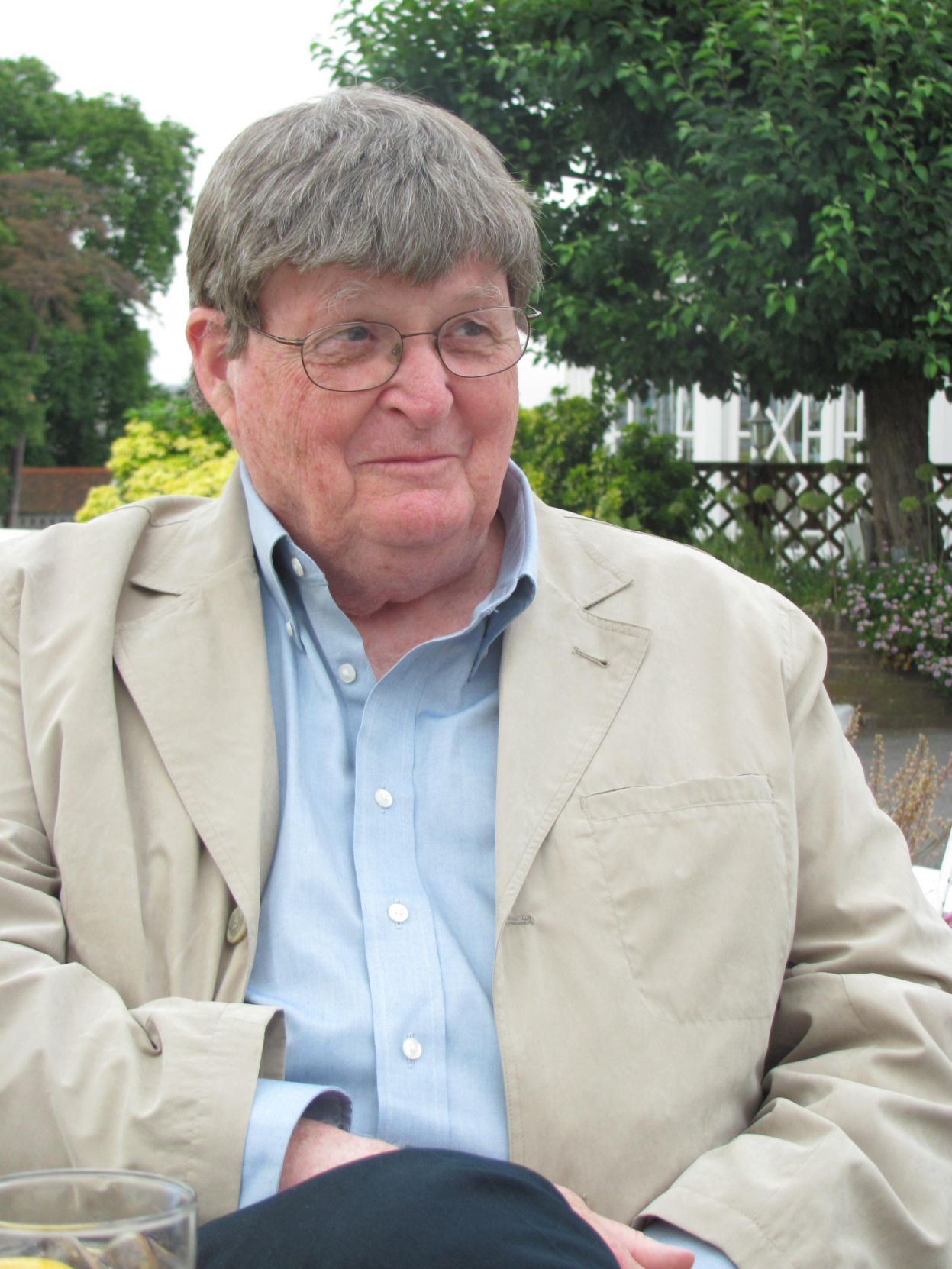 Sam Smith
Comments are no longer available on this story