
The Freeport Ordinance Committee will conduct a workshop next week with the town’s Shellfish Conservation Commission focusing on clam farming.
At issue for the Aug. 25 meeting is whether the town should proceed with a commission-recommended ordinance for clam-farming permits, or instead work within an existing Department of Marine Resources aquaculture leasing structure. The meeting in the Town Council chambers begins at 5:30 p.m.
The Ordinance Committee, a Town Council subcommittee, will make a recommendation to the full council on the contentious issue of aquaculture in Freeport, or simply file a report. Melanie Sachs, a committee member and Town Council chairwoman, said last Friday she expects no decision at the Aug. 25 meeting.
“It looks like discussion,” Sachs said. “We need the Department of Marine Resources’s point of view regarding our program.”
Doug Leland, shellfish commission chairman, attended a July intertidal group meeting in Augusta, which lasted more than three hours. Clamming stakeholders, municipal marine resource officers and two state officials were present.
“There weren’t any conclusions,” Leland said. “It was more information sharing.”
One difference between state leasing and town permitting is residency. While 90 percent of the people who harvest clams in Freeport are Freeport residents, by town statute, the state does not have a residency requirement.
The shellfish commission has been working for two years to craft a proposal, citing declining clam harvests in Freeport and around the state. Clam farmers could take their own measures to protect their resource from predators such as green crabs. But many harvesters oppose private clam farming. Those clammers are against taking mud flats from the public domain, and point to what they say is an increased harvest this year. The Department of Marine Resources will not release its findings on 2016 clam harvests until next March.
The state already has the authority to issue clam-farming leases to individuals — both long-term and experimental leases. In both cases, a harvester interested in pursuing a clam-farm lease must receive permission from the owner of the intertidal land and from the municipality in which the land is located.
“It is possible that state application requirements combined with municipal requirements can create a workable mechanism for those harvesters wishing to experiment with a clam farm, while protecting the interests of the municipality and local wild harvesters as currently achieved in Freeport’s Municipal Shellfish Ordinance,” Leland said. “This is the path currently being explored.”
Freeport, Brunswick and Harpswell each are working on some form of clam farming. Leland said that part of the July discussion at the Department of Marine Resources centered on the distinction between the town permitting process and the leasing of clam flats, which only can be established by the state.
The commission’s proposed amendment to Freeport’s shellfish ordinance has changed. The commission once suggested a parcel of town-leased mud flats near Recompence Shore Campround, but some riparian landowners there objected to clam farming. The commission has altered its proposal to simply allow harvesters to negotiate with landowners, an agreement that then would be subject to town and state approval. The flats in question must be subproductive.
Leland said that the basic difference between town permitting and state leasing of clam flats is liability – which entity would defend the practice should issues arise.
The Shellfish Conservation Commission is open to more conversation, he said.
“What I hope to do is to bring the options together and then find a path forward,” he said. “This conversation began over two years ago because the clam harvest has been down for 30 years. That’s what triggered all this conversation – not as a means to displace wild harvesting or to replace wild harvesting.”
Leland said that the Shellfish Conservation Commission has the responsibility of considering the implications of long-term resource trends and means for sustaining the industry for future generations. He referred to Department of Marine Resources findings that show soft-shell clam landings in Freeport down by more than 50 percent from 2014 to 2015, and down by more than 70 percent since 2012.
“Landings may improve this year,” Leland said. “I hope they do, but the Department of Marine Resources will not have 2016 data available until the spring of 2017. In the meantime, the long-term trend of the resource since the 1970s.
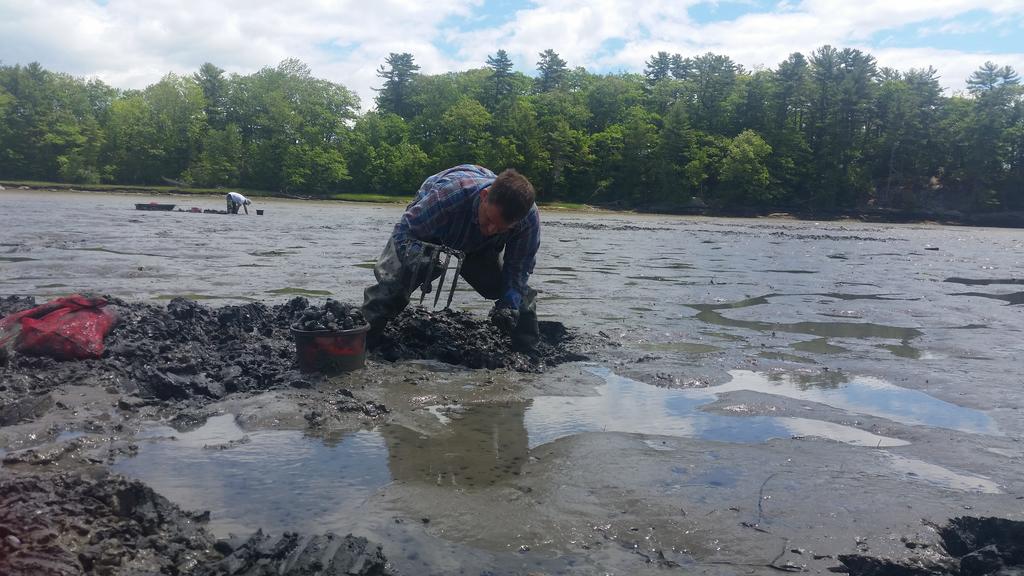
Adam “the Fluff” Morse harvests clams at Little River in Freeport. Clint Goodenow is in the background.
Comments are no longer available on this story