


Bath Middle School has added a new focus on manufacturing into its science, technology, engineering and mathematics classrooms this school year, hoping to give students an earlier framework for careers in the trades.
The middle school got over $500,000 through a STEM+M grant, which is a five-year grant through Diversified Educational Systems aimed at filling gaps in manufacturing careers in the United States. The grant funds go toward the materials, teacher training and classroom equipment setup in the school’s woodshop.
Bath Middle School is one of two schools in the state to receive the STEM+M grant, the other being Lewiston Middle School.
“The earlier you expose people to different opportunities, the more time they have to decide,” said Becky Glennie, a Bath Middle School STEM teacher. “If they’re making that decision as a junior in high school versus an eighth grader, it gives them a little more of a chance to experiment when the stakes are a little bit lower.”
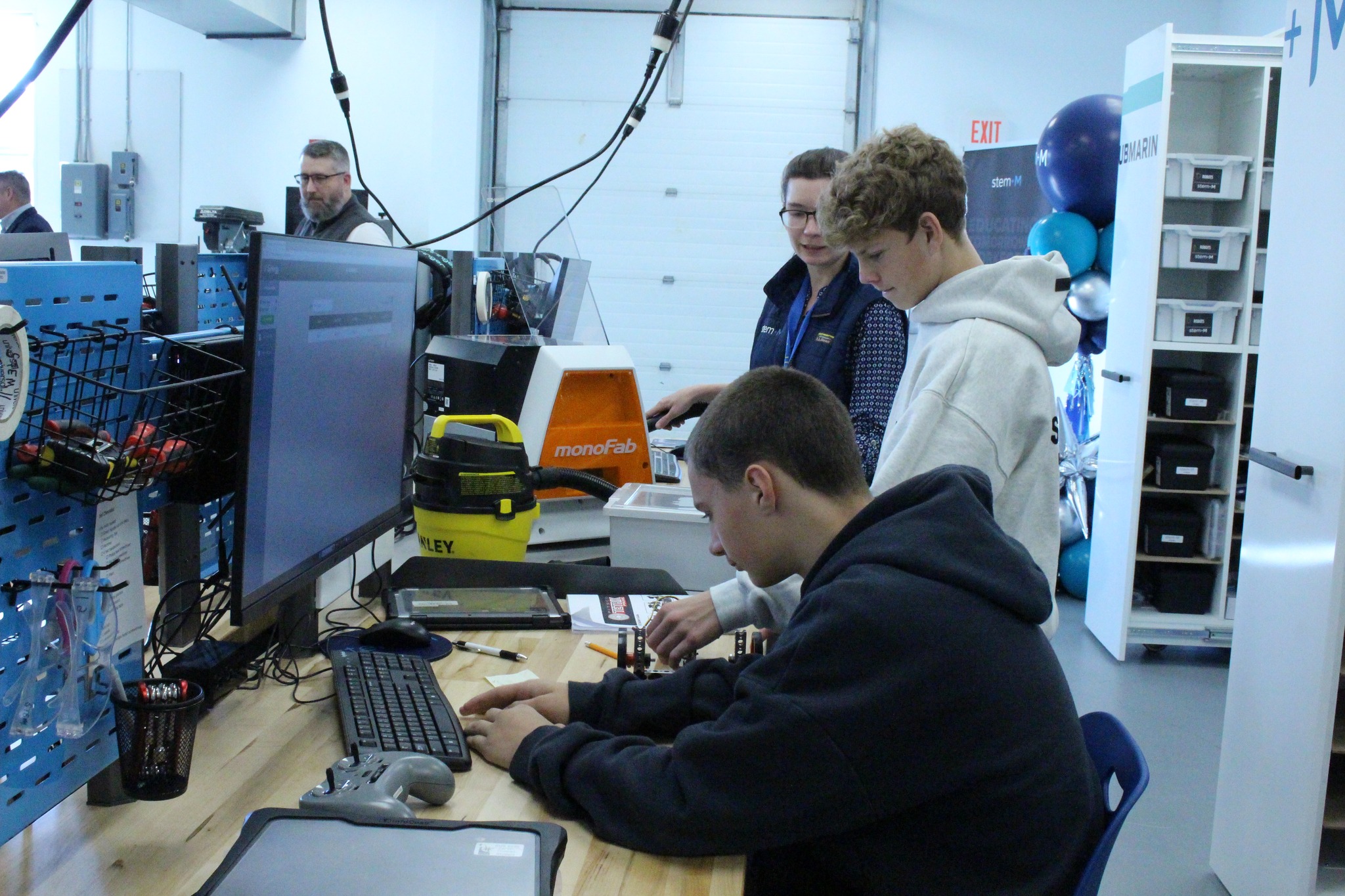
Seventh graders in the STEM+M program focus on engineering, with assignments ranging from building model bridges and cars to collecting data. The eighth-grade class has more career-focused introductory classes like electronics, robotics, Computer Numerical Control machines and 3D printing before they go on to high school.
The director of Bath Tech, Timothy Gagnon, who worked closely with Bath Middle School during the grant process, saw the STEM+M grant as an opportunity giving students more options, according to Paige Gallagher, dean of students at Bath Middle School. The middle school being near Bath Iron Works also played a role in the decision to pursue the STEM+M grant.
“This is an opportunity for students to see different offerings in [manufacturing] careers they could go into,” Gallagher said.
The STEM+M program aims to prepare students for manufacturing careers by structuring classes around technical jobs, working on group projects using equipment and technologies. The topics and tools in the STEM+M program overlap with Bath Tech programs, acting as an introduction to Morse High School programs.
One class Glennie’s eighth graders tackle is the electronics program, where students wire alarms and lights before moving onto creating a small light board, soldering the wires and learning about how the different components of a light work.
“There will be long-term benefits if we are using the curriculum or not,” Glennie said. “We will still have a lot of the materials and tools in order to continue teaching this to students in a way that resonates.”

The Times Record Sustaining Sponsor
We believe a community must be informed to thrive. bowdoin.edu

We invite you to add your comments. We encourage a thoughtful exchange of ideas and information on this website. By joining the conversation, you are agreeing to our commenting policy and terms of use. More information is found on our FAQs. You can update your screen name on the member's center.
Comments are managed by our staff during regular business hours Monday through Friday as well as limited hours on Saturday and Sunday. Comments held for moderation outside of those hours may take longer to approve.
Join the Conversation
Please sign into your Press Herald account to participate in conversations below. If you do not have an account, you can subscribe here. Questions? Please see our FAQs.