

Brunswick’s town councilors will soon consider a plan that will guide the town’s land use and growth over the next decade.
The 2025 comprehensive plan, titled “One Brunswick, Beautifully Balanced,” designates areas for growth, limited growth and rural protection, and serves as an outline for protecting natural resources, investing in infrastructure and maintaining town character. Notably, the plan reduces the designated growth area and discourages development in the rural parts of town.
In anticipation of the new comprehensive plan, the council approved a 180-day emergency measure last month that temporarily pauses new housing developments outside the growth zone.
The current draft of the plan is available online at planbrunswick.org or at the Planning and Development Department in Town Hall.
Brunswick’s Planning and Development Department — Julie Erdman, director of planning and development, and Jimmy Dealaman, principal planner — responded to The Times Record’s emailed questions about what residents need to know ahead of a public hearing on the plan on Dec. 15.
This interview has been edited for clarity and brevity.
What is a comprehensive plan?
The comprehensive plan is a community’s guide for the future. It expresses a community’s collective vision, values and goals; provides an action plan for implementing the vision; and serves as the legal basis for zoning, subdivision and land use codes. A comprehensive plan also provides policy guidance on community elements such as growth and development, municipal services, infrastructure improvements and other capital investments.
How was Brunswick’s comprehensive plan drafted?
The town’s Comprehensive Plan Update Steering Committee (CPUSC) was tasked with drafting the plan. Work began in 2019, but the process was delayed due to the COVID-19 pandemic in 2020. During the early stages of process, the committee focused on reviewing the existing comprehensive plan and state-required inventories and assessed contemporary land-use challenges.
Public engagement was also a primary focus early on and throughout the process, including but not limited to various public input workshops, community forums, surveys and consulting community stakeholder groups. Public feedback directly informed the CPUSC on what to include as the plan’s priorities.
The town’s Planning Department assisted the committee and toward the end of the process partnered with Haley Ward, a consulting firm that created an initial draft of the plan for the committee to review. Staff and the committee have been working tirelessly since July updating the plan and finalizing key details to reflect the feedback we received throughout the process.
What changes does it make?
Many of the recommendations included in the draft plan resemble the 2008 plan, such as using a growth boundary to concentrate development in serviced areas, limiting sprawl and protecting natural resources. However, some of the new changes include reducing the designated growth area to protect the characteristics of existing neighborhoods from state-mandated density increases while still allowing flexibility in areas of the town for guiding future uses that complement the surrounding context where they can be supported.
The plan identifies “placetypes” (i.e., where existing development patterns occur) and recommends where areas should be transformed, enhanced or protected. The plan also provides a stronger emphasis on climate resilience and sustainability, as well as considering the advantages of compact development where land can be more productive for tax revenue generation and help to ease the tax burden for residents.
How will changes to the growth areas guide future development?
While reading the plan, it’s important to understand that the recommendations and land use map are not prescriptive; they offer a guide to future growth by informing decision making. Ultimately, the Planning Department seeks to use this comprehensive plan to inform an update of the town’s zoning ordinance (anticipated to start in the fall of 2026), which will be another extensive public process. The growth/land use map provides four distinct areas; each area provides relatively broad guidance about types of growth that are typical or appropriate for an area.
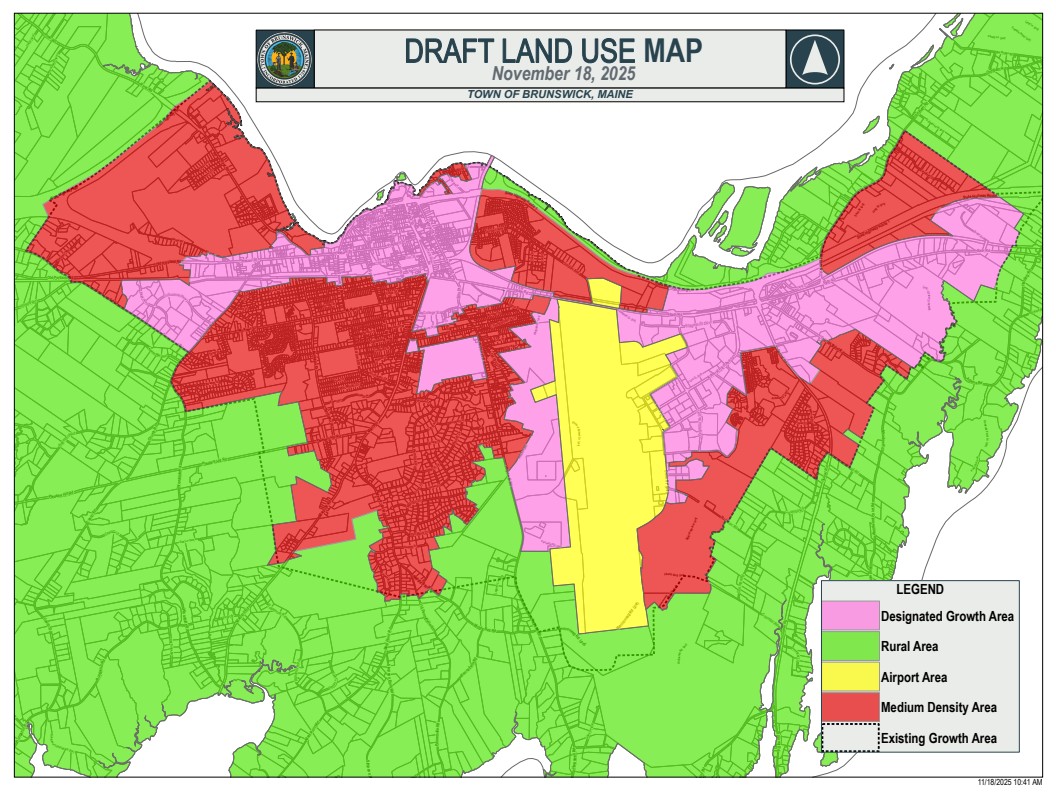
Future decisions about the town’s zoning will need to be consistent with this framework as well as other recommendations in the plan. Future decision-makers will retain some flexibility on how to create standards for individual areas, adjust zoning districts or undertake area-specific master planning.
What questions might come up in the public hearing, and how would you respond?
The Planning Department has been receiving a lot of questions recently about the revised designated growth area and why the committee decided to shrink it.
The state has recently adopted laws that require municipalities to allow for high-density development within the designated growth area. The town’s existing growth area is vast and includes 27 zones, which range from neighborhood to industrial districts.
One of the purposes of the draft plan is to responsibly control growth. In response to the state preempting what has traditionally been a local authority to determine, it was a natural moment to rethink where the town could stand higher density potential being created. By reducing the designated growth area, the town retains some control while being able to continue to evaluate what the appropriate levels of density are within residential neighborhoods.
In recent years, our community has experienced a disproportionately high amount of housing development, and many in the community have expressed concerns about this pace. A reduced growth area helps the town keep higher densities where existing services and public transit are nearby and this also lets the town be more targeted about significant changes which could adversely impact residential neighborhoods.

The Times Record Sustaining Sponsor
We believe a community must be informed to thrive. bowdoin.edu

Comments are not available on this story. Read more about why we allow commenting on some stories and not on others.
We believe it's important to offer commenting on certain stories as a benefit to our readers. At its best, our comments sections can be a productive platform for readers to engage with our journalism, offer thoughts on coverage and issues, and drive conversation in a respectful, solutions-based way. It's a form of open discourse that can be useful to our community, public officials, journalists and others.
We do not enable comments on everything — exceptions include most crime stories, and coverage involving personal tragedy or sensitive issues that invite personal attacks instead of thoughtful discussion.
You can read more here about our commenting policy and terms of use. More information is also found on our FAQs.
Show less