
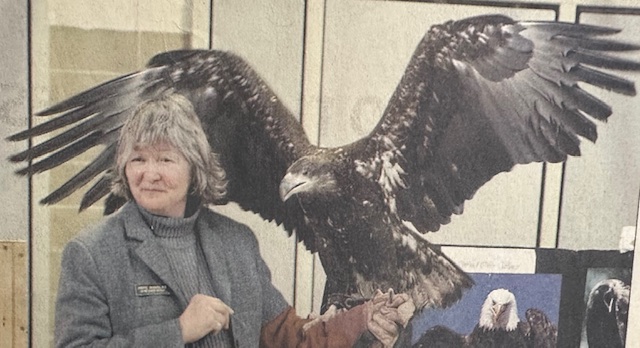
While visiting a former mentor in Naples, Florida, in the late 1990s, Hope Douglas saw a blind red-tailed hawk at the Nature Conservatory. The bird was dependent upon the conservatory, but it was doing well.
“I was captivated by its power and strength and courage,’’ she recalled.
That chance encounter changed her life.
Right after Douglas returned to her home in Connecticut, she resigned from her job as executive director of the Child and Family Agency in New London, Connecticut, to pursue a new vision. She wanted to establish an organization that would rehabilitate wildlife — primarily raptors and other birds — and then release them to the natural environment. The birds that could not safely return to the wilds could then be used to share the lessons they can impart, despite having incurred some debilitating injury.
“Wind Over Wings” made a profound impact on thousands of people as well as birds for nearly 30 years, first in Connecticut and later in Maine, after she and her partner Carol Fackler moved to Dresden in 2012. She and other volunteers for Wind Over Wings made over 300 presentations per year to school groups, libraries, senior centers and other places during that time span.
The ground rules were clear. She would bring four — and only four — birds to each presentation, often hawks or eagles or cockatoos. She would explain the history of each bird, describing the lesson the particular bird can teach us. The lessons ranged, for example, from life course change or the power of play to the ability to adapt or how to respect natural defenses.
Douglas received hundreds of letters from students and teachers over the years, thanking her for the presentations. Here are but two examples:
“Dear Ms. Hope Douglas,
Thank you for coming to my school, I liked meeting your owls especially. I have never seen an owl in the wild so it was a new experience for me. Wow, the saw-whet owl was the coolest because it didn’t look real. Another favorite was Blanco (the Moluccan cockatoo). Even if he didn’t talk, he danced. That ruled!
I think your organization Wind Over Wings is a great idea because you really do save the lives of millions of birds.
Sincerely, Jacob Willis
P.S. Save this signature because it’ll be worth lots when I make it to the pros … baseball.”
And another:
“Dear Wind Over Wings,
Hi. I am 8 years old. I just want to say that I feel bad for the birds that have to go to you. You take very good care of them. I’m glad you like birds. I’m a bird lover myself.
Zach”
It takes time to get an injured raptor ready to be released into the world. It’s even more of a challenge to prepare them to perform in public.
“We often read to the birds to calm them down and get them used to hearing the human voice,” Douglas explained. She refers to birds that perform as “the faculty,” as it is they, not she, who are teaching the lessons. She says she’s not a “bird whisperer.” It might be fair, though, to call her a “bird listener.”
When Douglas developed breast cancer in 2007 she said, “I took inspiration from the birds. All of them were badly hurt, but they didn’t let it stop them. They had taught me how to carry on with dignity. That’s how I approach cancer.”
Douglas is also a master storyteller. For example, she told the story about driving to Wisconsin to pick up Blanco, a Moluccan cockatoo, and bring him back to Connecticut. When Blanco’s owner, Marge, introduced her as someone who had driven miles to come and get him and bring him home, he said, “Egad, what’s wrong with her.” Blanco did not want to leave and repeatedly told Douglas that he was a “bad bird” so she wouldn’t take him. He also told Douglas he was sad.
Ultimately, she gained Blanco’s trust; they became friends, and he became a star performer.
And another. She was invited to bring one of her most popular birds to a fancy dinner party at a country club. When asked if he wanted crackers, the bird said “Yes.” When asked if he wanted water he said, “Yes, to wash down the crackers.” The dinner guests couldn’t believe the bird had really talked. They asked Douglas if she was just throwing her voice. The bird got frustrated and called one of the ladies “stupid.”
“We never got invited back,” Douglas said with a smile.
And yet another. During a presentation at a high school, one of the boys was dressed in a macabre T-shirt with a knife going through a skull and other sordid images. The bird said to the boy, “What’s your problem?”
Did you know that one of the Philadelphia Eagles mascots is an American bald eagle named Noah? Douglas was instrumental in rehabilitating Noah after he survived an 80-foot fall from a tree at just 8 weeks old.
During our conversation, Douglas noted that Mozart was inspired to write the opening bars of his “Piano Concerto No. 17” by listening to the singing of his pet starling.
A thank-you note from a teacher who had observed many presentations conveys the deep impact Hope Douglas had on so many people over the years.
“It is amazing to me that you always recognize others when it is YOU who is to be admired. What a treasure you have been for so many — both human and feathered. Initiating and fostering a love of all living creatures, and the important role we humans play in their survival has been a priceless gift to our children, especially. Your school visits will remain with all of us forever.”
As Hope Douglas says, we can learn a lot from birds. Clearly, we can also learn from this woman who dared to change her life course to pursue a fine vision. I’m sure that Blanco, the Moluccan cockatoo, and all his fellow feathered faculty and, yes, even Mozart would agree.
David Treadwell, a Brunswick writer, welcomes commentary and suggestions for future “Just a Little Old” columns at [email protected].

The Times Record Sustaining Sponsor
We believe a community must be informed to thrive. bowdoin.edu
Comments are not available on this story. Read more about why we allow commenting on some stories and not on others.
We believe it's important to offer commenting on certain stories as a benefit to our readers. At its best, our comments sections can be a productive platform for readers to engage with our journalism, offer thoughts on coverage and issues, and drive conversation in a respectful, solutions-based way. It's a form of open discourse that can be useful to our community, public officials, journalists and others.
We do not enable comments on everything — exceptions include most crime stories, and coverage involving personal tragedy or sensitive issues that invite personal attacks instead of thoughtful discussion.
You can read more here about our commenting policy and terms of use. More information is also found on our FAQs.
Show less