
Around 1807 Napoleon was well on the way to subduing all of Europe on the battlefield, having crowned himself Emperor of France in 1804. He did this with a new approach to warfare which prioritized efficiency, timely communication, keen topographical sense, accurate observation of evolving conditions, and a willingness to abandon tradition for the sake of superior results. In the end, Napoleon’s biggest problem was probably too much success.
Along the way, though, he invested heavily in a new visual telegraph system invented during the French Revolution by Claude Chappe and perfected for use in the field by 1803. Mechanical arms mounted on the top of signal towers were manipulated puppet-like with cords and chains to form semaphores which spelled out encoded words — visible during daylight hours with a telescope from the next tower over, usually about 6 miles distant. Using this Napoleonic semaphore, or système Chappe, detailed messages could be relayed quickly, securely and accurately. An order could travel from Paris to Lille (155 miles) in 10 minutes, with news of Napoleon’s son’s birth reaching Strasbourg (300+ miles) in 60 minutes.
As a result Napoleon built the world’s first industrial-scale optical telegraph network, using chains of 534 towers with movable arms to transmit messages over about 3,100 miles of transmission lines. On the battlefield, makeshift semaphore towers were constructed so that Napoleon could communicate in minutes with commanders spread over miles of uneven terrain. This provided him with greatly increased control over the movements of his forces, increased the flow of information relevant to military decision making, and afforded better chances to surprise his opponents. The system figured heavily in a devastating sequence of French victories spread over a decade of conflict in Europe.
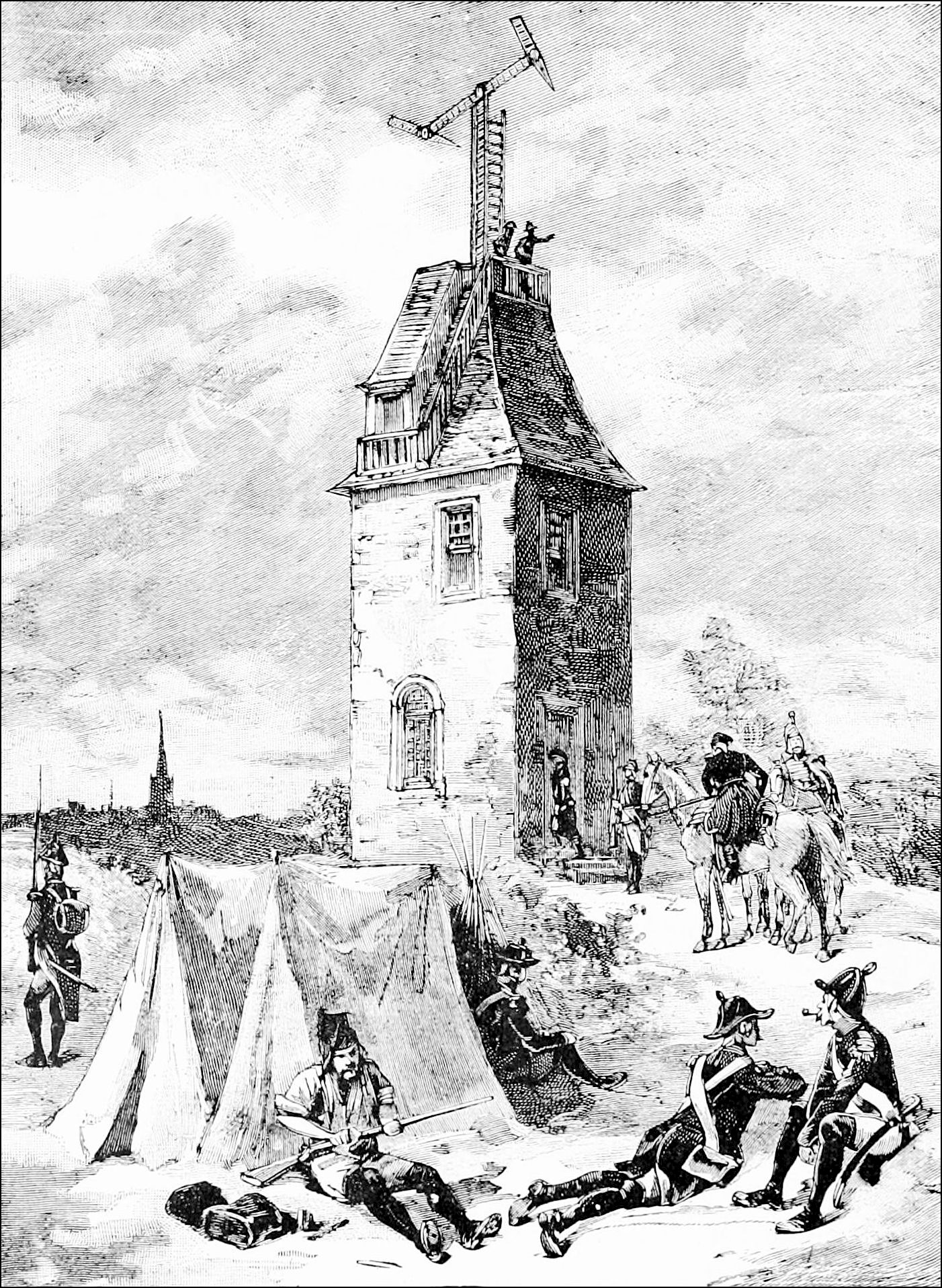
Also in 1807, a retired sea captain named Lemuel Moody completed construction on a monitoring tower at the summit of Munjoy Hill, now known as the Portland Observatory. He did this with a new approach to architecture which prioritized efficiency, timely communication, keen topographical sense, accurate observation of evolving conditions, and a willingness to abandon tradition for the sake of superior results. In the end, he had much success and very few problems.
Moody’s observatory was designed to collect information which many needed and no one else had. This was a valuable service for those shipowners who paid the five dollar annual subscription fee, and therefore a profitable one for Moody, who spent the remaining 39 years of his life doing water traffic control from the best perch in town, relying on the best telescope money could buy. Like Chappe’s signal tower system, and very possibly inspired by it, the Portland tower relied on elevated lines of sight, skilled operators and cutting-edge lens technology to gather and relay specialized information. The earlier Moody could identify a ship approaching Portland Harbor, the more time a paying customer had to assemble people and equipment on the receiving wharf.
Built like a ship and resembling a lighthouse, the Moody tower was neither; it was designed, as all Portlanders know, to identify (weather depending) approaching ships while they were still up to 30 miles out to sea, then report their imminent arrival to interested parties on the wharves. Having spent much of his life on the water, Moody assumed that if a ship could withstand gales and remain upright under the most violent conditions, then a tower built like a ship could withstand anything dry land had to offer. His assumption proved perfectly correct, and there probably remains much to learn in town from naval architecture.
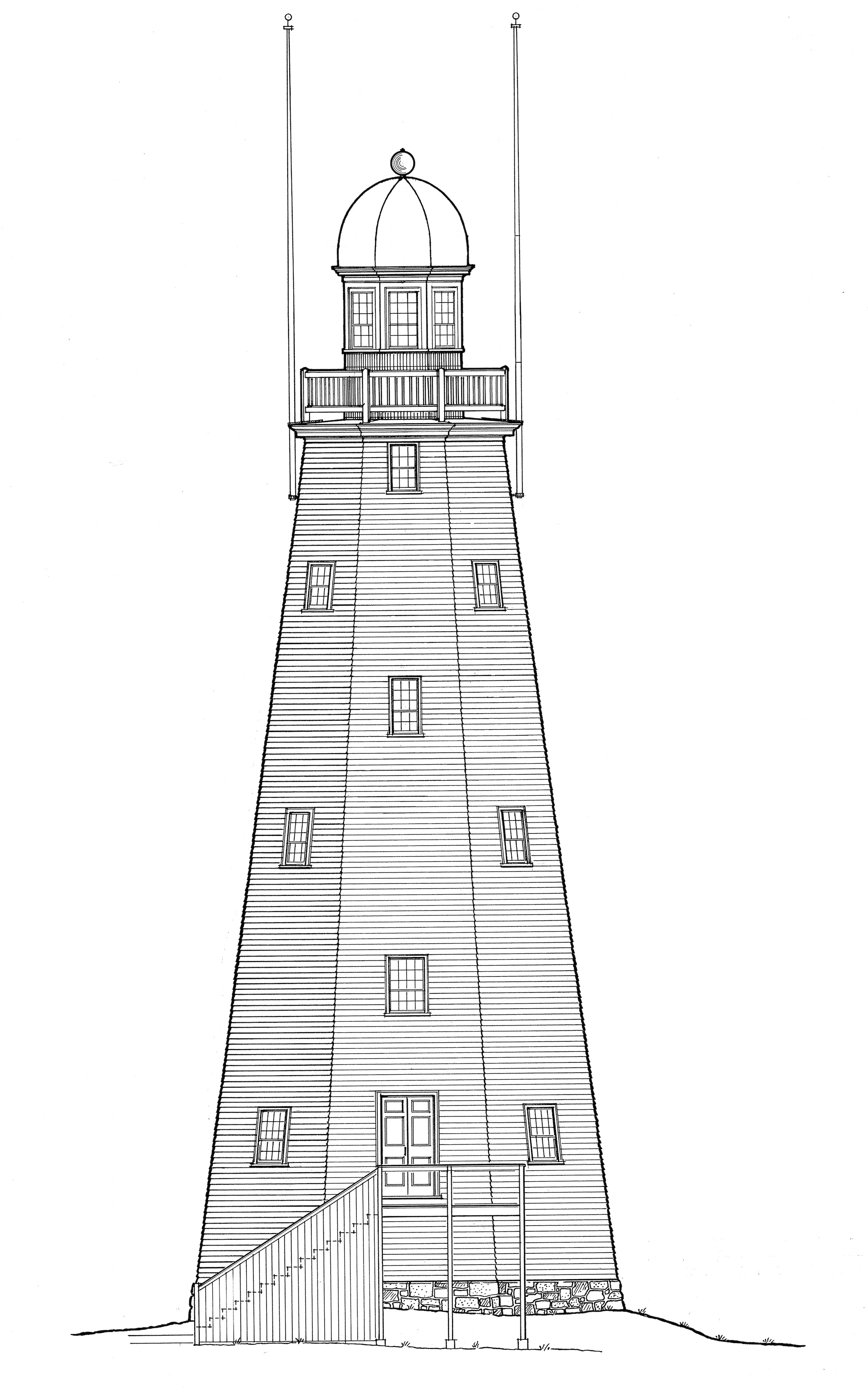
As a result, this tower has ballast rather than a foundation; it stands due to the stabilizing weight of rocks loaded into its ground story, which forms a sort of wooden basket to hold them. The lighthouse form, which this column has previously examined both as a faulty metaphor and as a functional model, was correctly perceived by Moody as the most sensible way to achieve the elevation he needed to help port commerce to perform more efficiently, converge forces on the wharves more rapidly, and run his business effectively.
All this results in another amicable example of architecture without an architect, where breaking the rules and conventions produced a stronger, more attractive structure. If you look carefully you will find many more hymns to the vernacular throughout the Old Port and Maine as a whole, each testifying in a pleasing way to the realization that good architecture solves a shared problem efficiently, with or without familiar styles, shapes or materials. (For even more mouthwatering examples in this line, please consult Rudofsky’s wonderful 1964 book “Architecture without Architects.”) In most cases, the person most likely to solve such a problem convincingly is the one most familiar with it, rather than the one with a particular diploma.
It should be clear by now how much Moody and Napoleon had in common, eagle-like, telescopes in hand, scanning their horizons, tracking large movements with a specialist’s eye, watching for unexpected or hazardous developments. Both knew that reliable information received early is precious. This knowledge led both, one peacefully and one violently, to invest heavily in elevated visual semaphore systems which would focus, amplify and transmit valuable facts with speed. In Portland, Moody used flags to identify approaching vessels (which they would raise when they were in range of his telescope) and alert ships’agents on the wharves below (which he would raise at the top of the tower so that they could be seen with telescopes from the waterfront). The result was an information relay system working roughly like this for a Star Line cargo vessel approaching Portland harbor:
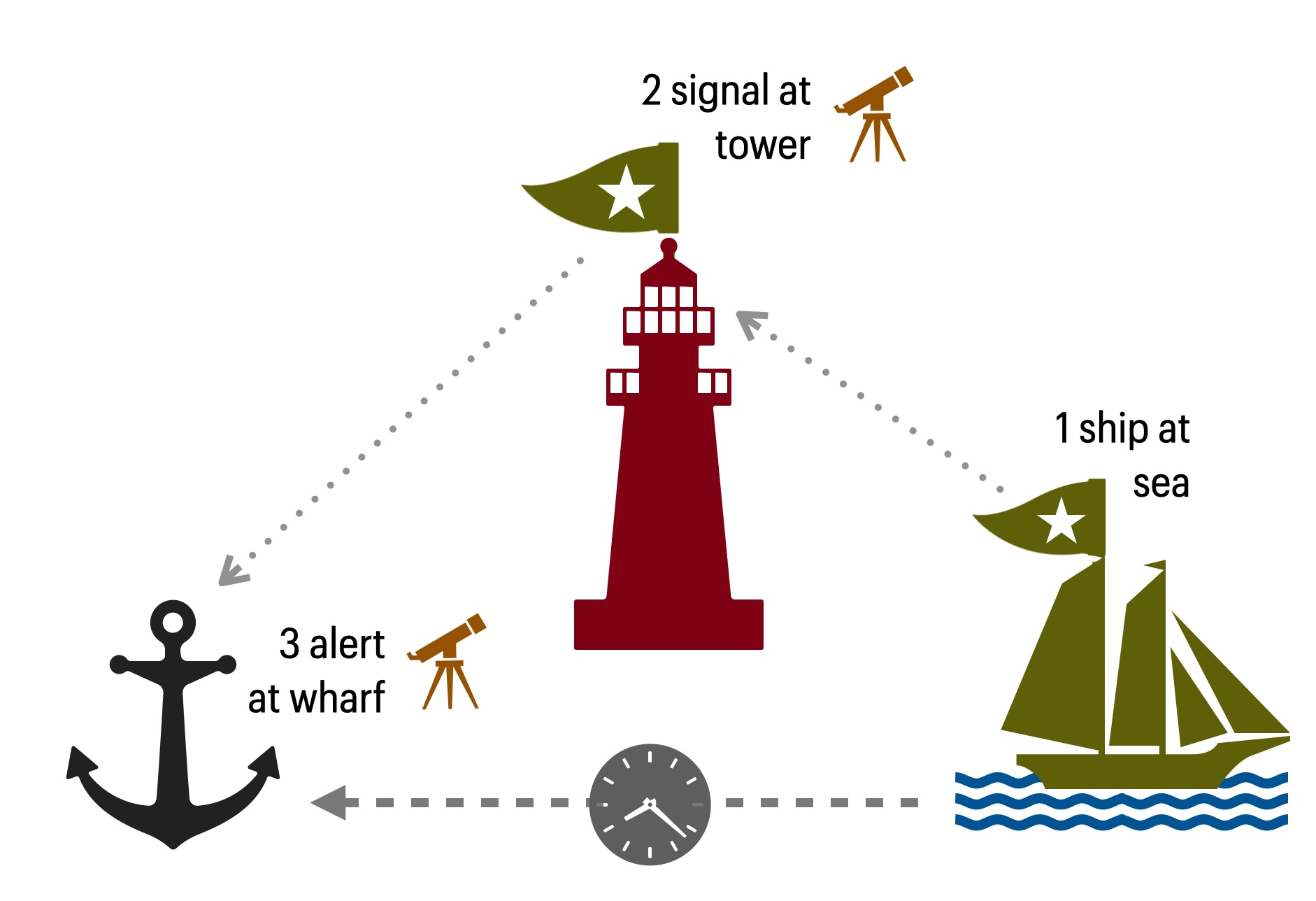
…to form an early social media network which integrates position, identity, signal, relay, visibility, commerce, distance, amplification and anticipation in an admirably efficient daisy chain of lens-enabled pay-to-play recognition. It is not difficult to see a family resemblance that joins several towers, old and young, to this delightfully complicated game of see and be seen: Chappe signal tower from the Napoleonic period (1804), Portland Observatory (1807), Matinicus Rock Light (1857), and cell phone tower (2018).
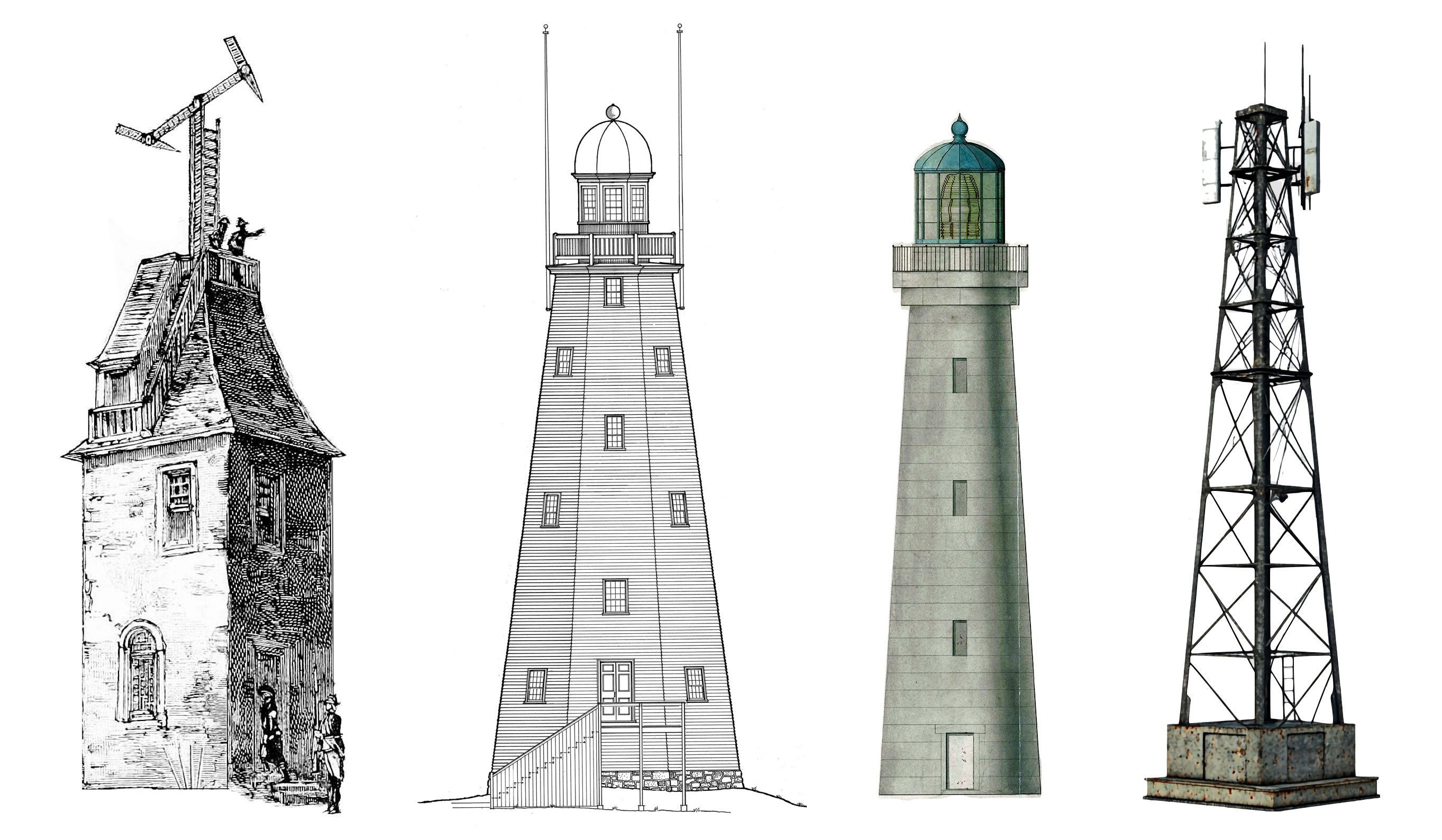
The oldest and the youngest seem to have the most in common, both functionally and formally. How strange!
What surely has changed is the value of information being relayed tower to tower. In Napoleon and Moody’s time, small parcels of simple information were coveted. They could change the outcomes of lives, wars, and fortunes. Given the care and expense of moving even short sentences over large distances, the quality and importance of the messages were generally high. Now we have floods of complex information, moving almost without cost, over unlimited distances, while the quality of the messages is generally low. Getting lower.
These relay towers, once built for better efficiency, coordination and clarity, have become unreliable. With slowly mounting exhaustion, we look, we listen, we reply, and yet our ships will not come in.
Jon Calame teaches art history at the Maine College of Art and Design and the University of Southern Maine. This column is supported by The Dorothea and Leo Rabkin Foundation.
We invite you to add your comments. We encourage a thoughtful exchange of ideas and information on this website. By joining the conversation, you are agreeing to our commenting policy and terms of use. More information is found on our FAQs. You can update your screen name on the member's center.
Comments are managed by our staff during regular business hours Monday through Friday as well as limited hours on Saturday and Sunday. Comments held for moderation outside of those hours may take longer to approve.
Join the Conversation
Please sign into your Press Herald account to participate in conversations below. If you do not have an account, you can subscribe here. Questions? Please see our FAQs.