


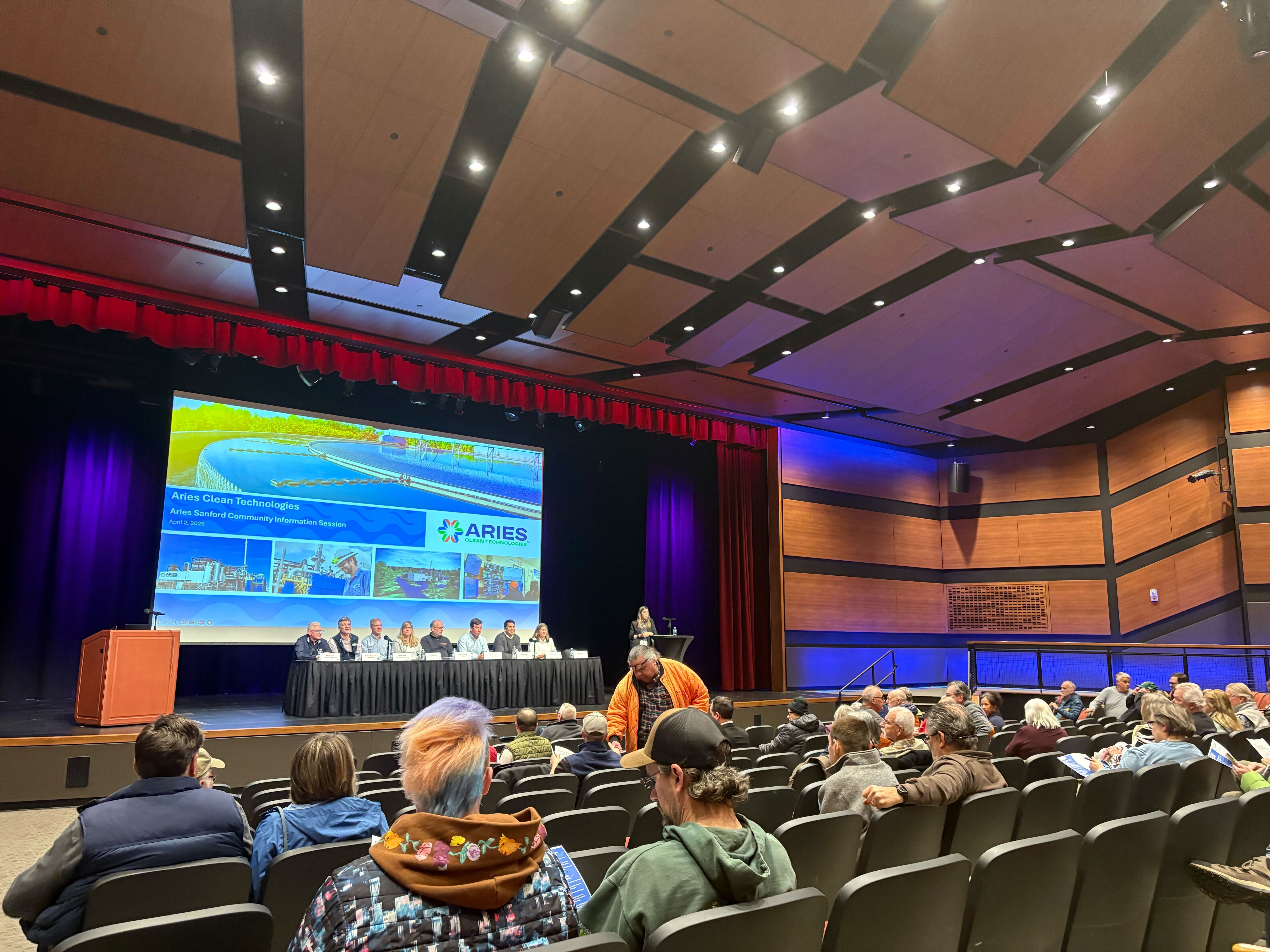
SANFORD — Protesters gathered outside as residents sat scattered throughout the Sanford Performing Arts Center on Thursday night to ask questions about, and in many cases push back against, a proposed sewage sludge treatment plant.
Tennessee-based Aries Clean Technologies wants to build the $65 million facility on an 11-acre site along Cyro Road. The company says the waste-to-energy plant would be able destroy almost all the “forever chemicals,” or PFAS, in dried municipal sludge — a possible solution to the growing problem of what to do with the wastewater treatment byproduct since Maine banned sludge-based fertilizers in 2022.
But many residents who attended Thursday’s forum to pose questions to Aries representatives and city leaders were skeptical about the science behind the plant, the possible side effects of opening such a facility, and why Sanford was chosen. Several times, audience members, unsatisfied by the answers they were given, unleashed a chorus of jeers and boos.
Ahead of the forum, a small crowd of protesters gathered outside, bearing signs that read “our home, our health, say no to Aries,” “not a waste hub” or simply “protect Sanford.”
The forum was structured in a Q&A style, with residents posing questions to an onstage panel comprising Aries company officials, scientists working with the company, a representative from an investment firm backing the project and Sanford City Manager Steven Buck. The town hall-like event followed a February open house that many attendees complained was poorly arranged and overcrowded.
The event began with a presentation about how the plant’s technology would work, as well as the benefits Aries says will come from its involvement in the community, both economically and environmentally. Mark Lyons, Aries’ senior director of business development, has said the project would create 30 full-time jobs, plus hundreds of temporary construction positions.
Lyons kicked off Thursday’s forum by saying, “Aries is committed to operating transparently, safely and in compliance with strict environmental regulations.”
Still, many questions focused on emergency protocols, the efficacy of the PFAS destruction and other environmental impacts. Residents also shared concerns about a similar Aries gasification plant in Linden, New Jersey, that was idled in 2025 because of funding and efficiency issues.
The Sanford proposal boasts destruction of 99% of PFAS — a statistic that had many residents unconvinced.
Kristin Davis, who lives on the town line between Sanford and Wells, referenced a report that indicated the now-idled New Jersey plant only achieved 97% PFAS destruction.
Panelist Dale Raczynski, principal of environmental engineering company Epsilon Associates, said the Linden plant never reached 99% because of the temperature at which it operated. While that plant burned sludge at 1,800 degrees Fahrenheit, the Sanford facility would heat it to 2,200 degrees.
Raczynski also told Davis that she was taking the report out of context. The audience booed in response.
“When your first plant is not even working today, you’re asking us to swallow a very big pill, and that’s ridiculous,” Davis told the panel.
Rick Southwick, the water quality tester for Estes Lake, asked about the current amount of PFAS in the lake and how the plant’s proximity to the Mousam River could impact pollution levels.
Jason Dana, vice president of technology at Aries, responded by saying that the plant would actually reduce the concentration of PFAS being discharged by Sanford’s Sewerage District.
Several other attendees repeatedly asked why Sanford was chosen. The panel responded each time by saying it was a combination of zoning requirements, the acreage necessary to build such a plant and cost considerations.
Sanford resident Kevin Martineau said he wished residents had more say in the development of the project.
“I still have concerns: odor, PFAS, long-term contamination,” he said after the event. “Sanford’s already had a history of large-scale mill development problems. That makes me a little bit cautious.”
At the February open house, Buck, the city manager, said the plant’s future is currently in the hands of the Maine Department of Environmental Protection. The project needs state approval for both an air emission permit and as a solid-waste processing facility.
David Madore, deputy commissioner for the Maine DEP, confirmed Friday that the department has received a permit application for the Aries facility. He said the department plans to conduct a formal hearing on the matter, for which a date, time and location have not yet been announced.

Comments are not available on this story. Read more about why we allow commenting on some stories and not on others.
We believe it's important to offer commenting on certain stories as a benefit to our readers. At its best, our comments sections can be a productive platform for readers to engage with our journalism, offer thoughts on coverage and issues, and drive conversation in a respectful, solutions-based way. It's a form of open discourse that can be useful to our community, public officials, journalists and others.
We do not enable comments on everything — exceptions include most crime stories, and coverage involving personal tragedy or sensitive issues that invite personal attacks instead of thoughtful discussion.
You can read more here about our commenting policy and terms of use. More information is also found on our FAQs.
Show less