


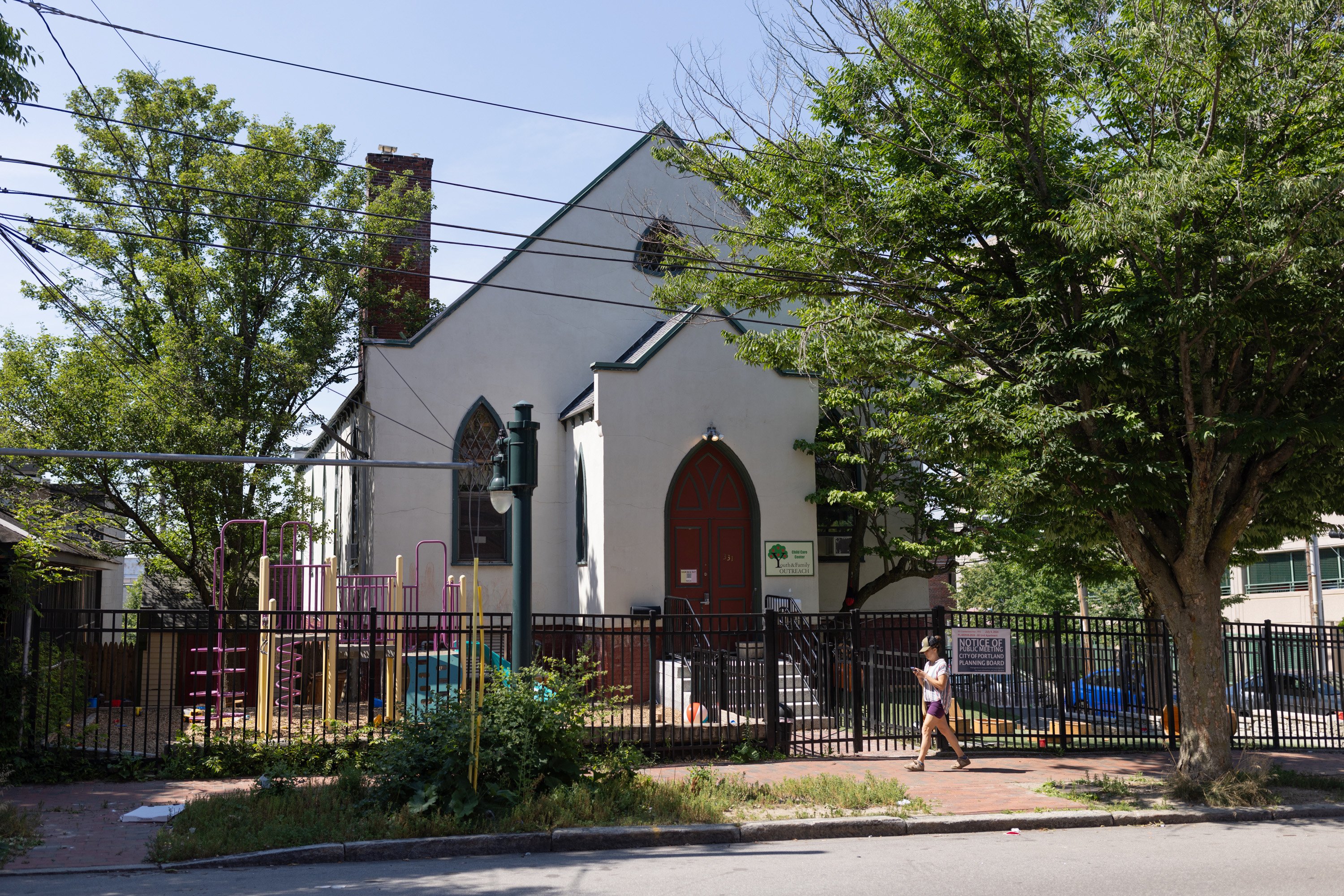
Rain poured from dark clouds last Friday as an excavator tore through a Portland chapel that had stood for nearly 175 years. By Easter Sunday, it was a pile of rubble.
Camelia Babson-Haley, executive director of the nonprofit Youth and Family Outreach, which owns the property at 331 Cumberland Ave., said it was “traumatic” to watch the building she worked in for 26 years razed, but said the forthcoming redevelopment will double the organization’s capacity to serve the community.
“It was incredibly difficult to see the chapel come down,” she said. “However, I also value progress and the community getting its needs met, and what we’re going to build is going to be an incredible resource.”
The $28 million project, approved by the city planning board in 2024, will create a “resource hub” for families with low to moderate income, with a child care center accommodating 110 children, a 60-unit housing development, and community space for partners to provide other services.
Babson-Haley said that before Youth and Family Outreach went to its temporary location in South Portland, the group had 58 child care spots at the chapel. The housing portion of the project, a partnership with the Developers Collaborative, will include 48 affordable units.
Babson-Haley said construction is on track to begin in July, with demolition and environmental cleanup slated to be complete in May.
The sight of the demolition work Friday led to a mix of nostalgia and criticism on social media, with some questioning why the building wasn’t preserved as historic. A few commenters also pointed out the irony of the demolition occurring on Good Friday, the Christian commemoration of Christ’s death.
“Watching these walls crumble today feels like a sort of civic Good Friday,” said Justin Kashuba, who posted a video of the demolition on Facebook.
The demolition permit was issued in February, according to city spokesperson Jessica Grondin.
Greater Portland Landmarks supported efforts to nominate the building for local designation and for listing in the National Register of Historic Places in 2024.
However, the Maine Historic Preservation Commission determined that the building was not eligible for the national register, according to Kate Lemos McHale, executive director of Greater Portland Landmarks.
She said Portland’s Historic Preservation Board considered the history and significance of the chapel but did not pursue designating it as a local landmark.
“While we share the sense of loss that many are expressing, a public review process was carried out, and we recognize that the Youth and Family Outreach organization provides critical services,” she said. “The chapel’s demolition elevates the need for conversation about preservation tools for Bayside and communities like it more broadly, and for salvaging reusable materials when buildings of any age are demolished.”
According to a 1967 article in the Portland Evening Express by Earle Shettleworth Jr., who would go on to become Maine state historian, the construction was the result of an effort by the First Parish Church to establish a Portland “ministry at large,” which served some of the city’s poorest families.
The chapel was built on land donated by Mary Deering Preble and completed in October 1851.
Shettleworth states the chapel was “typical of modest, wooden, Gothic Revival churches that appeared in America during the 1850s,” inspired by the architect Richard Upjohn. In 1924, an expansion was carried out that covered the exterior in stucco, which Shettleworth called “regrettable.”
According to the Youth and Family Outreach website, Portland Ministries at Large, which had overseen the chapel since it was built, filed for nonprofit status in 1979 and was granted independent status from the First Parish Church to conduct its outreach mission. In 1984, the agency began focusing its attention on social services for inner city youth, and a decade later it became Youth and Family Outreach.
“Our root mission remains the same, which is to always be assessing the needs of the community, and to the best of our ability pivot our services in order to meet those needs, which is what we’re doing with this project,” Babson-Haley said.
The City Council voted unanimously in 2024 to approve a no-interest loan of just over $1 million from the city’s housing trust fund for the project.
More recently, it has been delayed due to a federal rule designed to boost American manufacturing, which affordable housing developers say is hampering much-needed projects. Like many others, the team behind the Youth and Family Outreach project has requested a waiver from the U.S. Department of Housing and Urban Development.
Babson-Haley said they are hopeful the waiver will be approved within the next few weeks. If construction begins in July, the organization could be in its new home in the fall of 2027.

We invite you to add your comments. We encourage a thoughtful exchange of ideas and information on this website. By joining the conversation, you are agreeing to our commenting policy and terms of use. More information is found on our FAQs. You can update your screen name on the member's center.
Comments are managed by our staff during regular business hours Monday through Friday as well as limited hours on Saturday and Sunday. Comments held for moderation outside of those hours may take longer to approve.
Join the Conversation
Please sign into your Press Herald account to participate in conversations below. If you do not have an account, you can subscribe here. Questions? Please see our FAQs.