

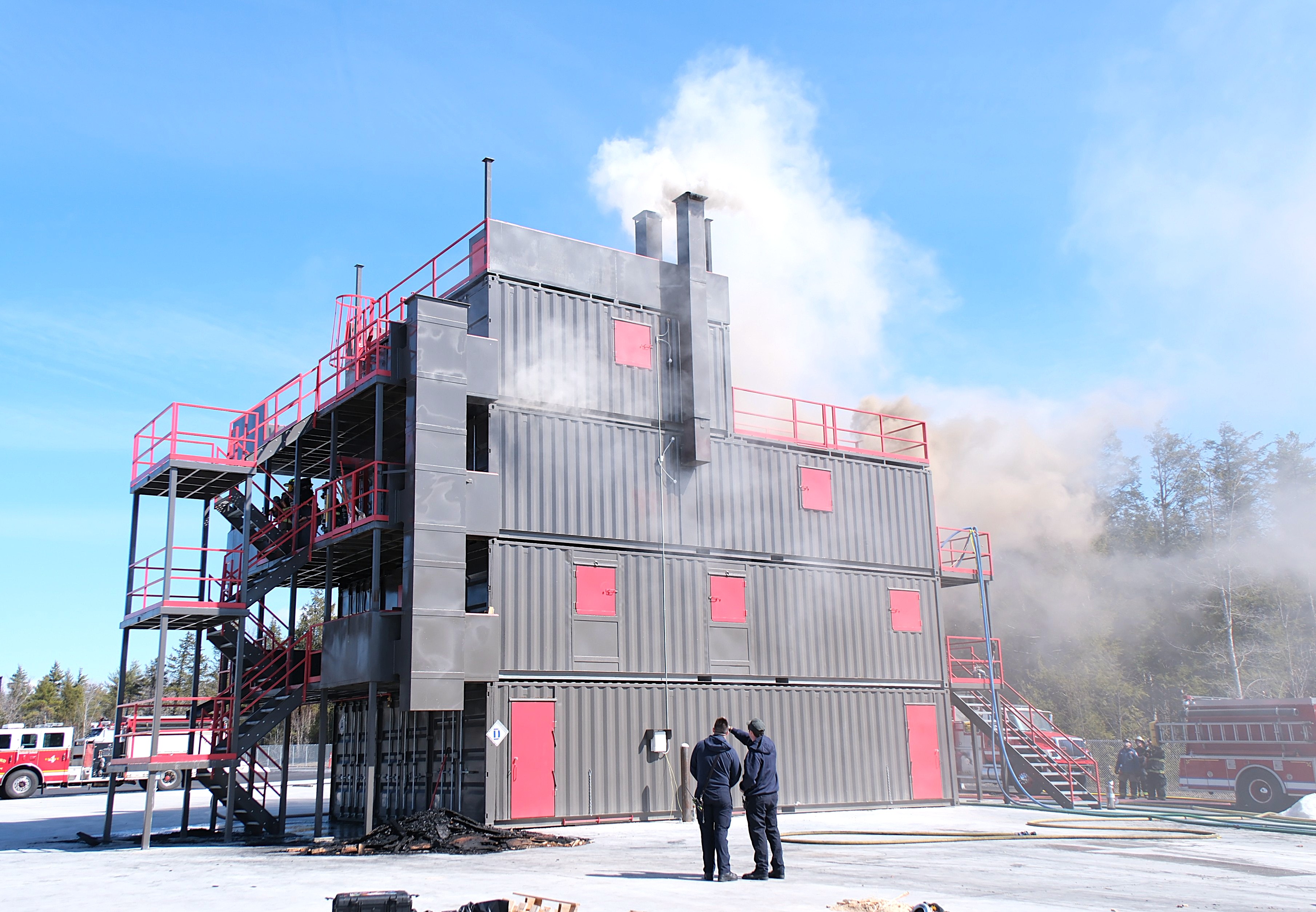
Firefighters dressed in boots and heavy protective gear made their way up five stories and into the steel drill tower, and they made it look easy. After about 20 minutes, heavy black smoke began to emerge from various windows of the structure, and firefighters, all instructors with years of firefighting experience, commenced to put it out.
The drill tower is among the key components of the York County Regional Training Center, the new multi-discipline first responder center for instruction off Route 4 in Alfred. It was used for fire instruction on that sunny, brisk spring day, but its function is broad.
“Law enforcement special response teams can use it for building clearance, ‘officer down’ rescue, hostage rescue and threat recognition scenarios,” said Roger Hooper, the longtime York County fire administrator named director of the training center, last fall. “EMS can use it for patient extrication from restricted access areas and moving patients through staircases. Firefighters can do live fire training, confined space rescue, high angle rescue, search and rescue operations, building ventilation and standpipe operations.”
All of the fire instructors taking part in the recent exercise know how to fight fires. What they were learning on that late March day was how to operate the burn rooms within the tower so they can conduct live fire programs for fire students. It was a “teach the teacher” exercise.
The tower, manufactured by Draeger, an international firm whose U.S. base is in Houston, is five stories and made of recycled steel shipping containers. It sports 12 compartments where instructors can engineer any number of scenarios to prepare students for real-world work. Components of firefighting – ventilation, heat management, door control – and a lot more can be facilitated using the drill tower.
“We’re learning a lot about fire behavior and dynamics,” said Lindsay Hunt, lead instructor in the Firefighter 1 and 2 programs, and deputy fire chief at Ross Corner Fire Company in Shapleigh. “This is called a ventilation controlled building, so students can see things in a safer, cooler environment.”
And while they were useful, the drill tower is a huge step up from makeshift units or donated buildings firefighters have used for training for years.
Sanford firefighter-paramedic Ryan Gaudreau, live fire instructor and technical rescue coordinator for the training center, said the drill tower’s multiple floors sport containers with two or three “rooms,” like an apartment. Before a fire is lit inside for training, there’s a walk- through, he said, so firefighters can keep track of doors, tripping hazards, where the windows are, and more.
Old Orchard Beach Deputy Fire Chief Travis McDonald, a live fire instructor and the training center’s fire training coordinator who is developing the standard operating procedures for conducting live fire training events, said the live exercise was the culmination of the training session for fire instructors.
And while most people unfamiliar with firefighting would not likely think about how something like opening a door could impact a blaze, it can, McDonald said. By opening doors at certain times, “we can change and affect the behavior of the fire,” providing a variety of learning scenarios.
“Timing can make a difference,” said David McLean, a retired Dover, New Hampshire, firefighter and longtime Southern Maine Community College fire service instructor, who oversees instructor professional development at the training center, as he observed operations that day.
As the black smoke emanating from the drill tower turned white, a signal, McLean said that firefighters were applying water to the blaze inside, he voiced the thoughts of many who were working and learning at the scene.
“It will better prepare students to meet the demands of the job,” he said.
For more information about training schedules, visit yorkcountymaine.gov/rtc.
Tammy Wells is media specialist for York County Government.
Comments are not available on this story. Read more about why we allow commenting on some stories and not on others.
We believe it's important to offer commenting on certain stories as a benefit to our readers. At its best, our comments sections can be a productive platform for readers to engage with our journalism, offer thoughts on coverage and issues, and drive conversation in a respectful, solutions-based way. It's a form of open discourse that can be useful to our community, public officials, journalists and others.
We do not enable comments on everything — exceptions include most crime stories, and coverage involving personal tragedy or sensitive issues that invite personal attacks instead of thoughtful discussion.
You can read more here about our commenting policy and terms of use. More information is also found on our FAQs.
Show less