


It’s a sentence on the Maine Military Museum and Learning Center ‘s website, an invitation to the curious and those who remember. It’s also an epitaph to a life dedicated to collecting and sharing stories of servicemen and women.
“If the museum is open, Lee is likely there.”
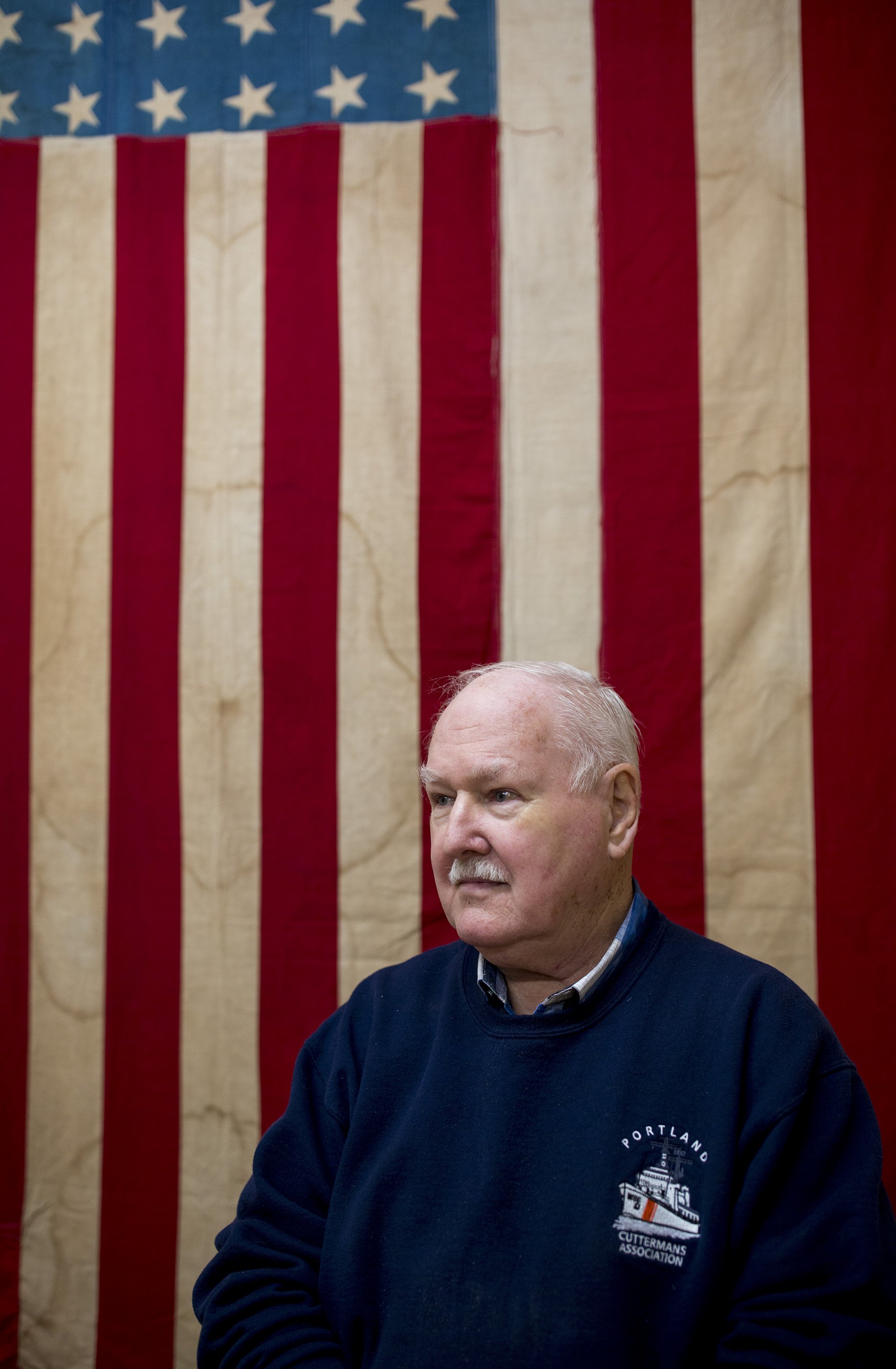
Lee Humiston was the founder, director, curator and lifeblood of the museum, located in the former Veterans of Foreign Wars Post 832 at 50 Peary Terrace, South Portland. The post was converted into a gallery space, teeming with military antiques that Humiston acquired throughout his life.
He died of cancer on Wednesday at the age of 86 while in hospice, his daughter Danielle by his side. He had been living in Old Orchard Beach.
“He’s a part of history now,” said Chris Montagna, one of the volunteers at the museum. The museum plans to rename one of its halls in his honor.
To call Humiston a military buff is an understatement, according to Peter Kane, his best friend.
A veteran of the U.S. Air Force, Humiston gathered thousands of military artifacts, dating back centuries. A cannonball that was fired at Portland during the Revolutionary War. A fife from the Civil War. A Pulitzer Prize-winning photograph from the Vietnam War.
And he always wanted to share his treasures with others.
“He was the sorcerer, the guy who could do it all,” Kane said. “He’s the guy who wouldn’t let things be forgotten or become half-truths.”
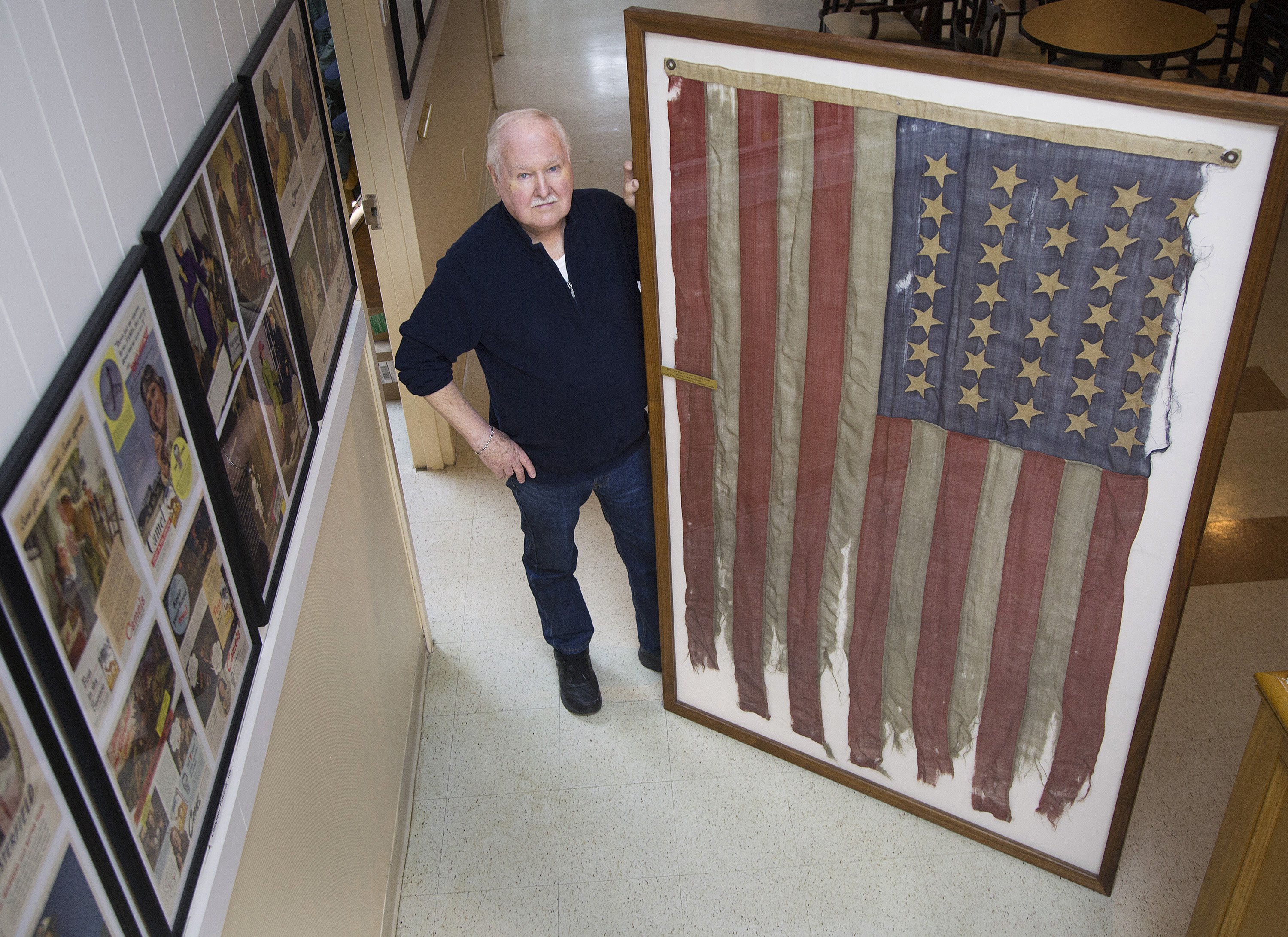
Humiston never met a stranger. He chatted with everyone who entered the museum, believing that every item held a story that should be remembered and retold.
“People would say ‘It’s my grandfather’s coat, it doesn’t mean anything,’” Kane said. “Lee would say ‘Tell me about your grandfather.’”
The museum became a reliquary, a sacred place for veterans and their families, all because of Humiston’s warm curiosity, Kane said.
He gathered one of the most extensive collections of memorabilia and artifacts from Vietnam prisoners of war. His knowledge was vast, and he helped curate two exhibits at the Smithsonian and an exhibit at the Nixon Library. Humiston also collected poems written by prisoners of war held in Hanoi, Vietnam, and Peking, China, for the book “Voices from the Dark.”
“We send him stuff because we know he’s going to do the right thing with it,” said Navy Vice Admiral Ed Martin in 2007.
“They called him the ‘keeper of the flame,’” Kane said. “That’ll be on his tombstone.”
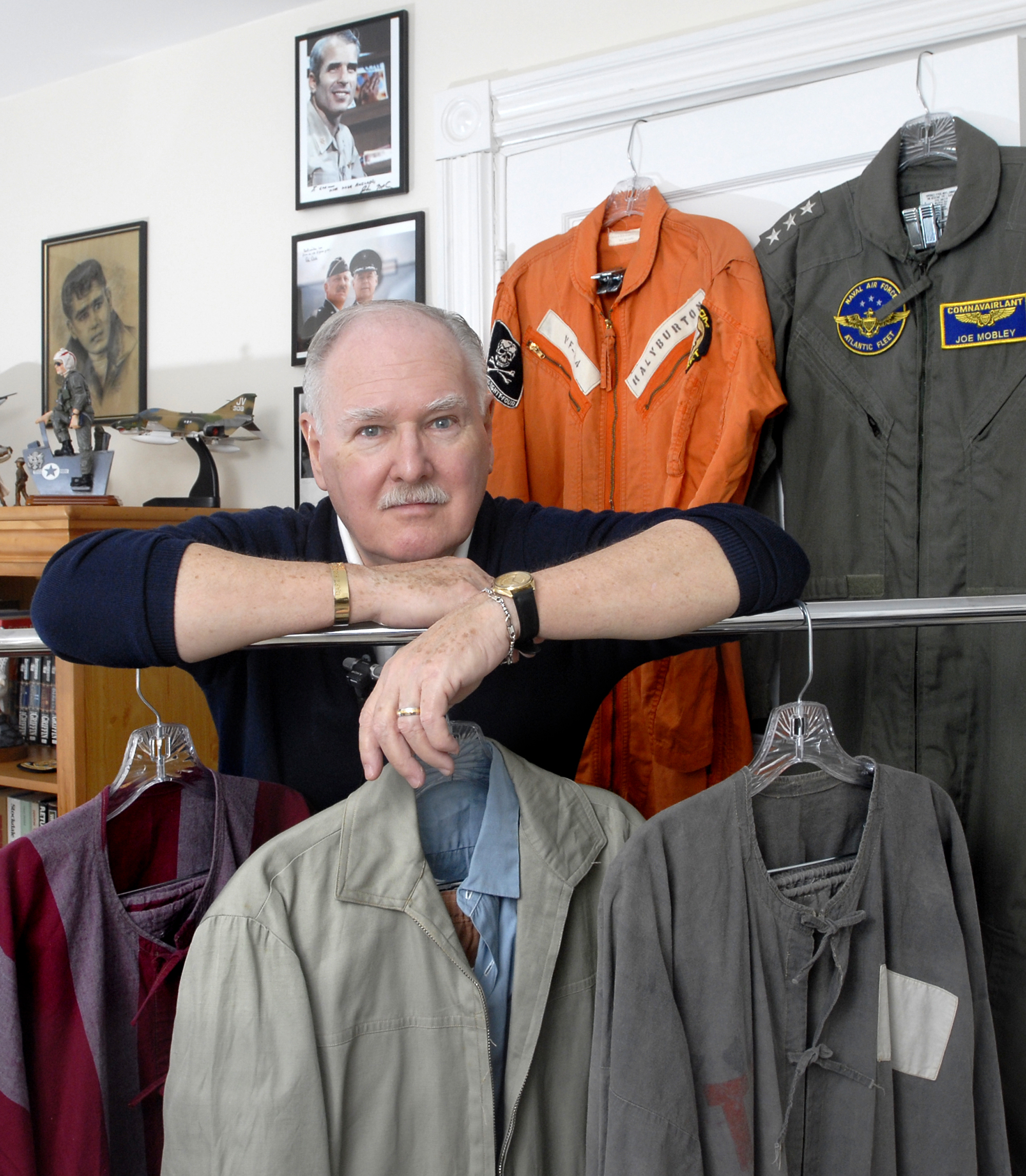
A LIFELONG INTEREST
Humiston was always drawn to the military and its history.
As a small child, he played with the colorful ribbons on his father’s uniform. South Portland was a military town when he was coming of age, with the Liberty Shipyard cranking out crafts for the war effort. When residents began to shed their military gear after World War II, Humiston began to gather it up.
“South Portland had one day in the spring when they’d pick up the trash for free, and there were just barrels with swords, flags, helmets, uniforms and everything else that the wives finally convinced their husbands to get rid of,” he said in an interview with the Press Herald in 2011.
The family’s 1,800 square-foot attic stored uniforms and swords, and he used to play war as a child.
“I had no idea at first that I was preserving history,” he said in 2011. “I just loved the military.”
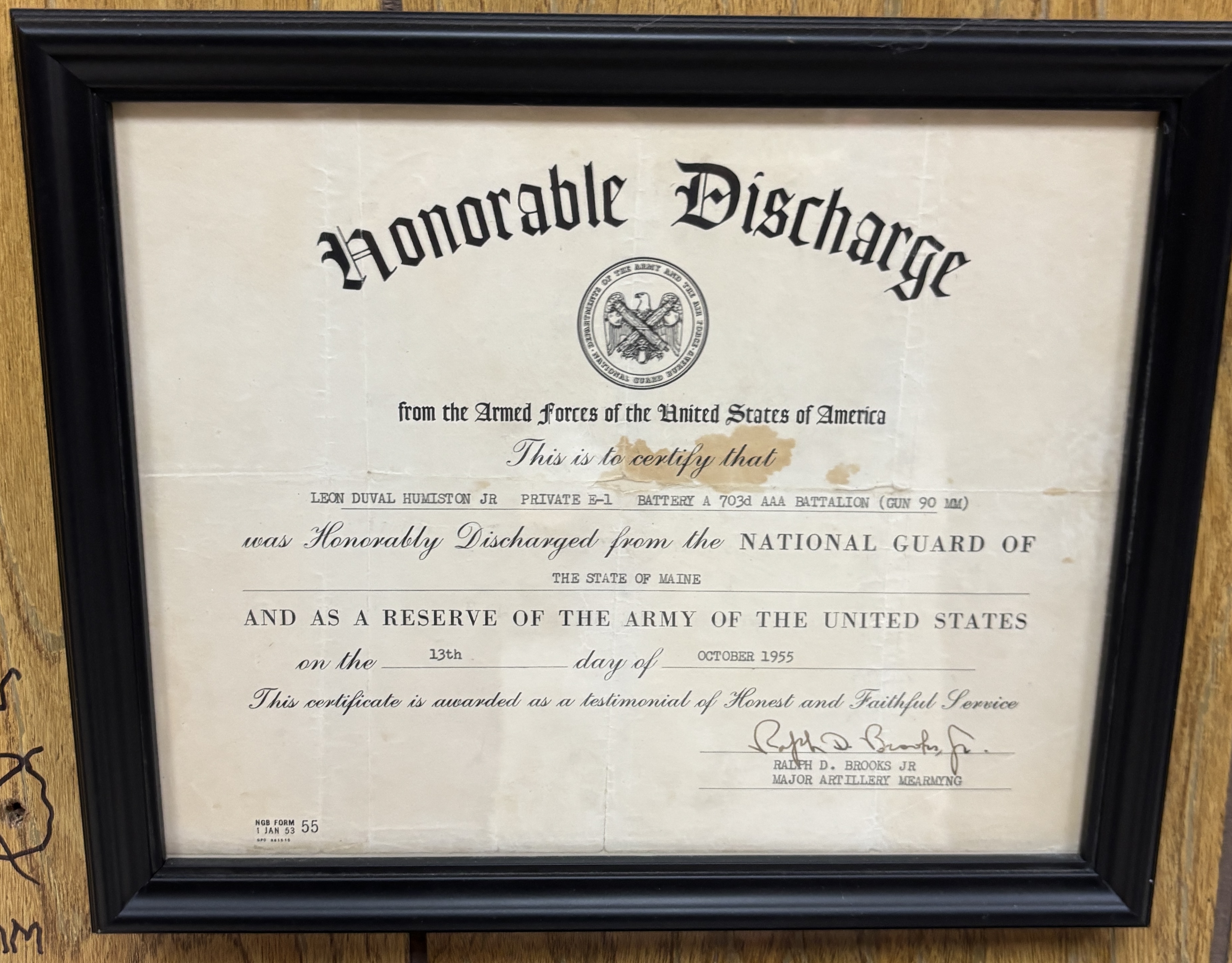
When he was 15, he tried to sneak into the National Guard and was honorably discharged when the higher-ups caught wind of how old he was. The stained document is framed and hangs in the museum’s office.
Humiston enlisted in the U.S. Air Force just prior to the Vietnam War when he was 17 — finally old enough — and spent more than 20 years in service, primarily working in finance. He was placed in a squadron with many World War II prisoners of war, building a rapport with them that extended to Vietnam prisoners of war, according to Montagna. He retired as a lieutenant colonel.
THE COLLECTOR
Humiston’s collection became well-known, especially to those who shared his passion for military antiques.
David Nelson, a fellow aficionado, visited the museum in its early years, curious about Humiston’s collection. The pair chatted about American history and their most prized items, and they immediately recognized a kindred spirit in each other.
“He really knew his stuff,” Nelson said. “He just loved it all.”
Nelson stopped by the museum every couple of weeks to show off his finds or to see what Humiston had acquired. Over the years, the museum gradually became more and more packed with items.
“We just traded back and forth,” Nelson said. “He would go around looking for stuff, wherever he could go.”
Kane, who estimated that he logged more than 15,000 hours volunteering at the museum, remembers driving up to Bar Harbor with Humiston to pick up a Soviet machine gun from 1943.
“Odd things come in,” Kane said. “They find their way here.”
Dozens of military uniforms, helmets and hats. Framed documents and pictures of soldiers. Photo albums of family members who served.
Mark Reilly, who used to deliver Humiston’s mail, remembers how excited Humiston became about every item in his collection.
“He would just look at the return address, and he’d describe the item that was in the parcel and it could be anything from something from the Vietnam War to something from World War II,” he said. “If the person donating it was somebody who had served, he would talk about the person as well.”
THE STORYTELLER
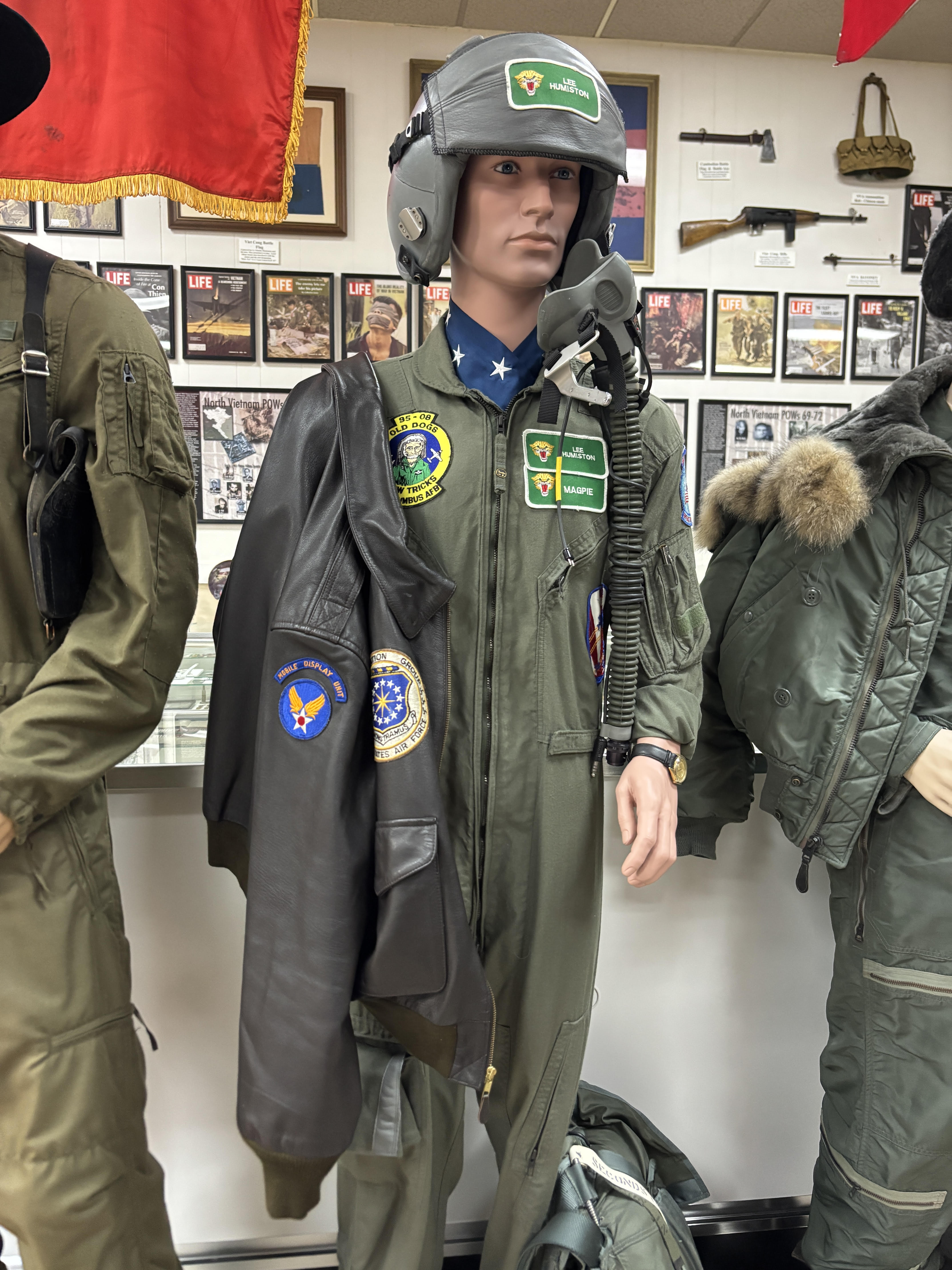
Humiston’s green jumpsuit is displayed on a mannequin in the museum. There’s a Kelly green pouch tacked to the left breast with his full name embroidered next to a roaring tiger. Beneath it is a patch embroidered with one word: ‘Magpie.’
It was his nickname in wartime because he always loved to talk.
“It was almost ‘Chatty Cathy,’” Kane said.
Humiston gave tours to anyone who visited the museum, including Nelson’s grandchildren.
“He knew about everything in there,” Nelson said.
John Ferland, a member of the 265th Air National Guard Squadron in South Portland, visited the museum regularly for retirement parties and holiday events, all of which Humiston hosted for free for service members.
“He was very patriotic,” Ferland said. “He loved the country and anybody who fought to defend it. He’d do anything he could to support them in any way he could.”
Ferland remembers that Humiston was in his element when he was sharing.
“He was like a kid in a candy store,” Ferland said. If the person who donated an item didn’t know everything about it, he would research it himself.
AN ENDURING LEGACY
The museum will continue its mission, supporters say.
It’s been registered as a charity and put in the hands of trustees, or the “dedicated followers” of Humiston’s vision, according to Kane.
And the next generation of military historians will preserve and share the oral histories.
Staff Sergeant Thomas Lundy, an airman in the U.S. Air Force, volunteered at the museum on weekends for the past two years. Humiston became a friend and mentor.
“He was like a grandfather to me,” he said.
Humiston told him stories about his youth in South Portland and they shared about their time in the Air Force, separated by decades. Sometimes, they’d watch old movies together, and he’d tell Lundy the significance of certain events or what happened to the actors.
“Lee taught me the skills to keep the flame there going,” Lundy said, such as framing, artifact restoration and how to give meaningful tours.
“I was kind of like an apprentice,” he said. Lundy’s on the board of directors, and he’s decided to stick around in New England more permanently because of the museum.
And like any friend, he learned Humiston’s quirks. He drank hot chocolate every day, Lundy remembered, no matter how warm it was outside. And he always stirred it with a U.S. military-issued mess kit spoon.
At the end of every volunteer shift, Lundy gave Humiston a hug and told him he’d see him again next week. He’s devastated that he won’t be able to do that again.
“The man was a rare soul,” he said.

We invite you to add your comments. We encourage a thoughtful exchange of ideas and information on this website. By joining the conversation, you are agreeing to our commenting policy and terms of use. More information is found on our FAQs. You can update your screen name on the member's center.
Comments are managed by our staff during regular business hours Monday through Friday as well as limited hours on Saturday and Sunday. Comments held for moderation outside of those hours may take longer to approve.
Join the Conversation
Please sign into your Press Herald account to participate in conversations below. If you do not have an account, you can subscribe here. Questions? Please see our FAQs.