

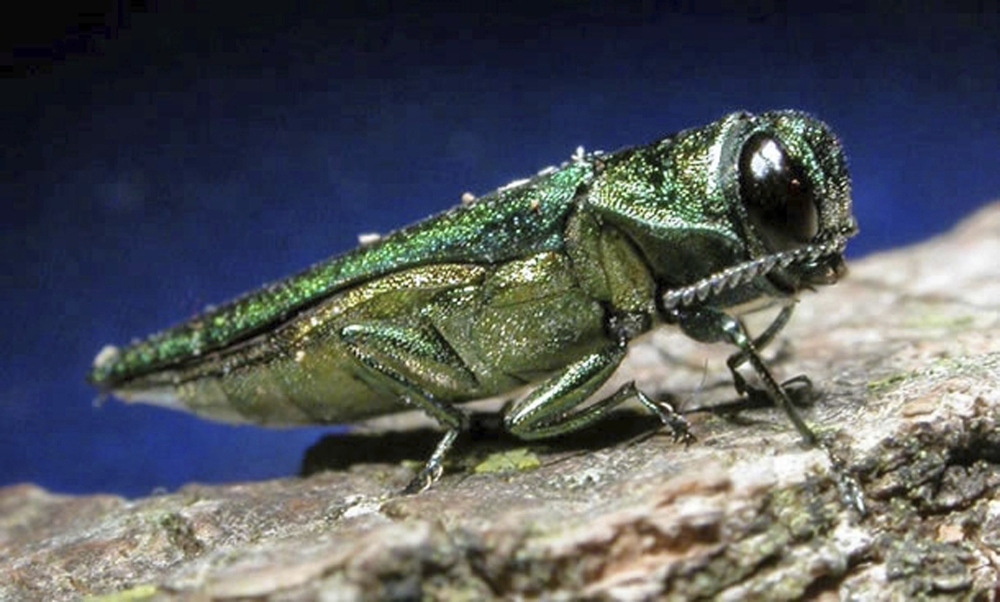
An invasive species was found in southern Aroostook County trees this month, far north and south of where the species is known to be in Maine.
A logger reported a tree in Benedicta that they suspected was infested with an emerald ash borer this month and their presence has since been confirmed, the Maine Forest Service said in a notice Friday.
The invasive species can injure and kill ash trees and cause them to become brittle, and the agency considers them “one of the most serious invasive species threatening our forests.”
The emerald ash borer is a small wood-boring beetle from Asia that invaded North America via transported wood, according to the Forest Service, and was first detected in Maine in 2018.
Most of southern and central Maine, and part of northern Aroostok County, are considered quarantine areas, meaning ash wood should not be transported outside those areas.
That includes all of Androscoggin, Cumberland, Kennebec, Knox, Lincoln, Sagadahoc, Waldo and York Counties. Parts of Franklin, Hancock, Oxford, Penobscot, Piscataquis, and Somerset Counties also fall in emerald ash borer quarantine areas, and the part of northern Aroostook County.
The invasive species’ significant jump to southern Aroostok County indicates it wasn’t a natural journey. The Forest Service has initiated a new quarantine zone in the Benedicta area that extends into part of north-central Penobscot County.
“This new detection is far removed from any area in Maine where emerald ash borer is found, meaning it is likely the result of human movement of infested ash material outside of Maine’s existing quarantine boundary,” the Forest Service’s alert states. “This highlights the importance of not moving things like firewood, as this action can have real consequences, not just for the ash resources of Maine but for other trees as well.”
In addition to adding the Benedicta area as a quarantine zone, the Forest Service expanded existing quarantine zones in central Franklin and southern Somerset and Piscataquis counties this month.

Comments are not available on this story. Read more about why we allow commenting on some stories and not on others.
We believe it's important to offer commenting on certain stories as a benefit to our readers. At its best, our comments sections can be a productive platform for readers to engage with our journalism, offer thoughts on coverage and issues, and drive conversation in a respectful, solutions-based way. It's a form of open discourse that can be useful to our community, public officials, journalists and others.
We do not enable comments on everything — exceptions include most crime stories, and coverage involving personal tragedy or sensitive issues that invite personal attacks instead of thoughtful discussion.
You can read more here about our commenting policy and terms of use. More information is also found on our FAQs.
Show less