

My outdoor club, the Penobscot Paddle & Chowder Society (PPCS), has scheduled a whitewater paddling trip on Kingsbury Stream in Abbott every April for over 30 years. Most of those years, club member Kyle Duckworth has coordinated the trip. On a couple of occasions, ice prevented navigation; otherwise, there has usually been plenty of water for an exciting descent of the Class II, III and IV rapids on the stream. This year, the trip was doubtful due to low water.
A week before the scheduled Kingsbury Stream April 12 trip, Kyle began following the U.S. Geological Survey online gauge report. The news was disappointing since the level was low and dropping. Two days before the trip, the gauge had diminished to a minimum runnable flow. Adding to the negative news, cool, gusty winds were forecast. However, there were some hopeful signs: rain showers were predicted for the night before the trip and somewhat warmer temperatures were an indication that snowmelt would increase. Kyle decided to gamble — a trip was on!
Since Kingsbury Stream is located in Piscataquis County, a lengthy traveling distance for most members, club interest waned given the gloomy outlook. However, in hopes of continuing the tradition, a few of us opted to take a chance and join Kyle.
When five PPCS Chowderheads arrived at the put-in on Route 16 in Abbott, the gauge had risen to over 400 cubic feet per second (CFS). We were encouraged to find the level at the put-in adequate for an enjoyable descent. The weather was less appealing with light snow falling and gusty winds blowing.
Undeterred, we transported shuttle vehicles to the take-out near the village of Abbott. By the time we returned and were ready to embark, the sun was out and the high banks of the stream sheltered us from the wind.
The trip begins with a steep, complex Class IV ledge drop. Four of us decided to launch below the pitch while Kyle boldly plunged over the left side and successfully maneuvered around boulders and through breaking waves to the bottom. Once Kyle safely joined us, we were off on our voyage.
A succession of long Class II/III rapids ensued. While the water level was less than optimal, wave trains were fluid and we had sufficient water. Our unanimous conclusion: the decision to paddle was the right one.
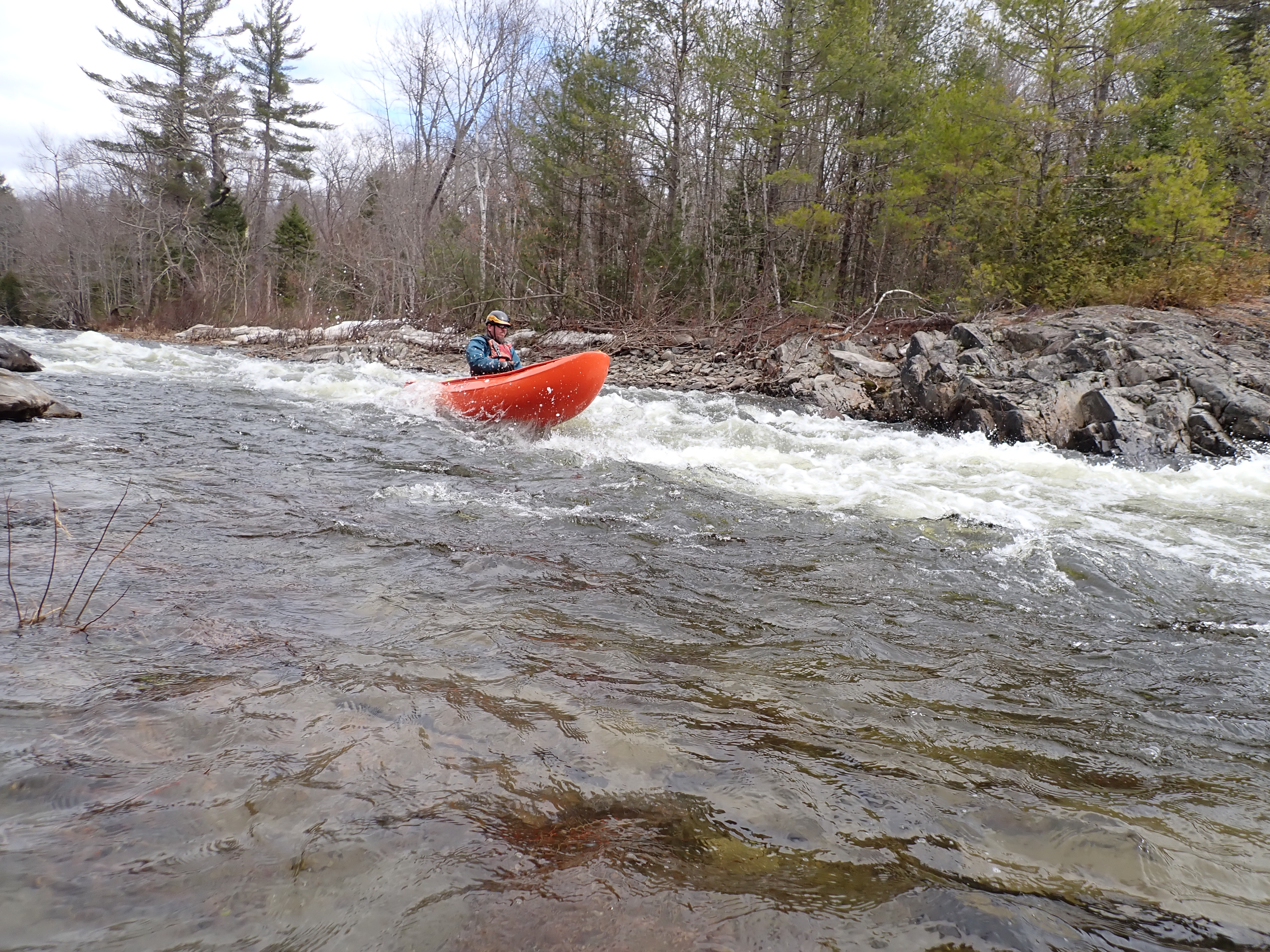
After a few miles of almost continuous whitewater, the stream angled left, steepened and narrowed. We carefully maneuvered through a feisty twisting channel in a constricted rocky gorge to the bottom.
Challenging rapids continued to a bridge on Coles Corner Road where we powered hard left to avoid a menacing hydraulic coupled with dangerous ledges directly under the bridge. Easier rapids ensued as the stream widened, thus exposing us to the gusty winds.
A long rapid with standing waves and a stretch of flat water brought us to a narrow, precipitous gorge. We stopped at the top on the left shore to scout the Class IV falls. After careful inspection, we identified an attenuated route on the right that required precise maneuvering between boulders, pour-overs and intimidating holes. Everyone successfully navigated through the complex descent remaining upright, thereby avoiding a difficult roll or an unpleasant swim.
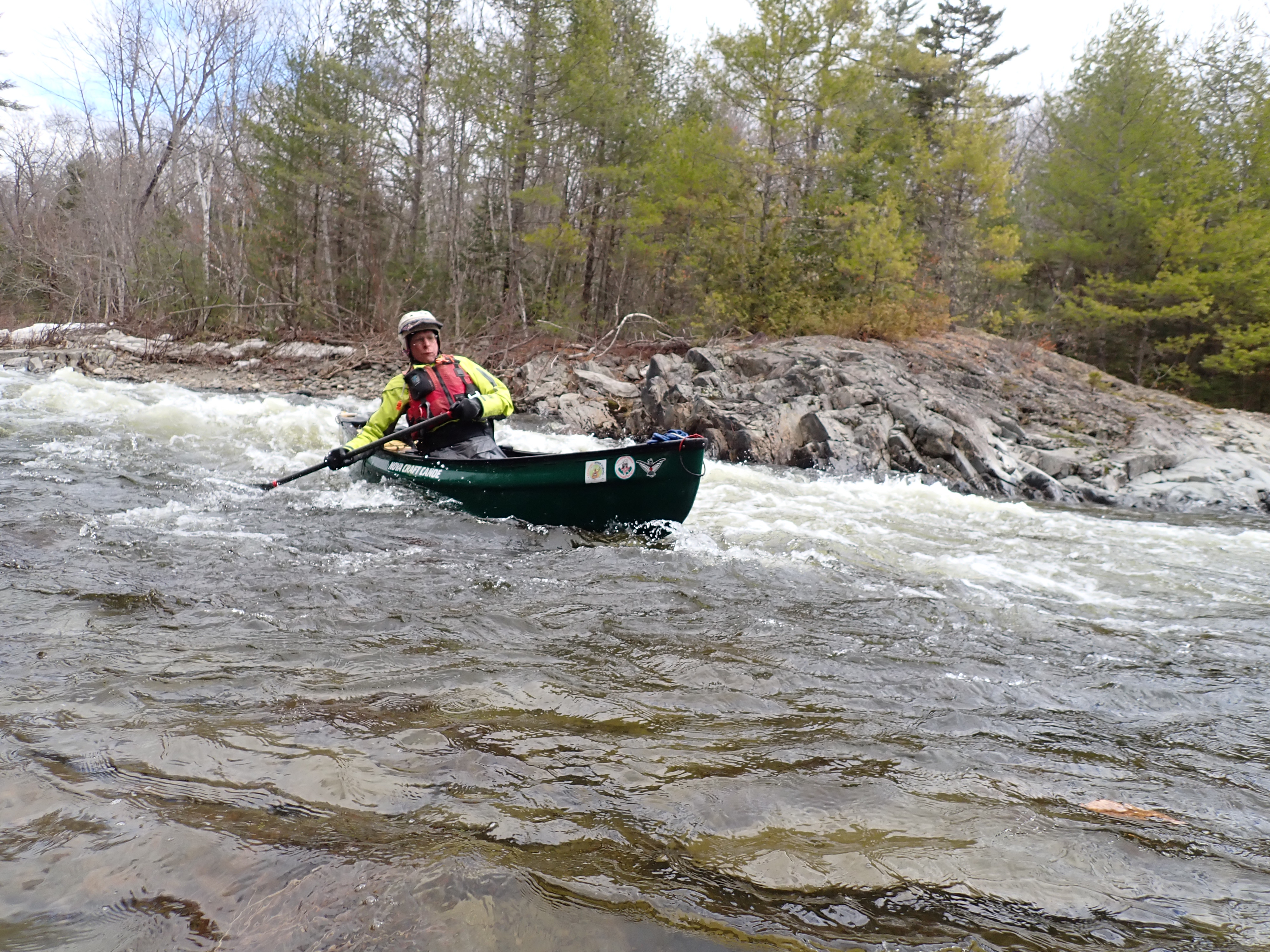
Immediately below, we boat scouted down a narrow chute that funneled through the center of a ledge drop that had large, curling waves below. The excitement wasn’t over. Another complicated rapid followed that required negotiating around a hairpin right turn and ending with dangerous exposed boulders blocking much of the main channel at the finish. One canoeist tumbled sideways over a boulder on the left but miraculously avoided broaching.
Our day ended with a strong headwind to the take-out in Abbott and a steep embankment that required a group effort to haul our boats out. Despite a multitude of obstacles, we managed to have a successful, enjoyable day of paddling. The water level was adequate, and by dressing appropriately, we remained comfortable despite harsh winds much of the day. In short, we made lemonade out of a lemon while establishing that 430 CFS was an acceptable level to paddle Kingsbury Stream.
My book, “Maine Al Fresco: The Fifty Finest Outdoor Adventures in Maine,” narrates several more exciting whitewater exploits around the state, including spring descents of Webb, Ducktrap and Cathance rivers.
The author of “The Great Mars Hill Bank Robbery” and “Mountains for Mortals – New England,” Ron Chase resides in Topsham. His latest book, “Maine Al Fresco: The Fifty Finest Outdoor Adventures in Maine,” is available at North Country Press and through online retailers. Visit his website at ronchaseoutdoors.com or he can be reached at [email protected].

The Times Record Sustaining Sponsor
We believe a community must be informed to thrive. bowdoin.edu
Comments are not available on this story. Read more about why we allow commenting on some stories and not on others.
We believe it's important to offer commenting on certain stories as a benefit to our readers. At its best, our comments sections can be a productive platform for readers to engage with our journalism, offer thoughts on coverage and issues, and drive conversation in a respectful, solutions-based way. It's a form of open discourse that can be useful to our community, public officials, journalists and others.
We do not enable comments on everything — exceptions include most crime stories, and coverage involving personal tragedy or sensitive issues that invite personal attacks instead of thoughtful discussion.
You can read more here about our commenting policy and terms of use. More information is also found on our FAQs.
Show less