

“Anne Hebebrand: A World That Is,” at Sidle House in Freeport (through June 13), is one of those rare exhibits where I found myself at times pleasurably immersed and other times completely mystified. There are at least two reasons for this — first, an unevenness of output that results from Hebebrand’s process, which is essentially intuitive, and second, the sheer unedited volume of works (about 65 in all). There is also the issue of titles, which range from evocative to twee to opaque.
As it turns out, however, these same reasons are what helped me pinpoint what has been a certain ambivalence about Hebebrand’s body of work as a whole, which I have found can be by turns captivatingly sublime and as pretty and sweet as a pastel confection in a bakery case.
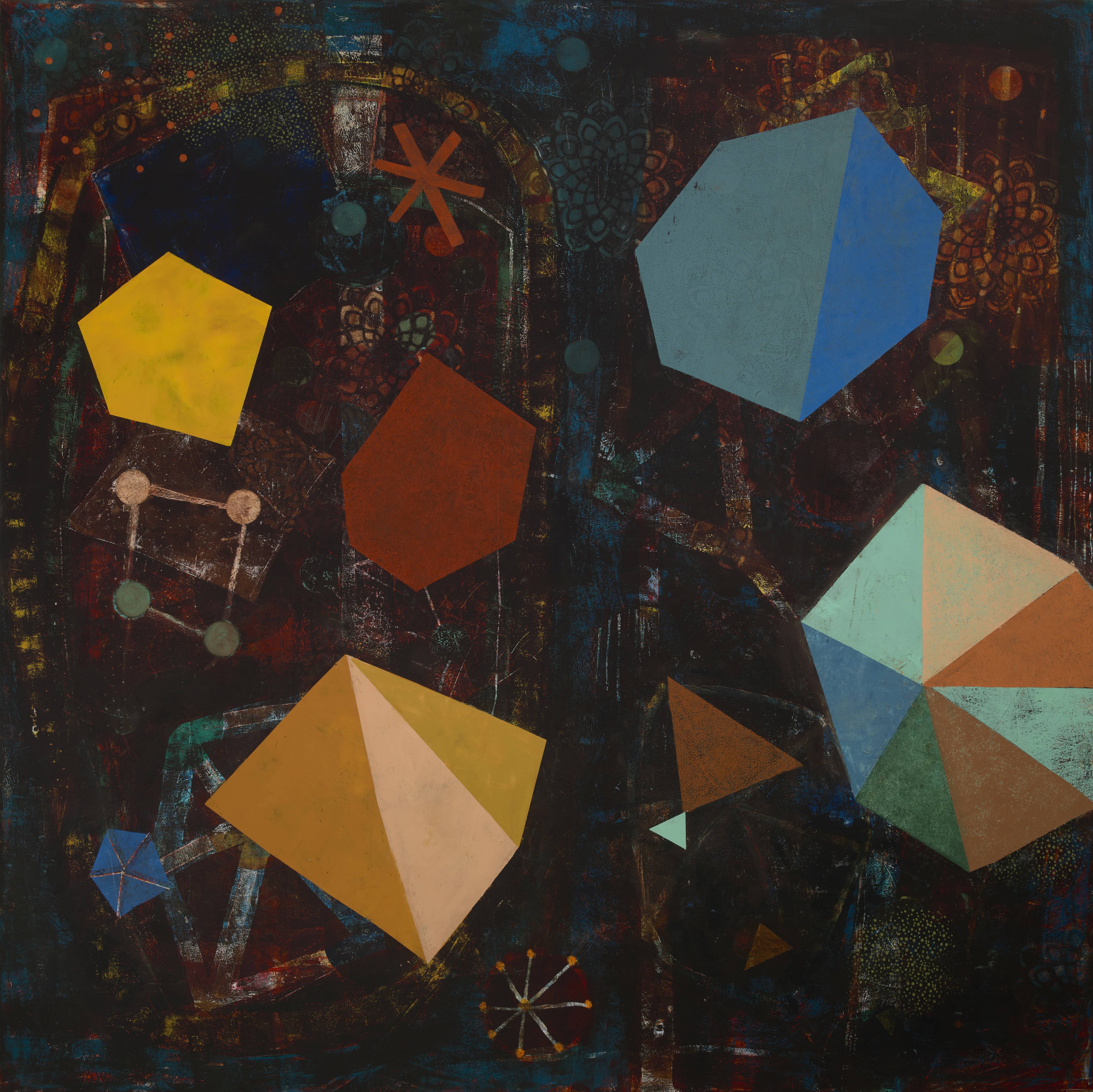
Hebebrand works spontaneously, applying sometimes 20 layers or more of oil and cold wax accretions, which she then scrapes back to reveal lower strata of color. She creates patterns by pressing materials such as newsprint and puckered medical exam-table paper into the wet paint, gouges the canvas, scratches it, scribbles on it, lays down elements that she then strips off after other layers have been applied… To say her methods are labor-intensive seems a gross understatement. These modes of creating implies memory and time, as we perceive past incarnations and iterations through each veil of overlay.
The outcome? Complex surfaces rich in texture, pattern and multiple levels of transparency. But this process is almost never an end in itself — certainly not, at least, in the best of Hebebrand’s work. Throughout the progression of her accretions and subtractions, Hebebrand is adding forms: variously colored geometric shapes, grid patterns, meandering lines, dots, dashes and so on. This mark-making can travel through various layers, emerging here, then plunging out of sight into the depths of the canvas under another layer. She will work a bit, then stand back and intuit what next must happen before a painting feels finished.
Aaron Rosen, who wrote the essay for the show’s catalog, posits that there is power in the playfulness of Hebebrand’s approach, citing German philosopher Hans-Georg Gadamer to back up the notion that “The nature of art…was best understood as a form of play, which (Gadamer) believed ‘contains its own, even sacred seriousness.’”
Certainly, there is a valid argument to be had about this topic. Nearly 40 years before Gadamer, after all, we had André Breton and the surrealists, who expressed this serious play in their use of automatic writing and drawing, which they maintained tapped into the subconscious and, so, touched something more fundamental and rationally nonconceptual.
But play and intuitiveness are fundamentally forms of experimentation. And in art, as in science, not all experiments are successful. The paintings on view span 2017-25. Within those eight years, we see Hebebrand meander down many paths. On one level, I suppose, we might say the quantity of images gives context to the artist’s trajectory. But the cumulative effect is to dilute the truly excellent work by mixing in more than a modest helping of work that feels like trial and error.
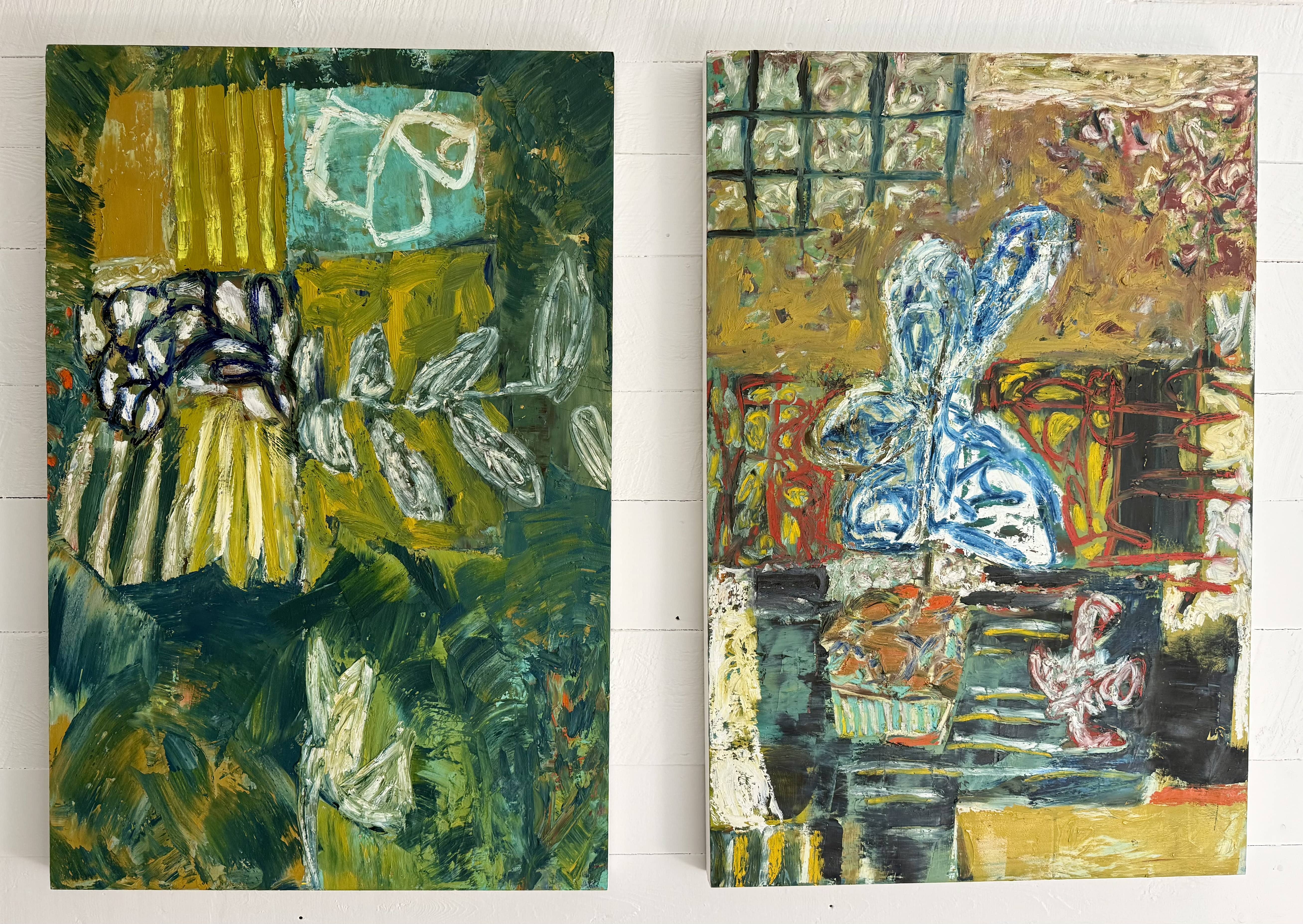
The silver lining for me was to come upon certain directions Hebebrand took for a time and unfortunately abandoned. She is resolute in her pursuit of abstraction, but the truth is that she has a natural gift for more figurative abstraction, as evidenced by two paintings from 2023, “Clearing in the Woods” and “Morning Memories.” These are damned good paintings, filled with bravura brushwork and an expressive gestural energy that veritably leaps off the canvas. They feel raw and alive, their surfaces jittery, teeming and activated.
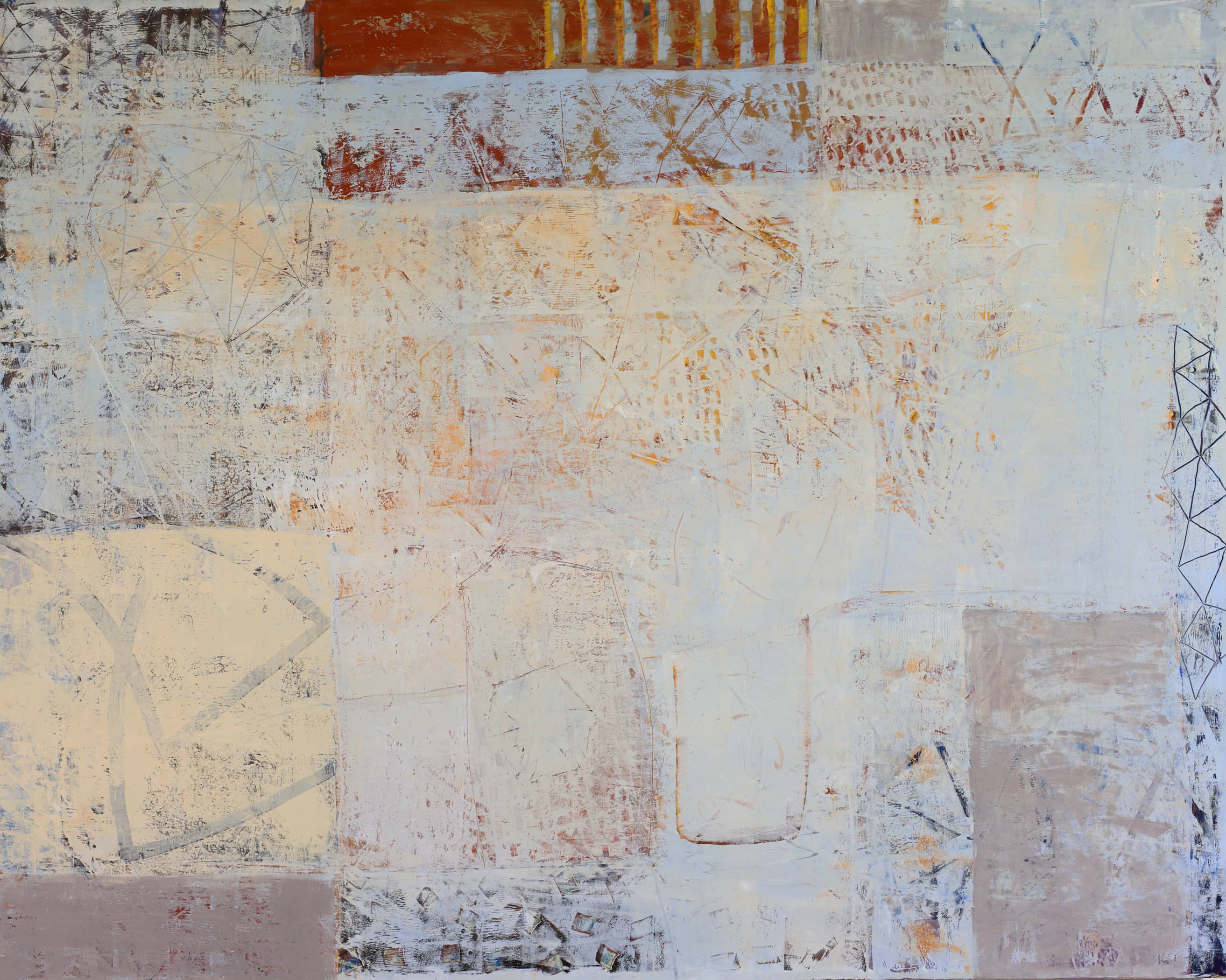
Conversely, the year before, Hebebrand created “Bathed in Flickering Light.” I appreciate the density of her layering here, I really do. It is skillful and exacting. But its all-over composition gives the eye nowhere to land, so one feels sort of aimlessly swimming around in it. The pastel palette transmits little energy and is, in fact, so innocuous and limpid that it can work a bit like wallpaper, especially at this large size (48” x 60”). If the intent of these proportions was to convey an enveloping, immersive experience, it is one that feels too easy to enter and, more importantly, to exit. It just doesn’t feel quite finished to me.
Also problematic to my view is the titling of some of the works, which can sound like they are striving for poetry, lyricism or gravitas. At times they send us in directions that limit our interpretation and enjoyment of them. For example, I felt drawn to one painting at the back of the Sidle House barn that had vertical striations on its left and right borders and bands of patterned color at the top and bottom. They seemed to frame a galactic black void through which confetti-like marks floated serenely, while two roundish blue forms (meteors, some sort of alien life?) moved toward the viewer. When I read the title, “Theater of the Absurd,” the blue forms suddenly morphed into a clownish head and body and the striations appeared as drawn stage curtains. Why the intimation of a proscenium? The title pulled me down from cosmic heights and plunked me into a seat in a dark theater.
“Diamonds of Thunder” — whatever that means — is way too explosive and ponderous an idea to describe a painting that looks more like a whimsical abstracted harlequin pattern. “Where the Melody Wanders,” a tight network of variously colored triangles and trapezoids, feels too fixed in place to do much wandering at all, and my association as I neared it was of an aerial view of a city plan rather than anything approaching music. A city plan can telegraph rhythm and music of course. But Mondrian’s “Broadway Boogie Woogie,” this is not.
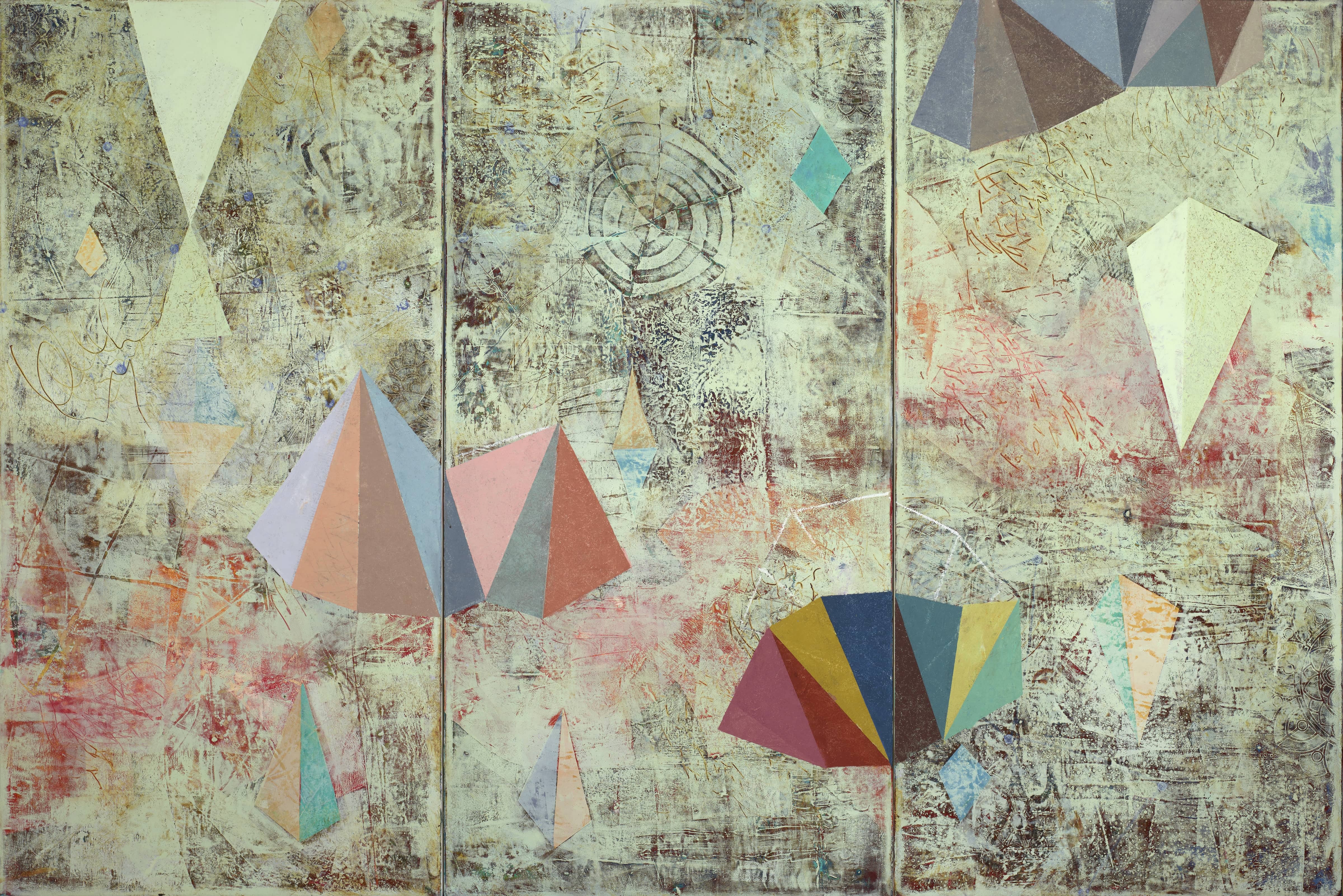
The final gallery (which is heated in colder weather and stays open long past the summer season) holds the most accomplished, resolved work in the show, a triptych painting called “To Dance Beneath the Diamond Sky.” This is Hebebrand at her best — densely layering tactility, transparency and partially veiled colors and forms (spirals, webs, meshes), then painting prismatic, fanned-out geometries in more saturated colors atop this ever-shifting field. Everything works here. The geometric shapes are clean-lined and sharp, which creates a kind of Hans Hofmann-like push-pull effect that energizes the surface. The title actually feels descriptively meaningful, and the size, 48” x 72”, allows us to plunge into the painting and want to stay there for a very long while.
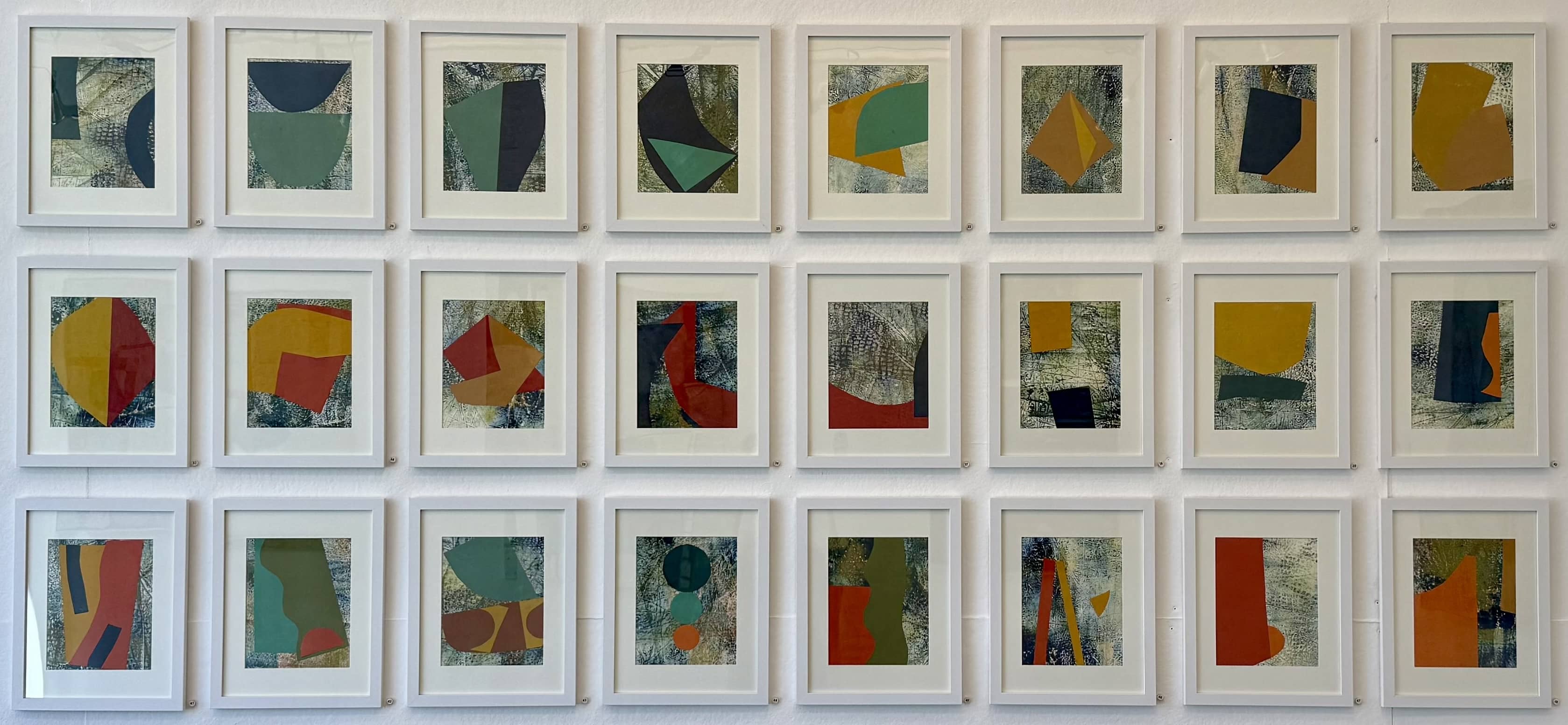
Also in this room was a revelation: a grid of 24 framed monoprints made with material utilized in another terrific painting (“Melodic Cosmos” in the central space of the barn) and paper cutouts a la Matisse. This is a most promising direction for Hebebrand. They have the same enlivening contrast between amorphous, textured fields and stark forms we find in the triptych. And their configuration on the wall is pitch-perfect. Moving one would destroy the perfection of the arrangement. You may covet them all as an installation. I certainly do!
Jorge S. Arango has written about art, design and architecture for over 35 years. He lives in Portland and can be reached at [email protected]. This column is free to access through support by The Dorothea and Leo Rabkin Foundation.
IF YOU GO
“Anne Hebebrand: A World That Is,” Sidle House Gallery, 20 Bartol Island Road, Freeport. Through June 13. 3-6 p.m. Thursday-Saturday. For more, 512-771-1149 or sidlehouse.com
We invite you to add your comments. We encourage a thoughtful exchange of ideas and information on this website. By joining the conversation, you are agreeing to our commenting policy and terms of use. More information is found on our FAQs. You can update your screen name on the member's center.
Comments are managed by our staff during regular business hours Monday through Friday as well as limited hours on Saturday and Sunday. Comments held for moderation outside of those hours may take longer to approve.
Join the Conversation
Please sign into your Press Herald account to participate in conversations below. If you do not have an account, you can subscribe here. Questions? Please see our FAQs.