

BIDDEFORD—Looking out over the crowd assembled for Biddeford’s second annual Juneteenth celebration Friday afternoon, Ashanti Williams, the city’s first Black city councilor, beamed with pride.
“Juneteenth celebrates our legit freedom. And to have it recognized nationally now by our federal government is a blessing,” he said. “This celebration right here is a reminder of who we are and how far we’ve come as a people, as a nation. This is a celebration of diversity, inclusivity, of Americans, period.”
More than 120 people gathered in Rotary Park for the event, co-hosted by Biddeford’s Diversity, Equity & Inclusion Committee, the Maine Black Chamber of Commerce and Heart of Biddeford. People browsed vendor stalls, danced to a DJ playing Marvin Gaye’s “What’s Going On” and Michael Jackson’s “Black or White,” and hunkered down at picnic tables to enjoy Jamaican beef patties and jerk wings catered by Go See Tyce BBQ of Saco. Organizers said the celebration has grown since its first year, attracting more vendors, sponsors and celebrants.
“Especially during these times, we need spaces where people can safely gather and celebrate Black joy,” said Flo Leighton-Shapiro, chair of Biddeford’s Diversity Equity and Inclusion Committee. “It means so much to see people are invested in the success of Juneteenth, and we can support BIPOC-owned businesses at a time when everything is so expensive.”
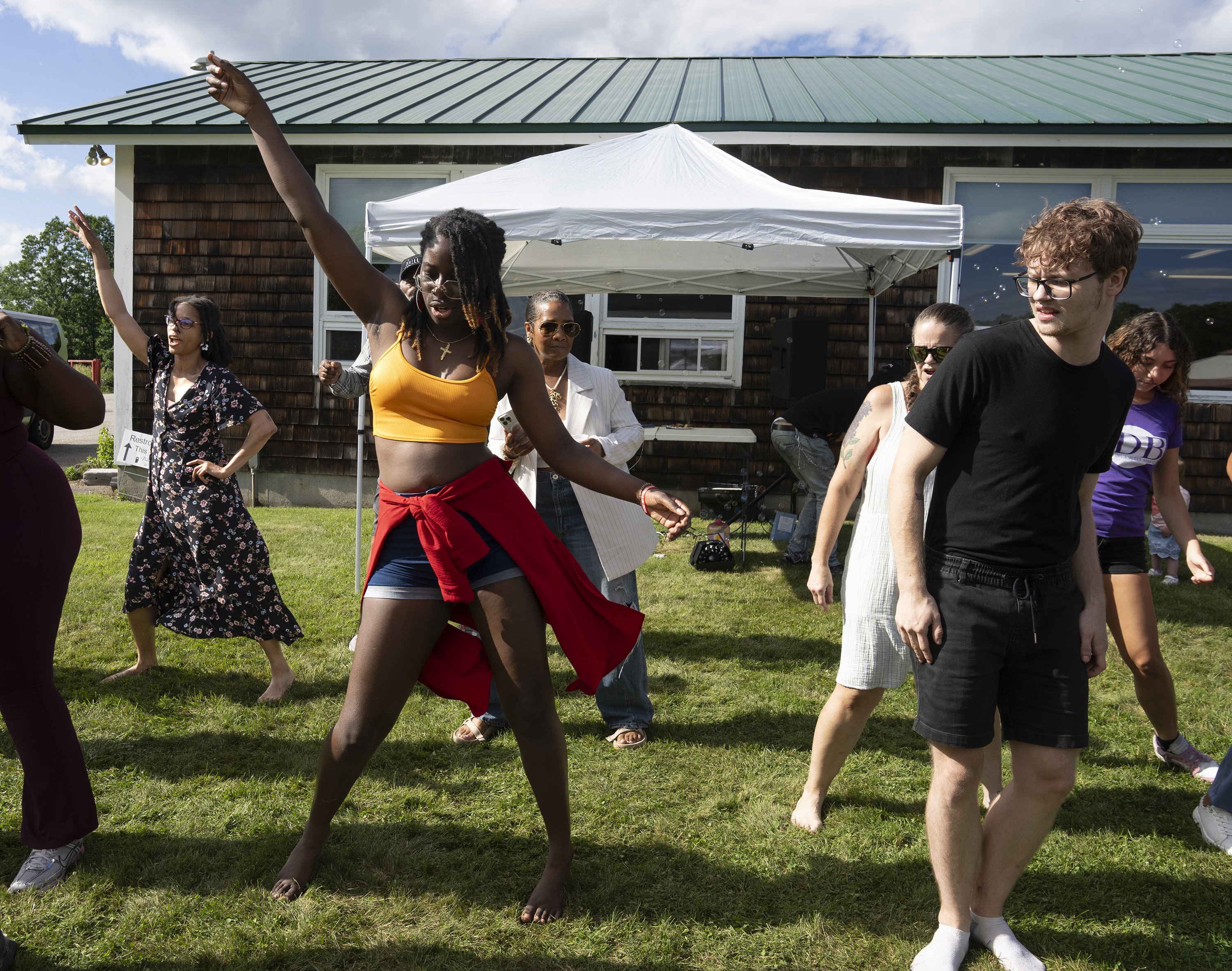
“Maine is one of the whitest states in the nation,” said Becky Johnson of South Portland, a biracial woman who brought her two youngest kids to teach them about Juneteenth. “To see Biddeford come together and put on a Juneteenth event when not a lot of other communities are doing that, I think it’s great.”
A federal holiday since 2021, Juneteenth commemorates when Union Gen. Gordon Granger arrived in Galveston, Texas, on June 19, 1865, to enforce the emancipation of the last enslaved people in Texas, 900 days after the Emancipation Proclamation was issued.
“It has taken a community over the last decade to get to a place where you can have a Juneteenth celebration in Biddeford, Maine,” said the event’s guest of honor, Shay Stewart-Bouley, executive director of the Boston-based anti-racism organization Community Change Inc., and creator of the website Black Girl in Maine.
“If we’re truly going to celebrate and honor Black Americans, we owe it to ourselves to know the history of Black Americans in our own state,” Stewart-Bouley said. “Here in Maine, for generations people believed the lie that there was little in the way of Black history. Until we unearthed the fact that the lack of a Black population in Maine was intentional, when we look at the history of our own Malaga Island, and see what was done to Black and mixed-race folks by the state.”
Stewart-Bouley said American celebrations of Black Americans are not always straightforward. “In many cases, the celebration is a deflection of deeper concerns,” she said. “Within the larger Black American community, there is a divide over whether making Juneteenth a federal holiday was a deflection from the issue of reparations, which the United States government has long avoided facing. It was the labor of enslaved Africans that helped to build this nation’s wealth.”
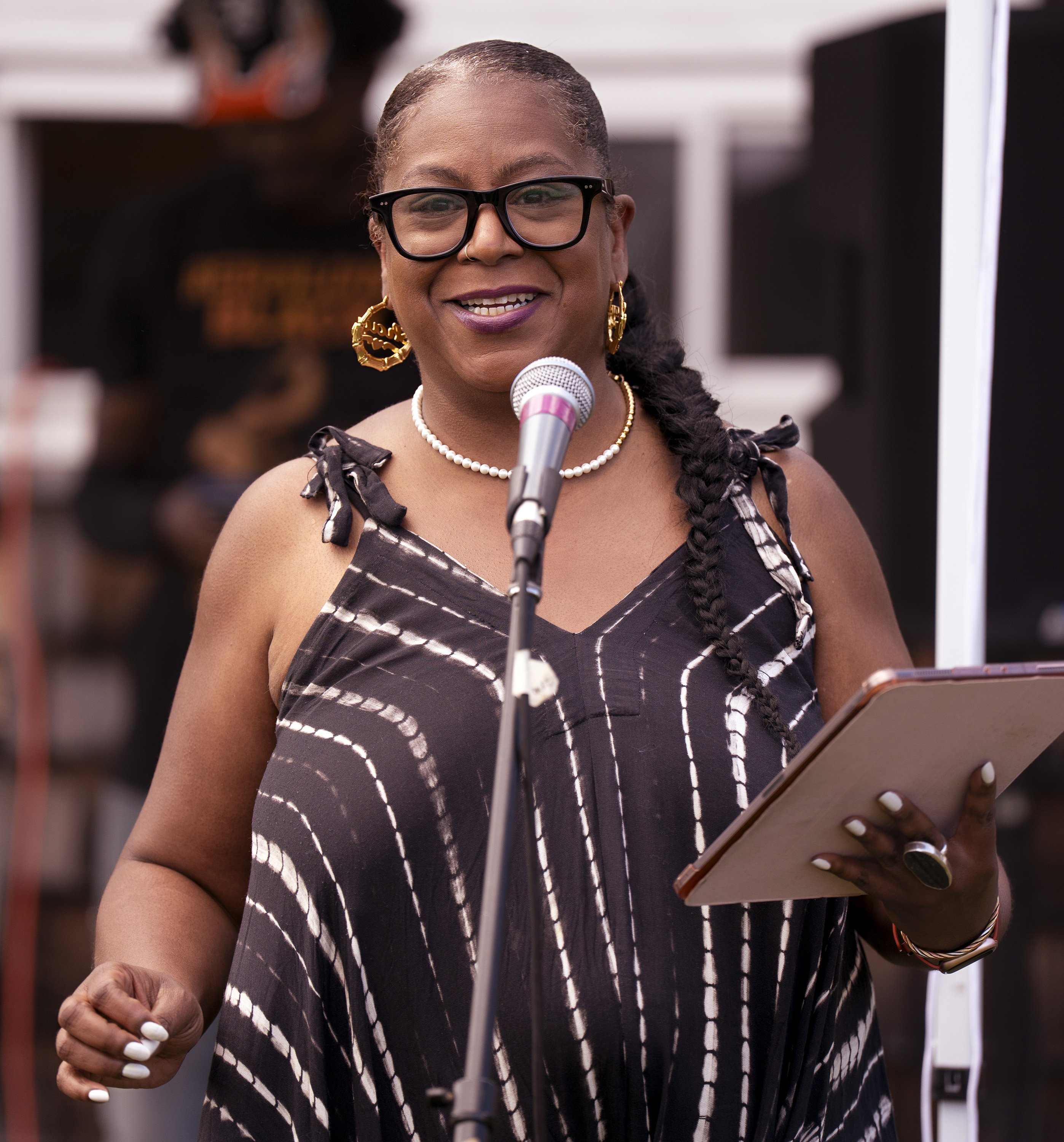
After Stewart-Bouley finished her remarks to the crowd, the Diversity Equity and Inclusion Committee gave her their inaugural Juneteenth Voices of Change Award.
Vendor Terrence Knight of Arundel said he thinks the broader population’s awareness of Juneteenth is limited. “I think people are like, ‘Wait, didn’t we just have Black History Month?’ We definitely need more awareness, and it starts in schools. We need an upgrade to the history curriculum.”
Knight said although southern Maine is predominately white, people go out of their way to support diversity. “I think that’s what the country needs more of. Instead of pointing out what’s different, embrace it and appreciate it. It doesn’t diminish your lifestyle to appreciate someone else’s.
“Growing up, people used to think they were showing support by saying, ‘I don’t see color. I don’t see differences,'” he added. “But by doing that you’re not seeing all of me. Color is an important part of me.”
Knight said he tries to impress upon his 13-year-old daughter, the only Black girl on her cheerleading squad, the value of being different.
“You kind of have to look at yourself as beautiful wildflower in a field of red roses,” he said. “There’s value in being the one who stands out. So don’t be afraid of it — embrace it.”

Comments are not available on this story. Read more about why we allow commenting on some stories and not on others.
We believe it's important to offer commenting on certain stories as a benefit to our readers. At its best, our comments sections can be a productive platform for readers to engage with our journalism, offer thoughts on coverage and issues, and drive conversation in a respectful, solutions-based way. It's a form of open discourse that can be useful to our community, public officials, journalists and others.
We do not enable comments on everything — exceptions include most crime stories, and coverage involving personal tragedy or sensitive issues that invite personal attacks instead of thoughtful discussion.
You can read more here about our commenting policy and terms of use. More information is also found on our FAQs.
Show less