

For paddlers looking for a unique, scenic kayak or canoe trip, Scarborough Marsh in southern Maine is a good choice. The 3,100-acre estuary is the largest salt marsh in Maine. Situated between the Dunstan and Nonesuch rivers and the Atlantic Ocean, freshwater flows from the rivers while twice-daily tides from the ocean inundate the marsh. For thousands of years, these competing aquatic forces have created a twisting, narrow channel that travels through the marsh to the sea.
Several years ago, I completed my first paddle through the marsh. What I found was a stimulating paddling experience that required negotiating through complex tides and currents in an exceptionally picturesque environment. Enhancing the adventure were scores of birds, a virtual birder’s paradise.
Scarborough Marsh was an important resource for Native Americans and early European settlers. Both groups hunted, trapped, fished and clammed there. Wabanaki people trapped alewives for food and fertilizer, and settlers grazed cattle on hay harvested from the marsh.
My wife, Nancy, and I recently announced a Penobscot Paddle & Chowder Society kayak trip through Scarborough Marsh. Planning around tides is an important part of a kayak trip in the marsh. We selected a day when we could start about midway through an outgoing tide at 10 a.m. with the intent of paddling out to the mouth of Scarborough River at the end of the marsh where we would stop for lunch at a gravel beach on Blue Point. After lunch, the plan was to return with an incoming tide.
Five of us met at the Audubon Center on Pine Point Road in Scarborough on a partly sunny, warm day with light winds. The center offers canoe and kayak rentals and guided tours. The boat ramp may be used to launch privately owned canoes and kayaks. We brought three solo kayaks and one tandem.
We embarked in a narrow channel and began our journey to the sea. Almost immediately, a snowy egret was encountered. Before the trip was over, our sightings included sandpipers, great blue herons, cormorants, kingfishers, swallows, herring gulls and more.
Passage through the marsh seems a maze as it twists and turns. At different times, paddlers can be facing any direction on the compass. Shortly after reconnecting with Pine Point Road, we passed by the remains of rotted wooden pilings that may have been part of an ancient fish weir.
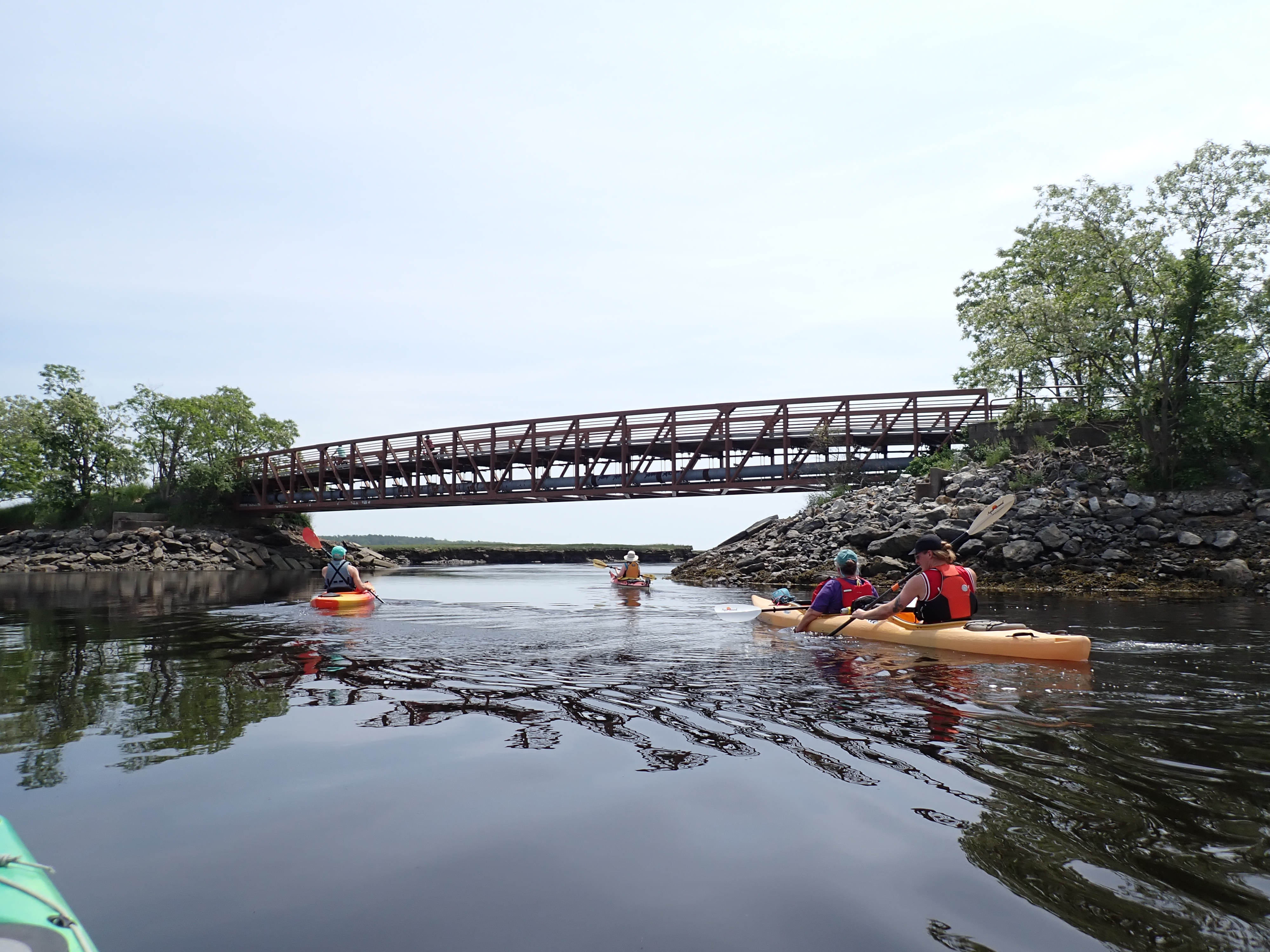
Around the bend, we passed under the Eastern Trail Bridge. Bicycle riders, walkers and runners were visible passing above and on the causeway that is part of a former railroad bed. This section of the popular rail trail connects Scarborough with Saco. The portion of trail that passes through the marsh is arguably the most scenic in the entire trail network.
The channelized currents under the bridge and just below were swirling and required careful maneuvering. Turning left, we paralleled the trail for a short distance before rounding another bend and heading downstream.
The channel widened and the character of the shoreline changed as we progressed. Tall swamp grass replaced the muddy precipitous banks and the undeveloped marsh was supplanted with housing on the southern shore.
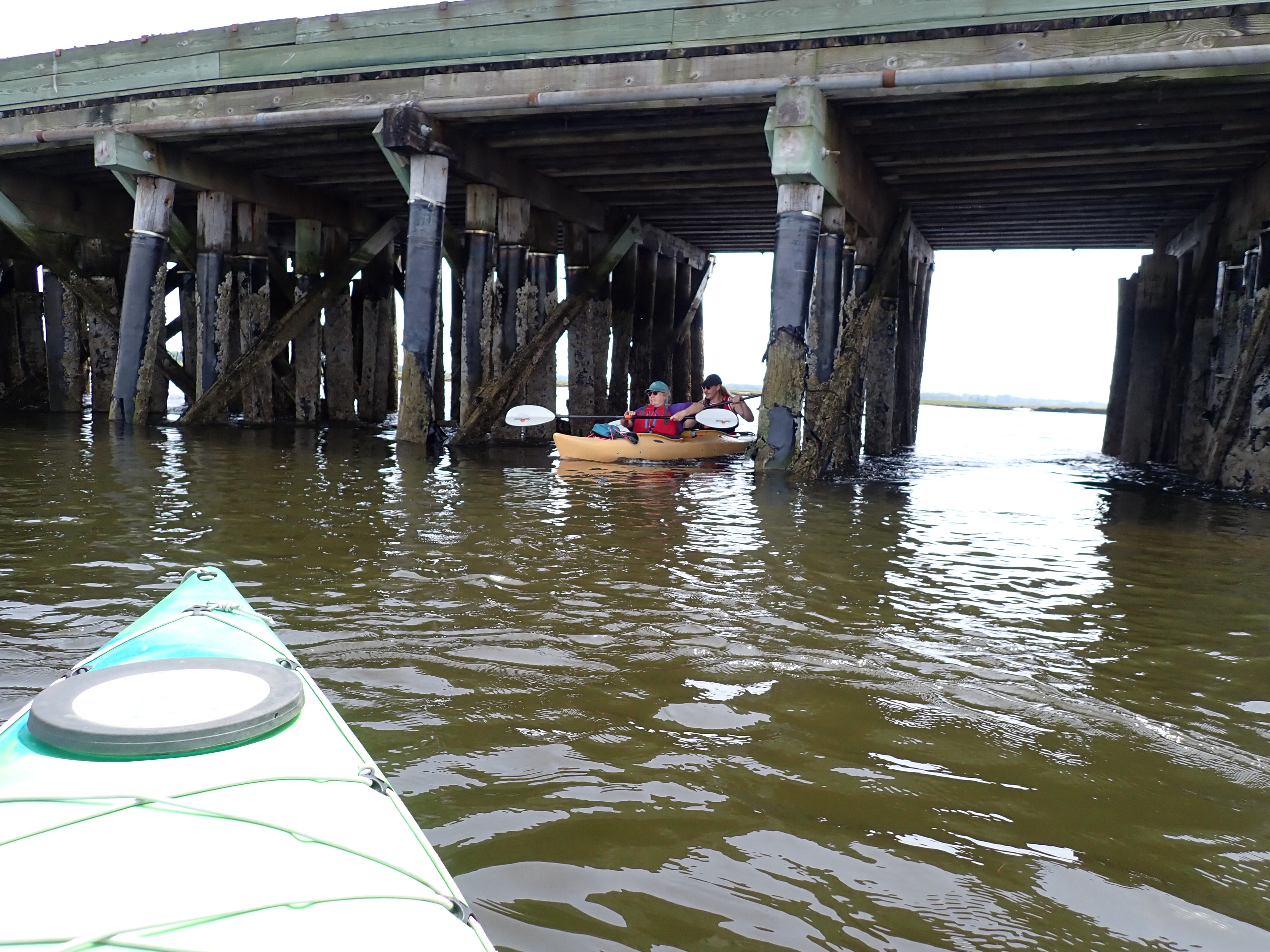
Shortly after passing Blue Point on the right, we approached the Downeaster Amtrak railroad bridge. The trestle is supported by wooden stanchions with narrow routes between. Powerful currents and submerged logs can make navigation treacherous at low tides. The tandem kayak team passed through without difficulty but was momentarily stalled on a log during their return. The rest of us decided to forego the excitement. We retreated to the beach on Blue Point for lunch.
After a leisurely respite, we began the voyage back expecting an incoming tide. My research on the tides was flawed as we persisted against an outgoing tide during our return. A significant concern was whether or not there would be adequate water to land at the Audubon Center. Dragging boats through the sticky, black mud was not an appealing prospect.
The depth of the water diminished to the point where we were scrapping bottom with our paddles when we finally arrived at the center. Despite the hiccup at the end, we completed a very entertaining day of paddling in a truly exceptional setting.
Read about many more exciting canoe and kayak trips in my book, “Maine Al Fresco: The Fifty Finest Outdoor Adventures in Maine.”
The author of “The Great Mars Hill Bank Robbery” and “Mountains for Mortals – New England,” Ron Chase resides in Topsham. His latest book, “Maine Al Fresco: The Fifty Finest Outdoor Adventures in Maine,” is available at North Country Press and through online retailers. Visit his website at ronchaseoutdoors.com or he can be reached at [email protected].

The Times Record Sustaining Sponsor
We believe a community must be informed to thrive. bowdoin.edu
Comments are not available on this story. Read more about why we allow commenting on some stories and not on others.
We believe it's important to offer commenting on certain stories as a benefit to our readers. At its best, our comments sections can be a productive platform for readers to engage with our journalism, offer thoughts on coverage and issues, and drive conversation in a respectful, solutions-based way. It's a form of open discourse that can be useful to our community, public officials, journalists and others.
We do not enable comments on everything — exceptions include most crime stories, and coverage involving personal tragedy or sensitive issues that invite personal attacks instead of thoughtful discussion.
You can read more here about our commenting policy and terms of use. More information is also found on our FAQs.
Show less