
No matter how humble, there’s no place like a Maine camp – cabins and homes tucked in the woods that families have visited and cherished for generations. Many are built by hand and fortified with a lifetime of memories.
Katie Rubino thought she had concocted the ultimate birthday party when she turned 12, inviting a half-dozen friends to a sleepover at her family’s Bridgton camp in the middle of winter.
But the propane heater broke, the pipes froze and the guests huddled in sleeping bags to stay warm.
Yet the girls had the time of their lives, playing outside and swapping stories late into the night. Rubino, who lives in South Portland, returned a year later to celebrate her 13th birthday, this time with a dozen girls.
No matter how humble, there’s no place like a Maine camp – cabins and homes tucked in the woods that families have visited and cherished for generations. Many are built by hand and fortified with a lifetime of memories.
The Rubino camp is not just a weekend spot for family getaways. It also is an affordable way to vacation in tough times. Unemployment is high and money tight, but Maine camps offer recession-busting vacations. Many have been passed down through generations, like a family quilt.
Camps enable entire families to vacation together, a luxury they could not otherwise afford. Many places were paid for generations ago. Residents do not need to spend a lot for gas, rent hotel rooms or take extended time off from work. Yet they still get away to enjoy the outdoors, fish, barbecue and spend time together.
So what if they have to rough it? That’s part of the fun.
“Camp is a place where you do not have all the amenities of home and where you are very willing to pile people in for the weekend,” said Deb Rubino, Katie’s mother. “But it’s also a mini-vacation that is inexpensive and where you don’t need to do the usual weekend chores at home.”
Unlike the lavish summer homes of many visitors from away, the classic Maine camp may be a log cabin or simple house with unfinished rooms, bunk beds and a wood stove for heat. The more rustic ones lack plumbing, or are not insulated for winter.
Comedian Bob Marley gently pokes fun at the Maine tradition of vacationing in camps that may lack heat, plumbing and electricity. Anthony Bourdain, who hosts the food travel show, “No Reservations,” passed Portland over for a backwoods stay at a Milo camp to experience the “real Maine.”
There are no hard and fast rules to owning a summer camp. Bob Crowley, the Maine science teacher who found fame and fortune by winning the “Survivor” TV series, has started building a yurt on land that he and his wife, Peg, own. Recently he shared photos of Peg and him seated on camp chairs and dining on Amato’s subs, the half-built yurt supported by tree limbs in the background.
“Our camp is finally finished, though it took 30 odd years to do it,” marvels Rubino about the Bridgton camp her father built when Deb was in grade school and just a few years younger than her own daughter, Katie, is today. Deb recalls working with her two sisters to paint the cabin walls as her father nailed barn boards to the structure.
‘We always ?come back’
The rustic appeal of a summer camp, combined with the breathtaking beauty of Maine, lure Tamsen Towle and Scott Moseley from Massachusetts each summer for a family reunion with his relatives.
They return to the same Old Orchard Beach cottage where Scott has vacationed since childhood, a former barracks that his grandmother bought and renovated.
Today Scott and Tamsen’s two children enjoy the summer rituals Scott took part in 40 years ago. The kids pedal their bikes in a town parade and attend Illumination Night, when people light candles on the beach and adorn their homes with holiday lights.
“No matter how busy we get, we always come back,” Towle said.
Maine camps have a mystique for many families. They are connection to personal histories and one of the few links to a simpler past, when extended families shared the same zip code and family members had face time, not Facebook, to stay in touch.
Some of Rubino’s favorite childhood memories are from camp vacations. Rubino remembers her father explaining that his own dad had located the spot where the well was dug on their property. “He said my grandfather was a diviner. He knew where to dig,” Rubino said.
That well still works today, though Rubino recalls one year that the family had to tote in five-gallon jugs of water, after a drought caused the well to run dry.
Now Rubino’s own two daughters – Katie and Nicole – are creating their own memories.
Close to town, worlds away
“The Auburn summer camp that Peter and Lisa Bingham own is a family relic, a summer retreat filled with memories, yet still a lot of fun.
The family travels from their Gorham home, with three kids in tow, to spend weekends on Taylor Pond. Peter’s grandparents started the tradition.
“It has been in my husband’s family for 50 years,” said Lisa Bingham, who is also the manager of South Portland Parks & Recreation. “We have pictures of my husband there when he was a baby in diapers. He’s older of course but the camp pretty much has stayed the same. It will always be a part of him.”
The Binghams added a bedroom and enclosed the porch, but have done little else. “The fishing is great and we watch the sunsets. We have a perfect view,” said Bingham, who uses her cell phone to post photos on Facebook for friends in greater Portland.
“Our camp is on a quiet dead-end street. It is the last home on Taylor Pond that is still seasonal,” Bingham said. “It does not take us all day to get there. Sometimes we just go for the night.
“We’re five minutes from town, but it feels like we’re 500 miles away.”
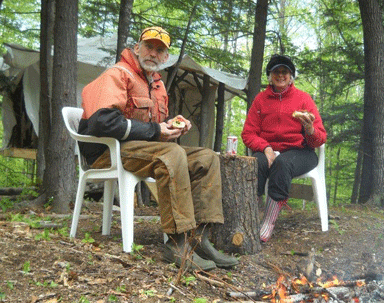 “Survivor” winner Bob Crowley of South Portland, shown here with his wife Peg, has made a summer project of building a yurt for a Maine camp, using shrink wrap and trees harvested from the Crowleys’ property in Androscoggin County. (Courtesy photo)
Comments are no longer available on this story