
WESTBROOK – During the next few weeks, students at Westbrook Regional Vocational Center will come under digital attack with little more than their wits and computer skills to protect themselves.
But if they survive, they will win bragging rights and possible job offers from certain governmental agencies that identify themselves with three-letter acronyms.
The students are participating in the CyberPatriots program, a contest devised by the Air Force Association. a civilian aerospace education association. The program aims to test the technical skills of today’s young people and to scout for new talent.
“Clearly, the focus is to recruit students who otherwise might not be noticed for their IT skills,” said Robert Jaime, a vocational instructor at the center and the coach of the eight-student team participating this year, alongside 838 other teams at schools across the country.
Even if they don’t win, Jaime said, the students welcome the chance to test their knowledge of online security against a real-world threat.
The format is simple: The team has set up two computer towers at the center to function as a server, similar to the kinds of servers many business computer systems run on today. Once it’s hooked up to the Internet, attackers from the association will do everything they can think of to attack the system, forcing it to shut down. If they can kill the server for longer than an hour, the team loses.
“The longer we can keep the server up and running, the more points we get,” Jamie said.
Keeping the server up, however, is no easy task. The contest involves a series of rounds, which will take place on specific dates between now and March. Jaime said last year, the center’s team was eliminated in the second round.
The attackers will use all sorts of computer assault methods, ranging from the simple to the complex. The center’s server could fall victim to a computer virus that goes unnoticed until it’s too late, or be the victim of a frontal assault from a denial-of-service attack, a classic cyberterrorism tool that floods the server with millions of useless tasks until the overwhelmed server simply gives out.
The students, Jaime said, normally take classes at the center to learn about computer hardware and software, and work toward earning a home and small business networking certification, but the competition gives them a taste of what kind of online dangers lurk in the real world.
“Kids love it,” Jaime said. “It’s a lot of fun. It’s not easy. They’ve got to work at it.”
If the team makes it far enough, Jaime said, they will get to travel to the final round, which takes place just outside Langley, Va.
Tyler McKague, 17, of Westbrook, is one of the center’s students participating in this year’s competition. He took part last year, too, and said he enjoyed the challenge.
“It gave us a chance to actually test out our skills against other people,” he said.
McKague said the experience has taught him that his software skills are not as strong as his knowledge of hardware, but the contests have cemented his interest in technology, so much that he plans to apply to Southern Maine Community College as a computer science major.
“I know I’m making a career out of it,” he said.
Nate Youland, 17, of Standish, also participated in last year’s competition.
“I learned quite a bit from it,” he said. “I learned how to resolve things fast, and how to work things out at the last second.”
In part, Youland said, it’s all about simply being vigilant for something that doesn’t seem right.
“If the virus detector’s going off, or if my computer starts running really slow, then I know something’s up,” he said.
John Knowlton, 18, also of Standish, is participating for the first time, and hopes the team can last longer than the second round.
Knowlton said one big reason computer systems in the real world are vulnerable to cyberattacks is laziness on the part of the owners, either on a home computer or a large-scale corporate server.
“It’s amazing how many people miss the easy-to-do problems,” he said.
Many people, Knowlton said, simply don’t bother to run regular checks of their computers or servers for viruses, or don’t change the default password for their network because they can’t be bothered to remember the new password. So many attacks can be prevented by some very simple tasks, he said.
“If you don’t close up those holes, anybody can get into (your system),” Knowlton said.
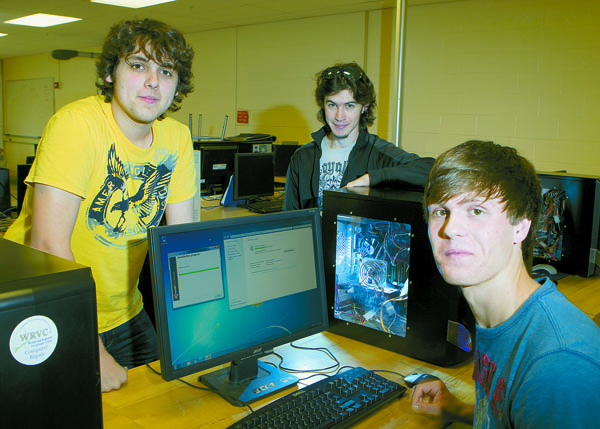 The cyber warriors for the Westbrook Regional Vocational
Comments are no longer available on this story