
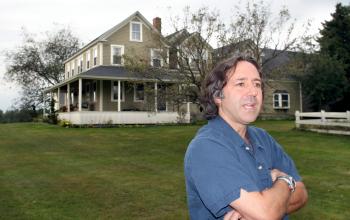
Drew and Elizabeth Gattine left their New York City law practices nearly 20 years ago in search of a simpler life.
They found it in 74 acres of farmland situated between downtown Westbrook and Portland on Stroudwater Street. But now, the landscape around them is changing. The construction of a new middle school is under way next door, and there’s an elderly housing complex planned to be built nearby.
The biggest change, however, is yet to come. The state’s largest retail center, pitched by the developer as a regional destination, is proposed for a site across the street from the Gattines’ home. As a city councilor, Drew Gattine will be one of the people deciding whether it will be built.
Gattine, who got involved in local government about six years ago because of a proposal to change zoning in his Stroudwater neighborhood, has always had a keen interest in land use as a city councilor. Although he says he recognizes the property across the road, and just off the turnpike, will be developed, he has in the past joined with neighbors to maintain the rural character of Stroudwater. As a proposal to turn the property into the largest retail development in the state goes to the City Council, Gattine stands out among his fellow councilors as the one who has been the most critical of it.
While his colleagues on the council say they still have questions, on the whole they support the project, which will be the subject of a City Council workshop Monday night. Despite concerns raised by Elizabeth Gattine and other neighbors at public hearings, the Planning Board has also supported the project, recommending necessary changes to the city’s comprehensive plan and the zoning of the site be made so that it can move forward. The developer, Jason Snyder, has said from talking to people in town, he believes at least 90 percent of Westbrook residents would like to see his vision realized.
Gattine said he doesn’t know yet how he’ll eventualy vote. Other councilors said that residents and business owners have questioned whether he should, because of his home’s proximity to the project. But, Gattine said, his concerns aren’t related to the location of his home – at least any more than they are for his constituents.
“The reason we have different councilors in different wards is so we have awareness,” he said. “I’m supposed to be more aware. It doesn’t mean I care more. It does mean I’m supposed to be mindful.”
Gattine said he’s never considered removing himself from the vote.
“I don’t think I’d be doing my job as a councilor if I walked away from difficult issues,” he said.
Not quite a farmer
Originally from Poughkeepsie, N.Y., Gattine, 45, graduated from Colgate University in 1983 and went on to law school at Columbia University, where he met his wife. She grew up in New Hampshire and had family connections in Maine – but none like they do now.
Since the Gattines moved to Westbrook, their relatives have gravitated to the state, including Drew Gattine’s mother, who lives less than a mile away on Monroe Avenue.
Their immediate family has grown, too, with twins Jordan and Sabrina, 12, and a host of pets, including two horses, two dogs, a rabbit and a hamster.
“Someone’s always plotting to add to our animal inventory,” Gattine said.
About six months ago, his son managed to add three goats to the herd – a 4-H project that has Jordan Gattine up at 5:30 a.m., alongside his father, taking care of their farm chores.
“It keeps you connected to the outdoors,” Gattine said.
He finds other ways to stay in touch with nature on his expansive property that extends all the way back to Stroudwater River, like snowshoeing and cross-country skiing in the winter.
According to City Assessor Elizabeth Sawyer, having that piece of property, which is valued at nearly $900,000, so close to two cities is unique.
But the Gattines aren’t the only ones who enjoy his land. He said he lets his neighbor’s cows graze there, too. Though Gattine said his neighborhood isn’t typical, the attitude among the residents on Stroudwater Street is neighborly. He used to ride his horse across their yards.
Still, Gattine insists, he’s no one’s definition of a farmer. When he first moved to Maine, Gattine worked for the Officee of the Attorney General as a health care lawyer, primarily representing Medicaid programs. Ten years ago, he and some of his colleagues in the state formed their own company, HWT, which fights health care fraud. Though he’s now in the private sector, as director of client operations at his company, Gattine said he still gets the satisfaction of making a difference in people’s lives.
“I like to have a public purpose in the work that I do,” he said.
Whether he was working in Augusta, his office in Portland or from his home, Gattine didn’t always have much reason to pay attention to what was going on in Westbrook. But since his children entered the school system, the downtown became more vital and his property was in the process of being rezoned, that changed.
Gattine first became involved in city politics in 2003, when properties straddling Stroudwater Street, including his and Snyder’s, were put in the category of business/professional/office. Gattine and his neighbors argued that the city didn’t give enough notice to landowners, and they ended up filing a lawsuit in April 2003, along with other Westbrook residents affected by the zoning changes. In May of that year, the city halted those changes, and ended up reconsidering the zoning plan. The lawsuit was eventually dropped.
Amid the zoning flap, Gattine ran for a seat on the City Council and won. When it came time to take a final vote on the city’s rezoning, Gattine said Snyder, who was not involved in the lawsuit and wanted the zoning originally proposed by the city, questioned whether Gattine had a conflict of interest because of his personal involvement with the issue. Gattine said it wasn’t a question for him then, either.
“I didn’t struggle. It was a rezoning of the entire city. Every councilor’s property was being rezoned,” he said.
DREW’S ARGUMENT
Snyder declined to comment on whether he thinks there’s a conflict of interest this time around. City Solicitor Bill Dale said, legally, there isn’t, unless the rest of the councilors think so.
Gattine’s main concerns with the project revolve around the language in the contract zone.
“Maybe it’s my legal background, but, to me, words are important,” he said.
In his presentations to the city, Snyder has said his 1.6-million-square-foot development will have high-end retail stores, like Bloomingdale’s and Nordstrom, and many amenities for residents, like a farmers market and skating rinks. According to Gattine, however, the contract zone proposal would allow for the vision Snyder presented to be built, but doesn’t guarantee that it will look the same.
“We have to determine what it is about this that we like,” Gattine said, and consequently ensure that’s what the contract zone requires the developer to build. If it’s the high-end stores that people like, he said, then it’s up to the council to make sure the contract zone doesn’t allow for something else.
“What we heard is the sales pitch,” he said.
Snyder’s spokesman, Dennis Bailey, said they’re willing to work with the City Council to “tighten anything that needs to be tightened” in terms of the contract zone.
But, Gattine has broader concerns, too, like what effect it could have on other retail in the city, what the plan is for the traffic it would bring and whether the project is feasible at all – now or in 10 years from now. Bailey said all of those studies would be done, but Snyder wants to hear that the city is behind the project before he spends the time and money to complete them.
Gattine admits that he’s “not a big fan of retail” in general, and thinks the developer should look to areas of the city that are zoned for that purpose, and not fully developed, first. He said he still thinks that the property’s business/professional/office zone is the most appropriate for the area, and could act as a transition between the retail zone on Route 25 and the rural properties on Stroudwater Street.
“To me, that’s always been sensible,” he said.
Still, he said, if Snyder’s project is what people in the city want, then he’ll do what he can to make that happen for them.
“I have opinions, but at the end of the day I have to do what’s right for the city,” he said.
Rushing in?
In order to ensure that Snyder’s development will match the vision he’s presented – and the one that people like – Gattine is ready to go through the contract zone with a fine-tooth comb.
“This thing is moving pretty fast right now,” he said. “We can take our time.”
Some other councilors, however, are eager to keep the process moving.
Councilor John O’Hara said he hopes his fellow councilors keep in mind that Snyder is willing to invest $300 million in the city and the state, at a time when both could use it, before they “try to amend the thing to death.”
“It’s been in the process for a long time,” said Councilor Lyle Cramer. “The sooner he’s able to break ground the better off the city’s going to be.”
Others have the same concerns as Gattine.
“I hope we wouldn’t rush into anything,” said Councilor Suzanne Joyce. “We have to be responsible.”
There is one piece of the process that O’Hara wouldn’t mind taking the time to flesh out, though – the question of Gattine’s conflict.
“I think a lot of people will be skeptical,” O’Hara said about whether Gattine’s self-interests will affect his vote. “I think the issue should be brought up…We want to be as transparent as we can.”
According to Dale, if the issue does arise, it’s ultimately up to the rest of the councilors to vote on whether Gattine should recuse himself. Joyce said he’s already proven to her that he can be impartial.
“The thing about Drew is that he can wear both hats,” she said, adding that she believes he would be just as thorough in his review of the project if it were being built across the street from her house.
Council President Brendan Rielly agreed, saying he thinks Gattine’s position and vote are valuable.
“You want your councilors to be affected by things,” Rielly said. “I think Drew’s done a tremendous job.”
Whatever his reasons are, there’s no doubt that Gattine has been looking at the project carefully. Sitting in his kitchen recently, he quickly pulled the city’s ordinance on contract zones up on his laptop. A preliminary traffic study for the project sat on his couch.
Elizabeth Gattine, too, has been actively asking critical questions about the project of city officials. But, Gattine said, it’s not something they obsess over. In fact, he said, in the past few weeks, they haven’t talked about it much at all.
“It’s not the most important thing we deal with every day, not even close,” he said.
Though the Gattines spent the first part of their marriage in New York City, he said, since moving to Maine, they’ve never looked back, and the prospect of Snyder’s project moving in across the street hasn’t changed that.
“This is my home,” he said. “As long as I’m happy, I’ll be here, and I don’t anticipate that changing anytime soon.”
 In his back yard
  In his back yard
Comments are no longer available on this story